
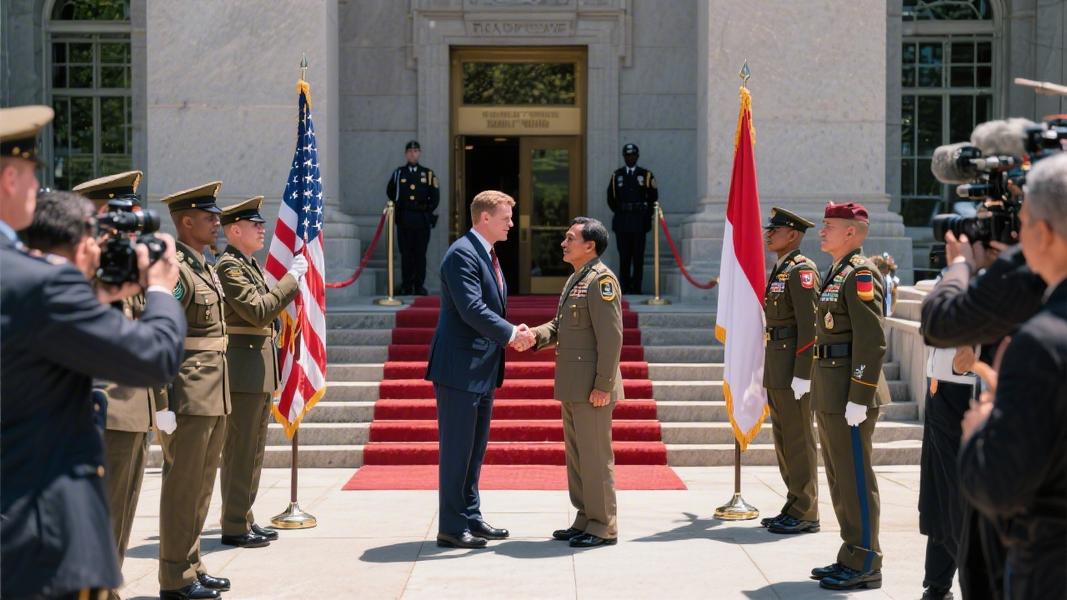
Pete Hegseth is rolling out the red carpet — or at least the honor cordon — for one of Southeast Asia’s most consequential defense partners. The Pentagon has confirmed that Indonesia’s Minister of Defense, Sjafrie Sjamsoeddin, will arrive at the River Entrance steps on April 13, 2026, for a formal meeting with the Secretary of War.
The visit, scheduled for 10:15 a.m., will feature an enhanced honor cordon — a full ceremonial military reception typically reserved for high-priority bilateral engagements. It’s a deliberate signal. In a region where China’s maritime ambitions continue to reshape the strategic landscape, locking in Indonesia, the world’s largest archipelagic nation and a critical Indo-Pacific player, carries weight that goes well beyond diplomatic pleasantries.
A Relationship That’s Been Building
This isn’t a cold introduction. Hegseth and Sjafrie have been laying groundwork for months. The two defense chiefs first connected in an introductory call earlier this year, where, according to a U.S. Embassy readout, “Secretary Hegseth and Minister Sjafrie reiterated the United States’ and Indonesia’s commitment to a secure and prosperous Indo-Pacific.” Both sides expressed a willingness to deepen cooperation on defense and regional maritime security — language that’s diplomatic shorthand for a lot of things, not least of which is managing the South China Sea.
Then came Kuala Lumpur. On October 31, 2025, on the sidelines of the ASEAN Defense Ministers’ Meeting, Hegseth and Sjafrie sat down face-to-face. The Pentagon noted the meeting was focused on reaffirming the strength of the bilateral defense relationship. Discussions covered joint training exercises, maritime security frameworks, and the broader question of regional stability — all of it underscored by a shared, if sometimes carefully worded, concern about Beijing’s reach. Video from the margins of that summit captured the two officials in substantive dialogue, and a separate recording showed the warmth of an exchange that clearly wasn’t just for the cameras.
What an Honor Cordon Actually Means
Here’s the thing about an “enhanced honor cordon” — it’s not standard. Most bilateral meetings at the Pentagon don’t get one. It’s a deliberate ceremony, complete with troops in dress uniform flanking a formal walkway, and it communicates something specific: this partner matters, and we want the world to see that we think so. Hegseth used the same treatment for German Defense Minister Boris Pistorius in July 2025, where he said he wanted to recognize the “long-standing partnership that we’ve had.” That Indonesia is now receiving the same treatment speaks volumes about where Jakarta sits in Washington’s strategic calculus right now.
Indonesia has long practiced a foreign policy of strategic non-alignment — it doesn’t join alliances, and it’s historically wary of being seen as anyone’s client state. So the optics here cut both ways. Washington wants the relationship. Jakarta wants the relationship. But Indonesia will do this on its own terms, and both sides seem to understand that.
Logistics for the Press
Journalists looking to cover the arrival ceremony have a tight window to get credentialed. RSVPs — including name and outlet — must be submitted to [email protected] by 5 p.m. on Friday, April 10, 2026. Miss that deadline and you’re out. Security screening at the Pentagon runs from 8:45 a.m. to 9:45 a.m. on the day of the event, and reporters will need proof of media affiliation along with two forms of photo ID. Late arrivals, the Pentagon press office made clear, will not be accommodated — no exceptions.
It’s a fairly standard set of hoops, but worth noting: this kind of access, tightly controlled and time-stamped, is exactly what the Pentagon uses when it wants coverage but also wants to manage it. The ceremony will be visible. The meeting behind closed doors, almost certainly, will not.
Why Indonesia, Why Now
The broader context is hard to ignore. The Indo-Pacific remains the defining theater of great-power competition, and Indonesia — with its sprawling archipelago straddling critical shipping lanes between the Indian and Pacific Oceans — is not a country any serious defense planner can afford to take for granted. Its coastline is vast, its exclusive economic zone enormous, and its navy has been steadily modernizing.
Still, Indonesia is nobody’s automatic ally. It buys defense equipment from multiple countries, including Russia and China, and it guards its sovereignty jealously. That’s precisely why the incremental, carefully cultivated nature of this relationship matters. A phone call. A pull-aside in Kuala Lumpur. Now a full ceremonial welcome at the Pentagon. Each step is intentional.
Whether the April 13 meeting produces any concrete deliverables — a new joint exercise framework, an arms agreement, a formal defense cooperation memorandum — remains to be seen. But the symbolism alone is doing work.
In the language of military diplomacy, an honor cordon isn’t just a ceremony. It’s a statement. And right now, Washington is making one.
