
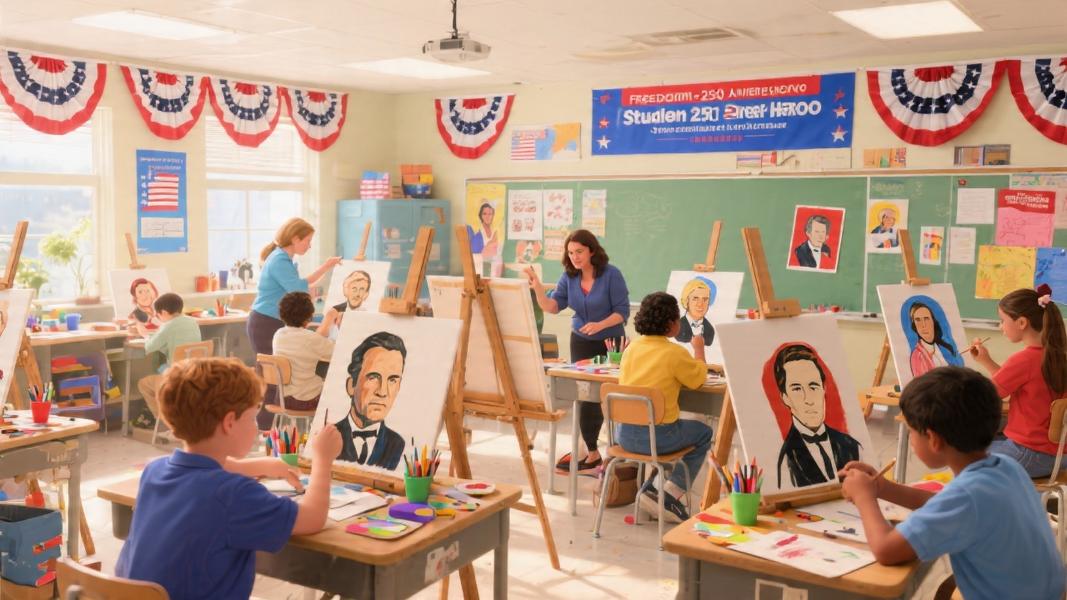
Young artists across the country now have a chance to do something rare: turn their sketchbooks into a ticket to Washington, D.C. The federal government wants to see how America’s students envision their heroes — and it’s willing to fly the winners to the nation’s capital to prove it.
The Freedom 250 American Heroes Student Art Contest is open to students in grades 3 through 12 in all 50 states and the six U.S. territories, making it one of the broadest youth art competitions the country has seen in recent memory. Sponsored by Freedom 250 and the National Endowment for the Humanities, the contest asks students to create original artwork celebrating figures from the National Garden of American Heroes — a roster of Americans whose legacies, the organizers argue, deserve far more than a plaque. Submissions are accepted now, with a hard deadline of Friday, May 1, 2026, at 11:59 p.m. ET.
What Students Are Actually Being Asked to Do
It’s not a digital design challenge or a slideshow. Organizers have been specific: artwork must be original, two-dimensional, and handmade — no larger than 24 inches on any side — with one submission allowed per student. Alongside the piece, each entrant must submit a 200-word artist statement explaining their creative choices. That’s it. One artwork, one statement, one shot. The rules are straightforward, which is either refreshing or a little unnerving, depending on how you feel about the blank canvas.
Students begin by choosing an American hero from the National Garden of American Heroes, then build their submission around that figure. The process is designed to be as much about reflection as it is about artistic execution. According to guidelines shared with school districts, the artist statement is considered a core component — not an afterthought.
Three Categories, 168 Winners
The competition is divided into three age brackets: Upper Elementary (Grades 3–5), Middle School (Grades 6–8), and High School (Grades 9–12). Across all 56 states and territories, one first-place winner per category will be selected — bringing the total number of first-place awards to 168. Those winners receive travel and lodging to Washington, D.C., for an exhibition and ceremony at the Great American State Fair. That’s a meaningful prize for a middle schooler from rural Montana or a high schooler in Guam who’s never set foot in the capital.
Judging won’t be arbitrary. A panel of artists and educators will evaluate entries on age-level artistic excellence, technical skill, creativity, relevance to the contest’s themes, and the clarity of the artist statement. In other words, a technically polished piece that says nothing won’t cut it — and neither will a heartfelt statement paired with something that looks rushed. Both halves matter.
The Bigger Picture
Why now? The contest is tied directly to America’s 250th anniversary — the semiquincentennial that the country will formally mark in 2026. That milestone has sparked a wave of commemorative programming at the federal level, and this contest is among the more civically ambitious of those efforts. It’s not just about making pretty pictures; it’s an attempt to get young people thinking seriously about who gets remembered, and why.
U.S. Secretary of Education Linda McMahon has publicly encouraged students to participate, lending the contest a degree of official weight that goes beyond a typical school art fair. Freedom 250, the sponsoring organization, has framed the initiative as a way of connecting the next generation to the American story through creativity.
Still, it’s worth noting what the contest is really asking of its youngest participants. A third-grader choosing between historical figures, then articulating in writing why they made that choice, is being asked to do something genuinely challenging. Some educators will see that as the whole point. Florida’s Department of Education, for one, has been enthusiastic, promoting the contest alongside related essay competitions as part of a broader civic education push.
How to Enter
Interested students — or the teachers and parents nudging them toward the application — can find full submission details and eligibility requirements through their school district or directly through the contest’s official channels. The deadline of May 1, 2026, gives participants several months to work, which is either plenty of time or not nearly enough, depending on how long it takes to decide which American hero deserves to be immortalized in tempera paint.
Either way, the canvas is open. Whether a student picks a Founding Father, a civil rights leader, a wartime nurse, or a scientist who changed everything — the choice itself says something. That might be the most interesting part of the whole exercise.
