
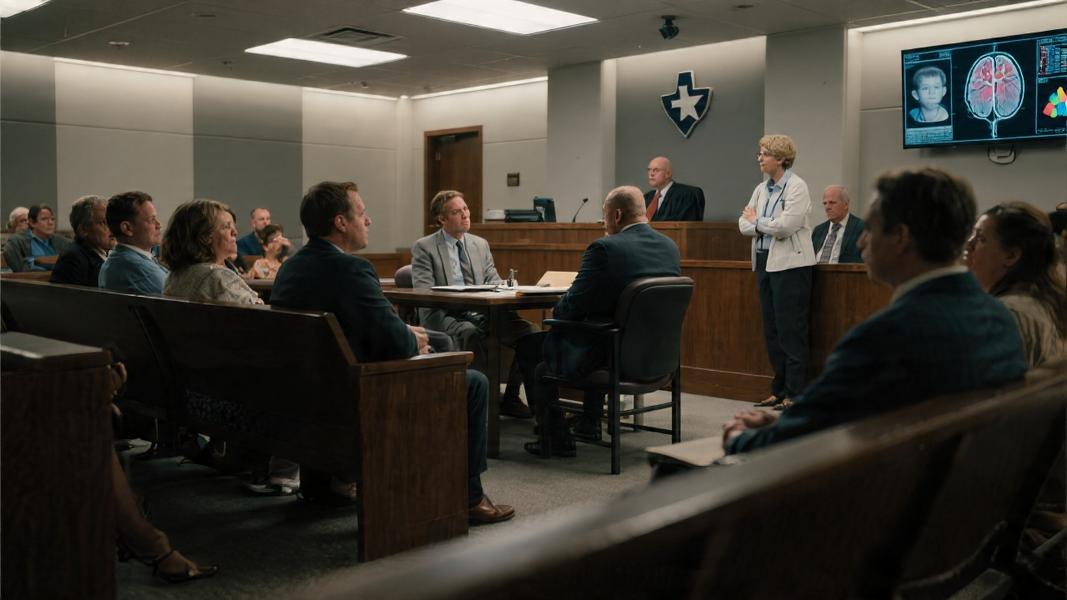
The jury deciding Tanner Horner’s fate heard one uncomfortable truth repeated in different ways on Day 11: a troubled brain doesn’t automatically mean an innocent hand.
Horner, who has already pleaded guilty to capital murder and kidnapping in the 2022 death of 7-year-old Athena Strand, now faces a jury tasked with the singular, devastating question of whether he lives or dies. The punishment phase has drawn a procession of defense witnesses — neurologists, psychologists, former teachers — each adding another layer to a portrait of a man shaped, they argue, by biology and circumstance. Prosecutors aren’t buying it. And neither, it seems, is the medical record entirely.
A Brain Unlike Almost Anyone Else’s
Start with the science, because the defense certainly did. Dr. Jeffery David Lewine, a neuroscientist brought in to analyze Horner’s brain imaging, told the jury that the number of abnormalities found in Horner’s scans would appear in less than 0.01% of the population. That’s a striking figure — one in ten thousand, roughly. The kind of number that’s meant to land hard in a courtroom.
But then came cross-examination. And that’s where things got complicated. Dr. Lewine acknowledged he cannot distinguish, based on imaging alone, between someone who cannot control their impulses and someone who simply chooses not to. It’s a concession that likely gave prosecutors exactly what they needed — and it didn’t go unnoticed.
Then there was the lead. Dr. Aaron Specht from Purdue University testified that Horner’s bone-lead levels measured approximately 33,000 micrograms — roughly 24 times higher than the average for his peers. Specht concluded this caused significant neurological damage. Lead poisoning at those levels, researchers have long noted, can affect impulse control, emotional regulation, and cognitive development in ways that don’t always show up cleanly in behavior until it’s far too late.
The People Who Knew Him Then
How does a kid like Tanner Horner move through the world? Apparently, with difficulty — and largely undetected by those around him.
A retired speech pathologist who worked with Horner painted a picture of a young man who struggled to read a room. Social cues, emotional recognition, personal boundaries — all of it, she testified, was genuinely hard for him. “His cognitive abilities stopped at a certain point for him to be able to understand jokes, teasing, bullying,” she testified. “He was definitely bullied through school. And those were aggravating to him. And he got angry, of course.” She was careful, though — she made clear that his autism did not cause, excuse, or justify the crime. What bothered her was something more procedural: “This young man should have never been in that truck by himself.”
A retired Azle ISD school psychologist added nuance to the academic picture. Horner was intellectually capable of standard coursework, she said — but his autism diagnosis meant he spent half of each school day in behavior improvement classes. Smart enough for the regular classroom. Struggling enough that he couldn’t stay in it full-time.
His fifth-grade teacher, for her part, remembered no major behavioral problems. She said she enjoyed having him in class. It’s the kind of testimony that’s hard to weigh — a warm memory sitting alongside a mountain of clinical data that tells a different story.
The Anatomy of a Defense
Still, the defense’s strategy is clear: build a mosaic. No single piece of evidence — not the brain scans, not the lead levels, not the autism diagnosis — is meant to stand alone as a reason to spare Horner’s life. Together, they’re an argument that the man sitting in that courtroom was, in some fundamental sense, set up to fail long before he ever got behind the wheel of a FedEx truck.
Dr. Erin Bigler, a clinical neuropsychologist and professor at Brigham Young University, testified remotely to explain how abnormalities in different brain lobes can affect behavior. She did not examine Horner directly — a detail prosecutors will likely revisit during rebuttal. Expert testimony from someone who’s never met the defendant has a ceiling, and both sides know it.
What the Victim’s Death Looked Like
Whatever the jury makes of the neuroscience, the prosecution made sure they didn’t forget what actually happened to Athena Strand. Medical examiner Dr. Jessica Dwyer testified that the child died from a combination of blunt force injuries, smothering, and strangulation. The evidence, she said, suggested Athena suffered. It’s the kind of testimony that can quietly undo hours of clinical explanation — a reminder, delivered in clinical language, of what this trial is ultimately about.
The defense has built a careful, layered case for mercy. The prosecution has a seven-year-old girl who didn’t make it home. The jury will have to decide which story weighs more — and in Texas, that decision carries the most permanent consequence the law allows.
