
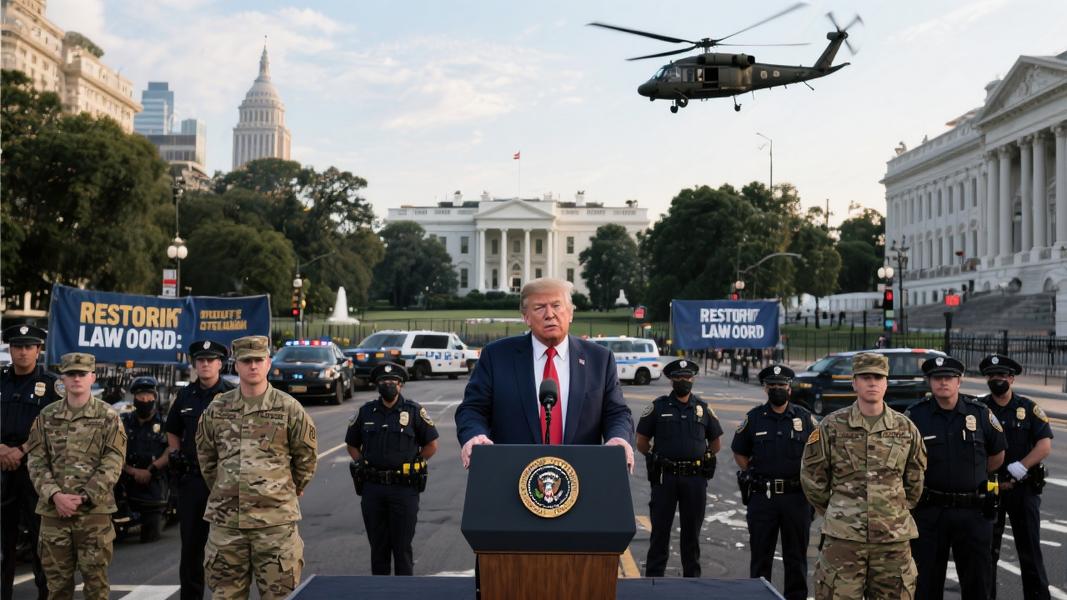
President Donald Trump signed a sweeping executive order on Sunday aimed at what he called a “crime emergency” in Washington D.C., significantly expanding federal law enforcement presence in the nation’s capital and wresting more control from local authorities.
Federal Takeover Expands
The August 25 order directs multiple federal agencies to bolster security in the District, including hiring additional U.S. Park Police officers and federal prosecutors focused on violent and property crimes. It comes just weeks after Trump’s administration took control of the D.C. Metro Police Department and mobilized the National Guard.
“Just like I took care of the Border, where you had ZERO Illegals coming across last month, from millions the year before, I will take care of our cherished Capital, and we will make it, truly, GREAT AGAIN!” Trump said in a statement accompanying the order.
The executive order creates a specialized D.C. National Guard unit trained specifically for maintaining public safety in the capital. It also establishes an online recruitment portal for Americans with law enforcement backgrounds to join federal agencies operating in Washington.
Crime Rates Under Dispute
The White House justified the federal intervention by pointing to what it describes as “rampant violence and disorder” threatening both local residents and government operations. Administration officials claim D.C.’s 2024 murder rate of 27.54 per 100,000 residents exceeds those of global cities like Bogota, Mexico City, and Islamabad.
“Washington, D.C. has a violent crime rate that is higher than some of the most dangerous places in the world,” the White House stated, citing recent high-profile incidents including the murders of two embassy staffers in May, the fatal shooting of a Congressional intern near the White House in June, and the beating of a Trump administration staffer “by a violent mob” in recent weeks.
The administration claims early results show dramatic improvements, with preliminary data indicating robberies down 46%, carjackings reduced by 83%, and violent crime overall decreased by 22% since federal intervention began.
But those figures have raised eyebrows among criminal justice experts, who note they contradict longer-term data trends. Before the federal takeover, many crime categories in D.C. had been showing multi-year declines according to local statistics.
Cashless Bail in the Crosshairs
The order also targets D.C.’s cashless bail system, which Trump has repeatedly criticized despite its having existed since the 1990s and containing numerous restrictions preventing violent offenders from qualifying. “We’re ending it,” Trump declared before signing the order in the Oval Office, “but we’re starting by ending it in D.C., and that we have the right to do through federalization.”
Is this just the beginning? Trump has signaled that the D.C. intervention could serve as a model for similar federal actions in other Democratic-led cities. “When I’m re-elected, I will crack down on the left-wing jurisdictions that refuse to prosecute dangerous criminals and set loose violent felons on cashless bail,” Trump previously stated, with Chicago frequently mentioned as a potential target.
Broader Federal Powers
The order extends beyond traditional law enforcement. It directs the Department of Housing and Urban Development to investigate compliance with crime prevention requirements in federally funded housing and authorizes the Transportation Secretary to conduct inspections addressing “unsafe conditions” in D.C.’s transit system.
Critics worry the moves represent an unprecedented federal overreach into local governance. Yet the White House maintains the Constitution provides clear authority for such intervention when the functioning of the federal government is at stake.
Trump’s vision for Washington is clear in his rhetoric: “Before the tents, squalor, filth, and Crime, it was the most beautiful Capital in the World. It will soon be that again.” But whether this federal takeover marks a temporary emergency response or a permanent shift in the governance of America’s capital remains to be seen.
