
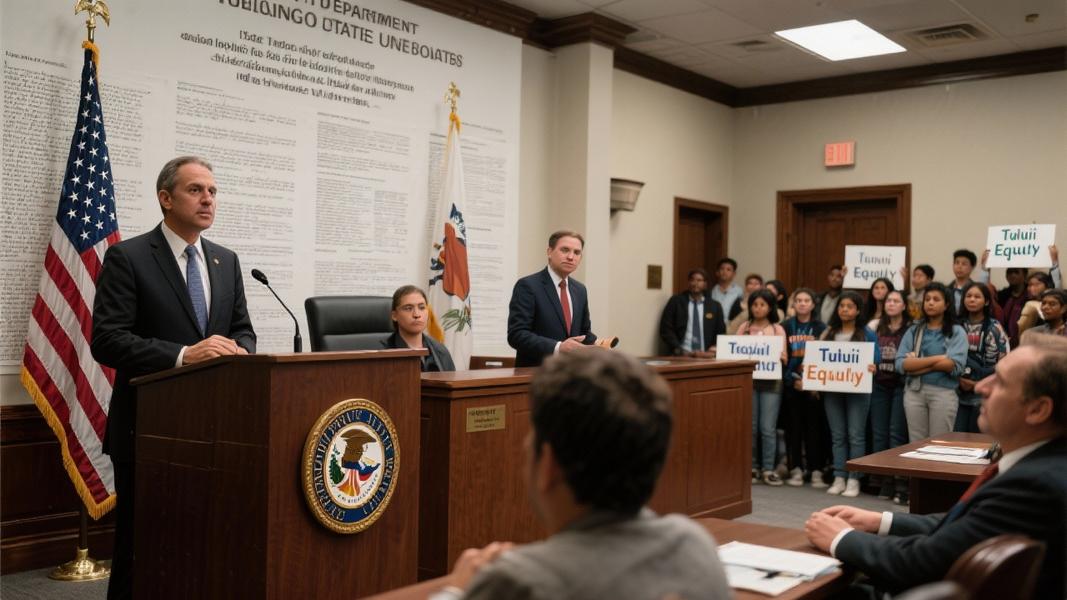
The Justice Department has launched a legal offensive against the state of Illinois, filing a complaint on Monday challenging state laws that offer in-state tuition and scholarship benefits to undocumented immigrants — a move that signals the Trump administration’s renewed focus on immigration enforcement.
The lawsuit, filed on September 2, 2025, claims Illinois laws providing these educational benefits to immigrants without legal status directly violate federal law by discriminating against U.S. citizens from other states, who must pay higher out-of-state rates at Illinois public colleges and universities.
“Under federal law, schools cannot provide benefits to illegal aliens that they do not provide to U.S. citizens,” Attorney General Pamela Bondi stated when announcing the action.
Legal Battle Lines
At the heart of the dispute is the Illegal Immigration Reform and Immigrant Responsibility Act (IIRIRA) of 1996, which explicitly prohibits states from offering preferential tuition rates to those without legal status unless the same rates are extended to all U.S. citizens regardless of residency. Despite this federal restriction, Illinois and approximately a dozen other states have implemented policies that the Justice Department claims circumvent this requirement.
U.S. Attorney Steven D. Weinhoeft didn’t mince words about the state’s position: “Illinois has an apparent desire to win a ‘race to the bottom’ as the country’s leading sanctuary state. Its misguided approach mandating in-state tuition, scholarships, and financial aid to illegal aliens plainly violates federal law,” he noted.
The complaint specifically targets Illinois laws requiring public higher education institutions to offer in-state tuition to all residents, regardless of immigration status — a requirement that the DOJ argues conflicts with federal law under the Constitution’s Supremacy Clause.
National Implications
Why now? The lawsuit aligns with two executive orders signed by President Trump earlier this year aimed at restricting benefits to undocumented immigrants and preventing preferential treatment of non-citizens over U.S. citizens. One order specifically directs officials to take action against state laws providing in-state tuition to undocumented students without extending the same benefit to all American citizens.
Currently, almost half of U.S. states allow some undocumented immigrants to pay in-state tuition rates, but the landscape is shifting rapidly. Several Republican-led states including Texas and Florida have recently moved to rescind these policies following similar federal challenges.
“We should not be subsidizing illegal immigration through our higher education system,” Florida Governor Ron DeSantis remarked when discussing his state’s policy repeal, which he claimed would save Florida taxpayers approximately $45 million annually.
Fairness or Discrimination?
Critics of policies providing in-state tuition to undocumented students argue they create an unfair burden on taxpayers and disadvantage U.S. citizens. “Such state policies not only violate federal law; they also encourage illegal immigration; are fundamentally unfair to students from out-of-state who are U.S. citizens; and force taxpayers to subsidize the education of illegal aliens,” according to an analysis published by the Heritage Foundation.
Dr. Zachary Marschall, editor-in-chief of Campus Reform, frames it as an issue of economic fairness: “No one could have predicted where we would be now with $100,000 tuition rates at private universities and up to $40,000 at public universities. Also, we’ve had four years of the Biden administration letting millions of people into the country without any accountability. So, I think this is now about making it fair for law-abiding American citizens, many of whom can’t afford college.”
But immigrant advocacy groups see the federal action differently. They argue these policies provide crucial educational access for young people who were brought to the United States as children and have grown up as Americans in all but legal status.
Legal Resistance Forming
The Mexican American Legal Defense and Educational Fund (MALDEF) has already moved to intervene in a similar case in Texas, defending that state’s Dream Act against federal challenges.
“Federal courts are public entities, and, absent extraordinary cause, federal courts undertake their work in public, with opportunity for public review and input,” Thomas A. Saenz, MALDEF President and General Counsel, explained regarding their involvement.
The clash highlights the ongoing tension between state autonomy in education policy and federal immigration enforcement priorities. It also raises questions about who bears the cost of higher education and who deserves access to state-subsidized rates.
For now, the fate of thousands of undocumented students in Illinois hangs in the balance as the courts prepare to weigh competing claims of discrimination, fairness, and the proper balance between state and federal authority. And for the Trump administration, it’s just the opening salvo in what appears to be a broader campaign to roll back policies seen as beneficial to those without legal status.
