
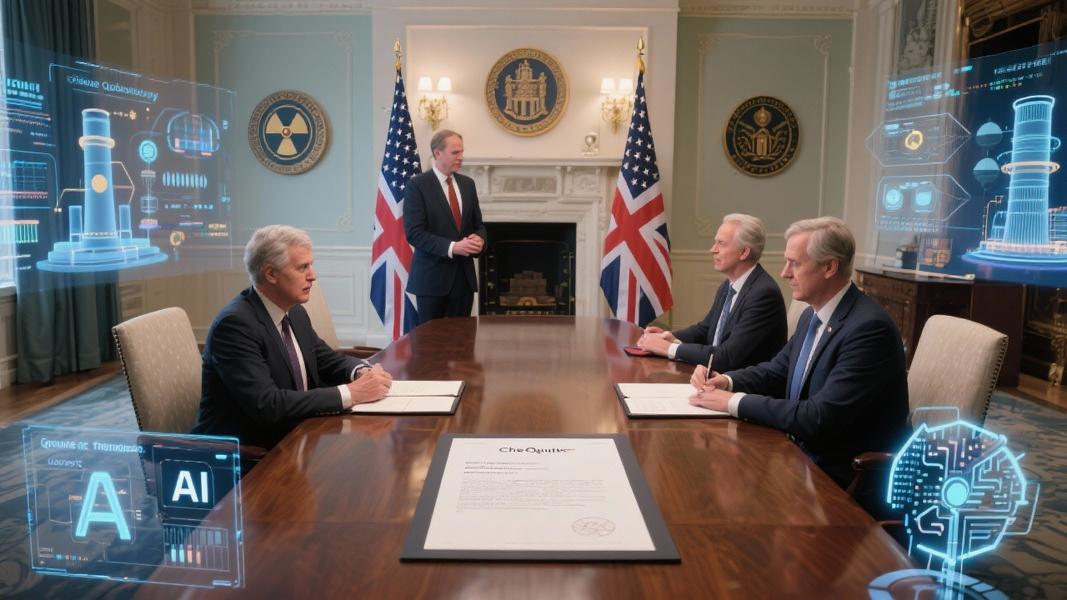
U.S. and U.K. ink landmark $350 billion technology deal, promising to reshape everything from AI to nuclear energy in what officials are calling the most ambitious tech collaboration between the two nations in history.
The “Technology Prosperity Deal,” signed by President Donald Trump and Prime Minister Keir Starmer this week, establishes joint research programs spanning artificial intelligence, civil nuclear energy, fusion, and quantum technologies. The sweeping agreement aims to generate $50 billion in economic value while creating up to 2,500 jobs in the U.S. and powering approximately 1.5 million homes with new energy capabilities.
AI at the Heart of Trans-Atlantic Tech Push
At the signing ceremony, Trump didn’t mince words about what’s driving the urgency behind the deal. “You need the energy. You have to have the energy,” he declared, noting that powering advanced AI systems requires “double what we have right now just to maintain that fight” for global technological supremacy. “We’re right now leading China and the world by a lot in AI — a lot — and we’re creating tremendous amounts of energy.”
The memorandum outlines collaboration on developing AI models and datasets for biotechnology and precision medicine, including cancer research and treatments for rare diseases. It also establishes frameworks for AI security standards, infrastructure development, and workforce training — all while promoting U.S. and U.K. AI exports “to offer the full stack of chips, data centers, and models.”
Tech giants are already lining up behind the initiative. “We have huge new investments from Nvidia, N scale, OpenAI, Google, Salesforce and many more backing cutting-edge British jobs for years to come,” Starmer noted during the announcement, calling it “the biggest investment package of its kind in British history, by a country mile.”
Breaking Free from Russian Energy Dependence
Perhaps the most ambitious timeline in the agreement? The commitment to achieve “full independence from Russian nuclear fuel by the end of 2028.” The deal establishes aggressive targets for nuclear regulatory processes, including completing reactor design reviews within two years and site licensing within one year.
For an industry accustomed to decades-long approval processes, these timelines represent a radical shift. The agreement supports civil nuclear energy innovation with the stated goal of leading global nuclear advancements and accelerating deployment of advanced reactors.
Why the rush? Energy demands from AI data centers are skyrocketing at precisely the moment when both nations are seeking to reduce dependence on foreign energy sources. Trump boasted about the new approach to energy project approvals: “We’re getting them approvals like they’ve never seen before. They used to wait 15 and 20 years to be rejected. Now they wait two weeks or three weeks to be accepted.”
Quantum Leap Forward
The agreement also positions quantum computing as a critical frontier. Both nations will establish a joint benchmarking taskforce to accelerate breakthroughs in quantum computing hardware, software, and algorithms, while launching what they’re calling a “Quantum Code Challenge” to mobilize researchers around real-world applications.
A U.S.-UK Quantum Industry Exchange Program will target adoption across defense, health, finance, and energy sectors — areas where quantum computing could potentially revolutionize everything from cryptography to drug discovery.
The deal doesn’t stop there. Looking even further ahead, the agreement includes provisions for joint research and development in “6G-relevant technologies,” including software for AI-enabled 6G networks and supply chain resilience — even as most of the world is still implementing 5G.
Governance and Implementation
How will all this actually work? The memorandum establishes a Ministerial-Level Working Group that must convene within six months to guide the bilateral cooperation and set priorities. Annual formal discussions will assess progress and determine future directions based on “emerging opportunities, policy developments, and shared strategic interests.”
The agreement is designed to complement the previously established U.S.-U.K. Economic Prosperity Deal, creating a comprehensive framework for technological and economic cooperation between the longtime allies.
Research security also features prominently, with both governments pledging to protect critical and emerging technology R&D and secure investment for advanced technologies considered vital to national interests.
“It’s a blueprint to win this new era together. Shape it according to our shared values, and seize the incredible opportunities that are on offer,” Starmer said of the agreement that both leaders hope will cement the special relationship for the AI age — and keep both nations ahead in the global tech race that increasingly defines economic and military power in the 21st century.
