
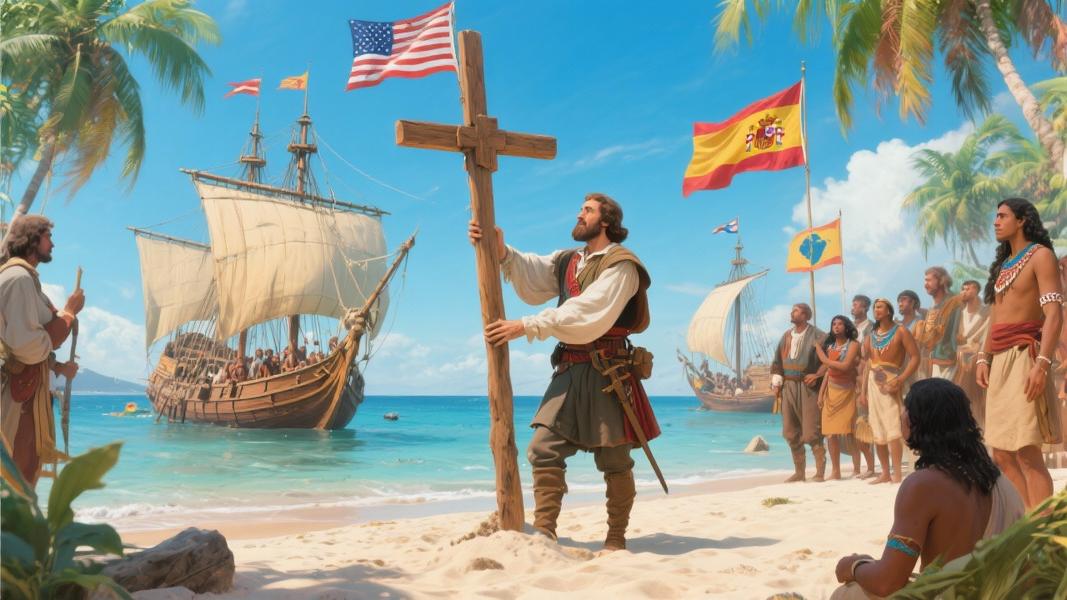
When Christopher Columbus set sail from Spain in 1492, he couldn’t have known his journey would forever alter world history. The Italian explorer’s westward voyage in search of an ocean route to China instead led to European awareness of continents entirely unknown to them.
Born in Genoa, Italy in 1451, Columbus emerged as one of the most significant figures of the Age of Exploration, though his path to maritime fame was anything but straightforward. After being rejected by King John II of Portugal in 1484, Columbus spent years seeking patronage before finally securing support from Spain’s Ferdinand and Isabella—and only after multiple denials.
A Daring Voyage West
On August 3, 1492, Columbus finally departed from Palos de la Frontera, Spain, commanding a small fleet of three ships: the Santa María (his flagship and largest vessel, classified as a carrack), accompanied by two smaller caravels, the Pinta and the Niña.
Why sail west to reach the East? Columbus was convinced he could reach China and the lucrative East Indies by crossing the Atlantic—a bold proposition in an era when most European trade routes to Asia involved lengthy journeys around Africa or overland expeditions. With approximately 90 men distributed across his three vessels, the expedition represented a significant gamble for both Columbus and his royal patrons.
The journey quickly proved more challenging than anticipated. After five weeks at sea with no land in sight, discontent spread through the crew like wildfire. The men, having sailed farther west than any known European expedition, began to fear they would never return home.
Mutiny seemed imminent. “According to one account, the sailors even conspired to do away with their leader, whom they ‘planned to throw into the sea,'” notes one historical record. Only Columbus’ persuasive leadership—and perhaps the crew’s fear of being stranded without a commander—prevented outright rebellion.
Landfall and Legacy
Would Columbus’ gamble pay off? After sailing westward for what must have seemed an eternity to his nervous crew, the expedition finally reached land in the Bahamas, though Columbus himself would die believing he had found a route to Asia rather than an entirely different continent.
While Columbus’ navigational calculations regarding the Earth’s circumference proved significantly underestimated, his confidence in the possibility of westward passage was ultimately vindicated—though not in the way he expected. His voyage initiated sustained contact between the Eastern and Western hemispheres, setting in motion what historians call the Columbian Exchange of plants, animals, diseases, and cultures.
The environmental and human consequences of this contact were profound and often devastating, especially for indigenous populations. That said, the scientific and navigational achievements of the voyage remain remarkable. Columbus and his crews successfully navigated the open Atlantic using only rudimentary instruments, celestial observations, and dead reckoning—a testament to the maritime knowledge of their era, despite their geographical misconceptions.
Columbus’ determination to pursue his vision against significant odds—including royal rejection, crew rebellion, and the genuine possibility of sailing into oblivion—remains perhaps the most enduring aspect of his complicated legacy. Five centuries later, the voyage continues to represent both the daring spirit of exploration and the complex, often troubling consequences that can follow when worlds collide.
