
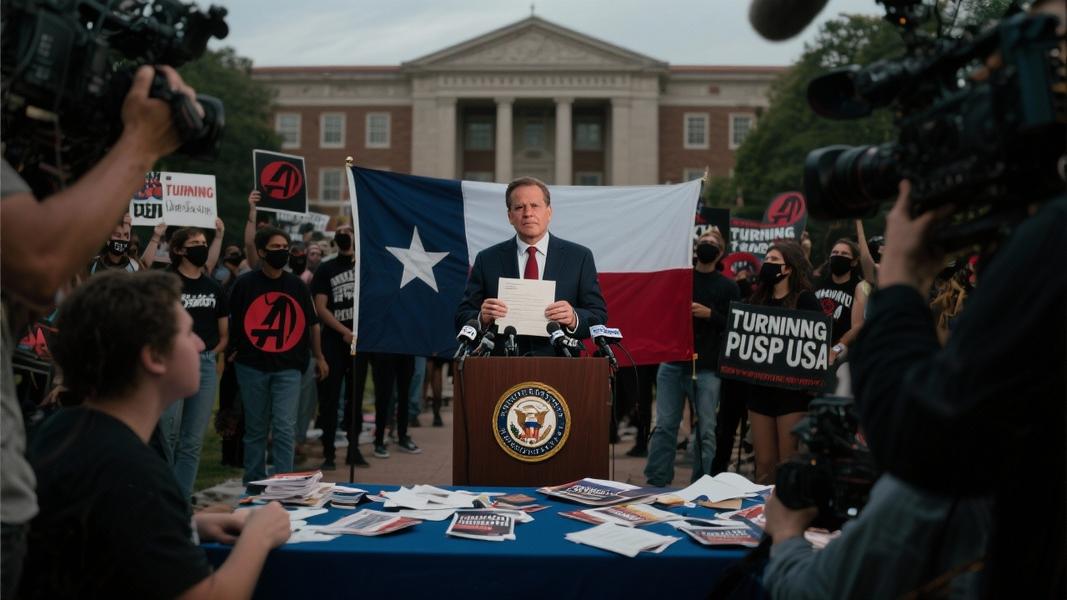
Texas Attorney General Ken Paxton has launched a sweeping investigation into the University of North Texas, alleging the institution has failed to discipline students who celebrated the assassination of conservative activist Charlie Kirk and threatened violence against others.
The investigation, which Paxton announced this week, represents the latest escalation in what the attorney general describes as a broader crackdown on “leftist political terrorism” across Texas campuses and beyond.
Campus Tensions Spark State Action
“In the face of left-wing terror being celebrated and the threatening of students, UNT leadership has chosen to do next to nothing. That’s outrageous,” Paxton declared in a statement that accompanied his office’s demand for answers from university administrators.
The controversy stems from alleged incidents following Kirk’s assassination, where some students reportedly celebrated the attack while others faced repercussions for defending the conservative commentator. In one case, Paxton claims a student was removed from class after expressing support for Kirk, while those celebrating the assassination faced no consequences.
“For too long, universities have become incubators for radical left-wing ideology instead of fostering a space for learning and open, peaceful discussion of ideas,” Paxton wrote in a letter to university officials. “Educational institutions cannot be incubators of violent radical leftists.”
The attorney general’s investigation into UNT is part of a broader initiative that includes what he describes as “undercover operations” aimed at infiltrating what he terms “leftist terror cells” operating in Texas.
Broader Crackdown Underway
What’s driving this aggressive approach? Paxton cites several recent violent incidents, including an attack on an ICE facility in Alvarado and Kirk’s assassination, as evidence of a growing threat that demands immediate action.
“Leftist political terrorism is a clear and present danger,” Paxton stated. “Corrupted ideologies like transgenderism and Antifa are a cancer on our culture and have unleashed their deranged and drugged-up foot soldiers on the American people.”
The investigation has already sparked debate about the appropriate boundaries between addressing legitimate security concerns and potentially infringing on academic freedom or free speech rights on campus. Critics worry that the attorney general’s approach could have a chilling effect on political discourse at state universities.
Still, Paxton remains uncompromising in his stance. “There can be no compromise with those who want us dead,” he insisted when announcing the broader investigation efforts earlier this month.
University Under Pressure
For UNT administrators, the attorney general’s demands present a complicated challenge. Paxton has explicitly called for the expulsion of students who celebrated Kirk’s assassination, putting significant pressure on the university’s disciplinary process and raising questions about due process.
The university’s handling of the situation is now under a microscope, with Paxton’s office demanding detailed information about how administrators have responded to reports of threatening behavior and celebrations of political violence.
Caught between competing demands — maintaining campus safety, respecting free expression, and now responding to a state investigation — UNT faces difficult decisions about how to proceed.
In his communications with university leadership, Paxton has been unambiguous about what he expects: “I implore you to take the only proper disciplinary action against the students who celebrated the death of Charlie Kirk: expulsion.”
The attorney general’s warning to those he accuses of political violence strikes an ominous tone: “To those demented souls who seek to kill, steal, and destroy our country, know this: you cannot hide, you cannot escape, and justice is coming,” he cautioned in a recent statement.
As the investigation unfolds, both the university community and state officials find themselves at the center of a contentious debate about the boundaries of acceptable speech, the role of universities in addressing political extremism, and the appropriate response to celebrations of political violence — wherever they may occur on the ideological spectrum.
