
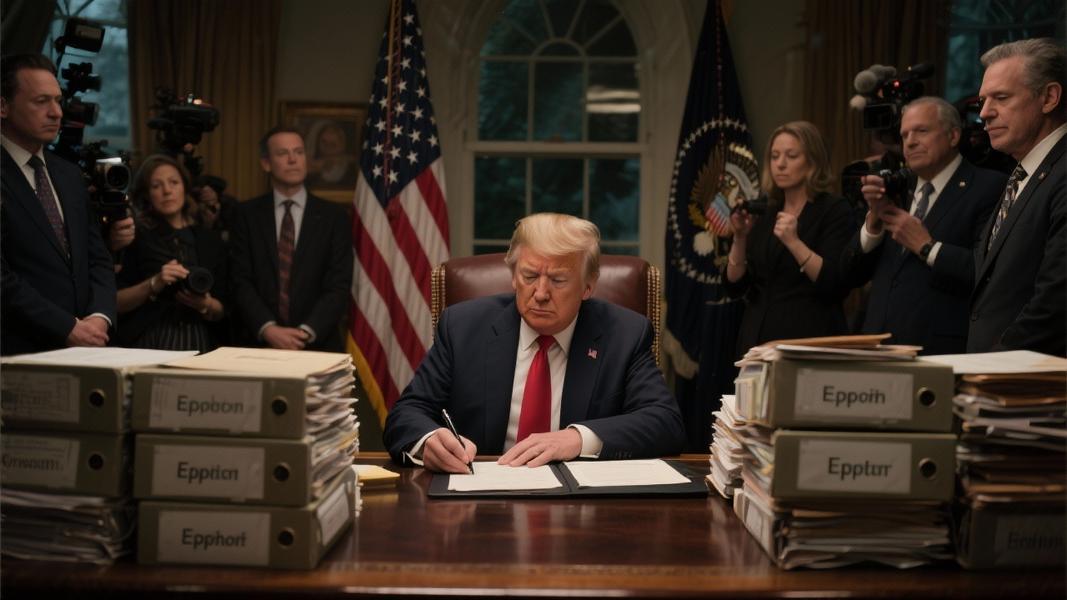
President Donald Trump has signed legislation forcing the release of Justice Department files on Jeffrey Epstein, capping a dramatic reversal on an issue he initially resisted engaging with during his early days back in office.
The bill, which passed with overwhelming bipartisan support, gives the Justice Department just 30 days to disclose all files and communications related to the convicted sex offender, including information about Epstein’s 2019 death in federal custody. “I have just signed the bill to… Now, that is a reference to Congress’s approval yesterday of legislation that compels the Department of Justice to release all of its files relating to Jeffrey Epstein,” Trump stated after signing the measure.
A Reluctant Signature
Trump’s approval comes after initially criticizing Republicans who pushed for the disclosure. What changed? Political pressure mounted as the legislation gained momentum in Congress, where it passed the House by an astonishing 427-1 margin, with Rep. Clay Higgins (R-La.) standing as the lone dissenter. The Senate then approved it unanimously without even requiring a formal vote.
In explaining his shift, Trump claimed that “Democrats have used the ‘Epstein’ issue, which affects them far more than the Republican Party, in order to try and distract from our AMAZING Victories.” The statement suggests a strategic calculation that fighting the disclosure would create more problems than signing it.
The new law allows for some redactions related to ongoing federal investigations but explicitly forbids withholding information simply due to political sensitivity or potential embarrassment — a provision that has raised eyebrows across Washington.
What Will Be Released?
Within a month, Americans could see a treasure trove of previously undisclosed materials. “Under the legislation, the Department of Justice has 30 days to release these files, and they could include documents like travel records, internal DOJ communications about investigations into Jeffrey Epstein, uh, and also records relating to Jeffrey Epstein’s death in prison in 2019,” a White House official explained.
The potential revelations about Epstein’s death — officially ruled a suicide but long the subject of conspiracy theories — may prove particularly explosive. Documents may be redacted to protect ongoing investigations, though the legislation’s strict limitations on what can be withheld has set expectations for substantial disclosures.
Trump’s Complicated Epstein Connection
Why has this been such a thorny issue for the president? Trump’s own historical connections to Epstein have created political complications. It’s been documented that Trump had been friends with Epstein, the disgraced financier who moved in elite social circles. “But the president has consistently said he did not know of Epstein’s crimes and had cut ties with him long ago,” according to sources familiar with Trump’s position.
Still, the Epstein saga has created strange political bedfellows. Some of Trump’s most ardent supporters have promoted theories about government cover-ups regarding Epstein’s activities and associations, while Democrats have pointed to Trump’s past social relationship with the convicted sex offender.
Adding another layer to the situation, Trump has recently asked his attorney general to investigate Epstein’s links to prominent Democrats, reports indicate, potentially turning what began as a bipartisan transparency effort into a political weapon.
For victims of Epstein’s crimes, many of whom have fought for years for transparency and accountability, the impending document release represents a rare moment of Washington unity that could finally shed light on one of the most disturbing criminal cases in recent American history — though whether the files will satisfy the public’s questions remains to be seen.
