
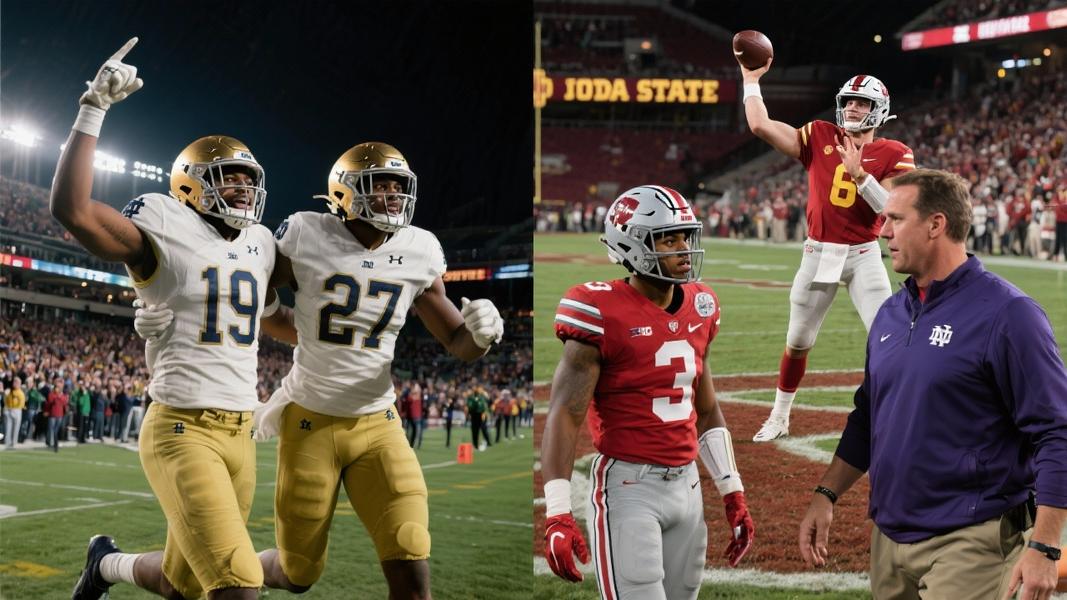
Notre Dame football has made a bold statement by declining a bowl invitation after being snubbed from the College Football Playoff, despite finishing the 2025 season with an impressive 10-2 record.
The Fighting Irish, ranked No. 9 in the AP poll and No. 11 in the College Football Playoff rankings, announced their decision Thursday in a statement on social media. “As a team, we’ve decided to withdraw our name from consideration for a bowl game following the 2025 season,” Notre Dame stated on X. “We appreciate all the support from our families and fans, and we’re hoping to bring the 12th national title to South Bend in 2026.”
Big 12 Teams Join Bowl Exodus
Notre Dame isn’t alone in its bowl game rejection. Iowa State and Kansas State, both from the Big 12 Conference, have also declined bowl invitations despite being eligible with records of 8-4 and 6-6 respectively.
Why turn down the postseason spotlight? For Iowa State, the decision came directly from the players. The team announced that its athletes voted against bowl participation, citing insufficient healthy players to safely practice and compete.
The coaching carousel has played a significant role in these decisions. Iowa State lost head coach Matt Campbell to Penn State, promptly hiring Jimmy Rogers as his replacement. Meanwhile, Kansas State’s Chris Klieman announced his retirement, with the program bringing in Collin Klein from his offensive coordinator position at Texas A&M to take the helm.
Conference Pushback: Big 12 Issues Hefty Fines
The Big 12 Conference wasn’t pleased with these decisions. In response, the conference slapped both Iowa State and Kansas State with substantial $500,000 fines for opting out of bowl participation.
“While the conference acknowledges the difficult timing around coaching changes, the Big 12 is responsible for fulfilling its contractual obligations to its bowl partners,” the conference explained in its official statement.
Kansas State athletic director Gene Taylor defended his program’s decision, emphasizing the challenges of fielding a competitive team during a coaching transition. “This decision was not taken lightly, but with our coaching staff transition and several uncertainties regarding player availability, I felt it was not in our best interest to try to field a team that was not representative of Kansas State University,” Taylor commented.
He also praised the resilience of his squad: “We applaud this group for fighting back from a 2-4 record to lead us to bowl eligibility yet again, and we are happy that our seniors were able to go out on top with a victory inside Bill Snyder Family Stadium.”
Player Welfare Takes Center Stage
For Iowa State, the focus remained squarely on player health and safety. Jamie Pollard, the school’s athletic director, expressed full support for the team’s decision to prioritize well-being over postseason play.
“The administrative staff and coaches respect and support the players decision,” Pollard noted. “Our student-athletes have had an incredible season and we are grateful for their leadership as we worked through this process with them today.”
Could this trend of bowl game rejections signal a shift in how programs view postseason opportunities? With the expanded playoff format and increasing concerns about player health, the traditional bowl system faces new challenges in maintaining its relevance and appeal.
As for Notre Dame, their sights are clearly set beyond bowl season and squarely on championship contention in 2026 — making a statement that anything less than playoff consideration simply isn’t worth their time.
