
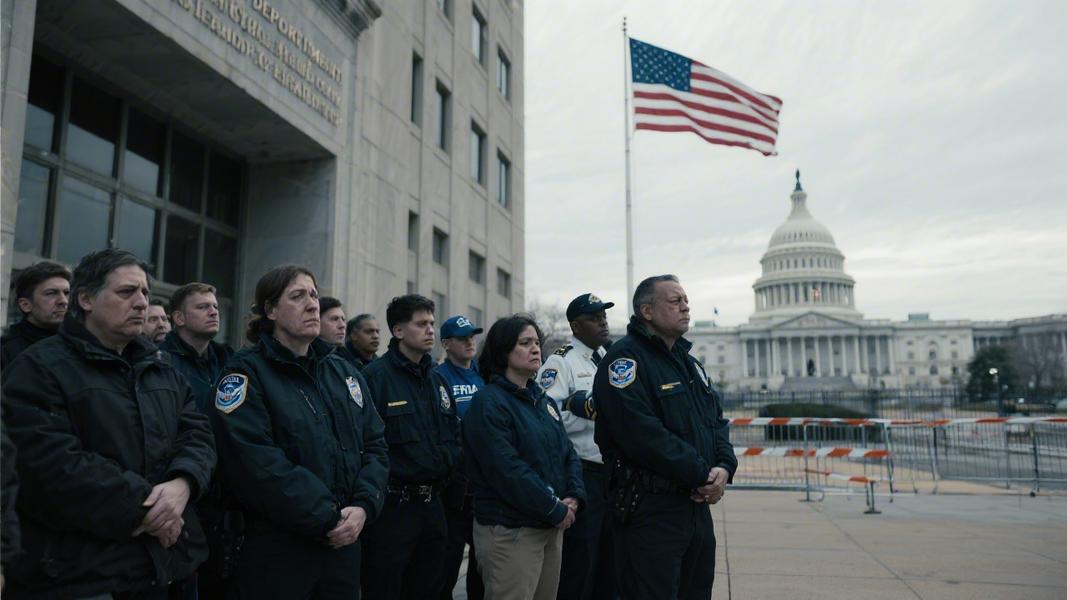
The federal government’s latest funding crisis has officially broken records — and for the more than 100,000 workers going without paychecks, that’s not a distinction anyone wanted.
What began as another grinding standoff between Congress and the White House has metastasized into the longest funding lapse in American history, surpassing every prior government shutdown on record. The Department of Homeland Security has now gone more than 24 days without authorized funding, leaving a sprawling agency responsible for airport security, disaster response, and maritime law enforcement effectively running on fumes — and faith.
Who’s Feeling It First
Walk through any major airport right now and the math becomes pretty obvious. TSA wait times have crept toward four hours at some of the country’s busiest terminals, a slow-motion crisis that’s less about security failures and more about a workforce that’s being asked to show up and work without knowing when — or whether — they’ll be paid. TSA officers, Coast Guard civilians, and FEMA employees are among those caught in the lurch, a cross-section of public servants whose jobs don’t exactly come with a pause button.
How bad is it, really? Bad enough that the administration felt compelled to issue a formal release from the White House acknowledging the milestone — a rare admission that the clock is no longer working in anyone’s favor politically.
A Record Nobody Wanted
Previous shutdowns — including the 35-day lapse that stretched from late 2018 into early 2019 — were ugly enough to leave lasting impressions on federal workers and their families. This one’s already worse. And it doesn’t appear to be ending soon. Negotiations between congressional leaders and the executive branch have stalled repeatedly, with each side pointing fingers across the aisle while the agency responsible for securing the nation’s borders and skies quietly deteriorates from within.
Still, the political calculus here is complicated. Shutdowns, for all their human cost, have historically served as leverage — a blunt instrument wielded when subtler tools have failed. The question, as it always is, is who blinks first. So far? Nobody.
The Human Cost Behind the Headlines
It’s easy for these numbers to blur together. 100,000 workers. 24 days. Record-setting. But behind every statistic is someone who’s already burned through their emergency savings, already had the uncomfortable conversation with a landlord, already started doing the grim arithmetic of which bills can wait and which absolutely cannot.
Coast Guard families have historically been among the hardest hit during DHS-specific funding lapses, given that service members — unlike their civilian counterparts — are required to report to duty regardless of pay status. That’s not a footnote. That’s a constitutional and moral knot that Congress has never fully untangled, no matter how many times it’s been highlighted in shutdown after shutdown.
FEMA employees, meanwhile, operate in a sector where the work doesn’t slow down simply because the funding has. Disaster doesn’t take a legislative recess.
What Comes Next
That’s the catch. There’s no clean off-ramp here — at least not one that’s visible yet. Continuing resolutions, emergency stopgaps, last-minute deals struck in the small hours of a Tuesday morning: Washington has a long and undignified tradition of solving these crises just barely in time, or sometimes not quite. The workers absorbing the cost in the meantime don’t get a retroactive apology. They get back pay, eventually, if the final legislation includes it — and it usually does. But “eventually” doesn’t pay rent in March.
Congressional sources have suggested that a framework for a short-term resolution is being discussed, though that description has been accurate, in some form, for most of the past three weeks. At some point, the gap between “being discussed” and “being done” has to close.
The Bigger Picture
Shutdowns have a way of feeling abstract until they don’t. Until the line at security is an hour longer than it should be. Until the FEMA case worker handling your flood claim doesn’t pick up. Until the Coast Guard cutter stays in port a little longer than it otherwise would have. The machinery of the federal government is vast and, in normal times, largely invisible — which is precisely why its absence tends to announce itself in the most inconvenient ways possible.
What this particular shutdown has done, more than most, is strip away the pretense that these funding fights are consequence-free political theater. They’re not. They never were. The record now reflects that plainly — not as a historical footnote, but as an ongoing, unresolved fact of life for more than a hundred thousand Americans who simply came to work.
The longest shutdown in history is still happening. The ending hasn’t been written yet.
