
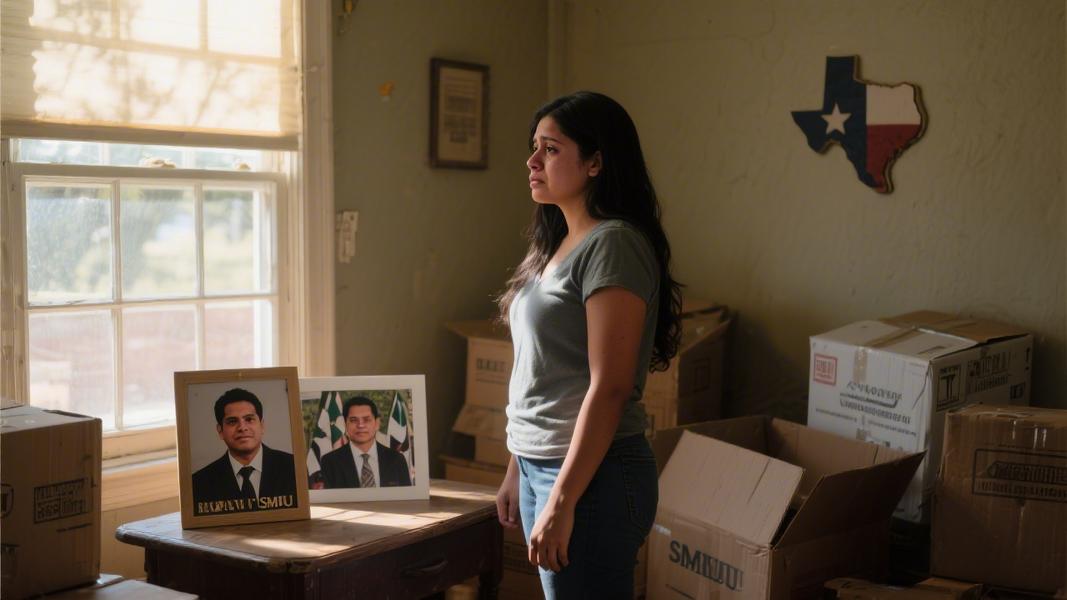
For seven months, Omar Salazar sat inside a detention facility north of Dallas while his wife, his community, and his attorneys fought to keep him in the only country he’s ever really known. On Tuesday, that fight came to an end — and not the way anyone hoped.
Salazar, a Dallas community leader and Southern Methodist University alumnus who was brought to the United States from Mexico as a child, lost his immigration case before Judge Matthew Andrasko and now faces deportation. He has 60 days for voluntary departure. His wife, Ella Salazar — a U.S. citizen — says she plans to follow him.
A Case That’s Become a Symbol
Salazar’s story has drawn unusual attention, even by the standards of a national immigration debate that’s produced no shortage of heartbreaking cases. He has no criminal history. He married his longtime girlfriend while detained at the Bluebonnet Detention Facility, following a traffic stop that triggered the chain of events leading here. The immigration judge himself found Salazar to be of good moral character over the ten-year period preceding his application — and still denied his bid to cancel removal.
That’s the catch. Good moral character, strong community ties, no record — and it still wasn’t enough. His attorney, Jacob Monty, didn’t mince words. “This case illustrates the mass deportation machine at work and the tragic consequences that affect people like Omar, but also U.S. citizens like Ella Salazar,” Monty said. “A sad day for Omar, but a sad day for America, too.”
What Comes Next — And It Isn’t Simple
The family does have options, technically. An appeal remains possible, though it would likely extend Salazar’s detention by another eight to twelve months. Any application to re-enter the country legally could take three to six years to process. So the math is brutal: stay and fight, and Omar sits in a detention center well into 2027. Accept the ruling, and the couple starts an indefinite life in Mexico while Ella figures out her passport situation.
She announced the decision herself on social media Tuesday night, with the kind of blunt grief that doesn’t need a press release. “Today, we received the news we were hoping not to get,” she wrote. “We lost our case. Omar will be sent back to Mexico soon and I will be following him once I will be able to get my passport in order.”
‘A Panic Attack 24-7’
How do you describe seven months of waiting for a verdict that could end your life as you’ve built it? Ella Salazar found the words. “It was really hard,” she told CBS News Texas. “It felt, for a little bit, like I was just kind of in a panic attack 24-7.” Still, by Wednesday, she was describing a different emotional register — not relief exactly, but something like exhausted acceptance. “Obviously, it’s not the decision we wanted, but it was something that we knew was a possibility,” she said. “Kind of just needed a day to be sad, but today, it feels a lot more hopeful, a lot more at peace.”
That shift — from panic to a fragile kind of peace — says something about what families in these situations eventually have to do just to function. You can’t stay in crisis mode indefinitely. At some point, the uncertainty resolves into reality, and reality, however painful, is at least something you can plan around.
The Broader Picture
Monty’s phrase — “the mass deportation machine” — is pointed, and deliberately so. Salazar’s case didn’t involve a violent offender or a national security concern. It involved a man who came here as a child, built a life, earned a degree, became a community figure, and got pulled over in traffic. The system processed him anyway. That’s either a feature or a bug, depending on where you sit in the current political debate over immigration enforcement.
What’s harder to argue with is the human cost — not just to Omar, but to Ella, a U.S. citizen who now faces the prospect of leaving her own country to keep her family intact. That’s a consequence the current enforcement framework doesn’t always advertise.
As the 60-day clock starts ticking, the Salazars are doing what families do: making plans, steadying themselves, trying to find solid ground in a situation that offers very little. “A sad day for Omar,” Monty said — and then added the line that lingers: “but a sad day for America, too.”
