
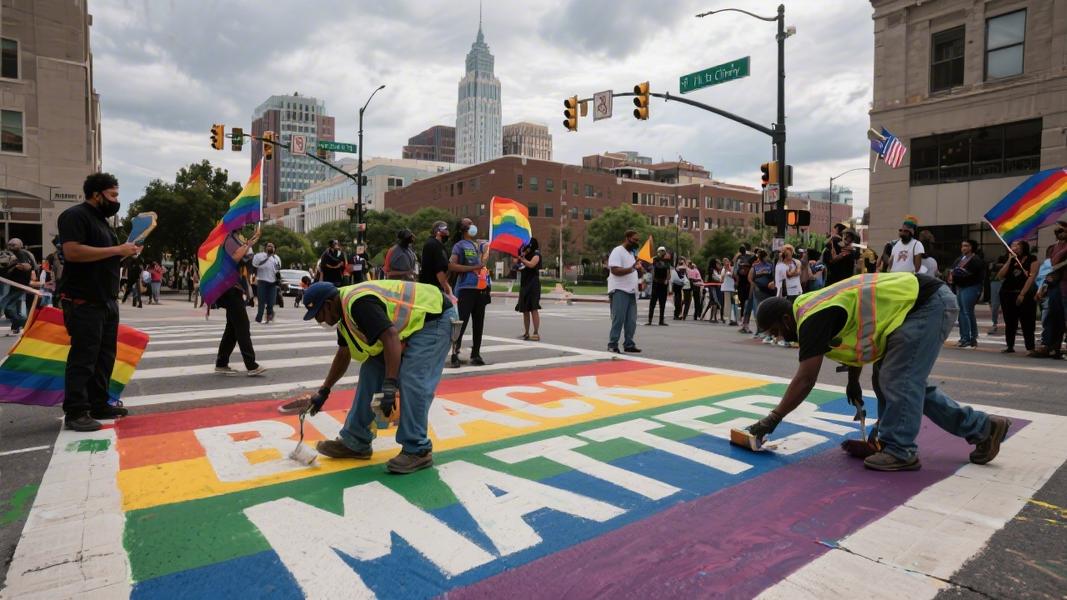
City crews descended on Oak Lawn this week with grinders and paint rollers, and what they left behind — bare gray asphalt where rainbow crosswalks once stood — has ignited a debate that’s equal parts political, cultural, and deeply personal.
Dallas has begun removing 30 decorative crosswalks across the city, including the iconic rainbow designs along Cedar Springs Road in Oak Lawn and Black Lives Matter murals in South Dallas, following a directive from the Texas Department of Transportation tied to Governor Greg Abbott’s order to eliminate what the state has characterized as political ideologies from public streets. The removals, expected to be completed by April 28, 2026, are drawing grief, defiance, and some serious questions about who gets to define what counts as art — and what counts as politics.
Privately Funded, Publicly Erased
Here’s the part that stings most for advocates. The rainbow crosswalks weren’t built with public money. The LGBTQ Chamber of Commerce fundraised $128,250 to install them beginning in 2019, then raised an additional $45,000 to repaint them in 2025 — just months before Abbott’s order came down.
Valerie Jackson, Chair of the LGBTQ Chamber of Commerce Foundation, didn’t mince words about how that lands. “My personal emotions are grief,” she said. “It is interesting that it would take tax dollars to remove these right now. They didn’t want to use tax dollars, and now they are using them to remove these.” That’s the catch. A community poured over $170,000 of its own money into a public space, and the government is now spending more public money to undo it.
The State’s Ultimatum
Dallas didn’t go quietly. The city requested exemptions for several of the crosswalks, arguing — not unreasonably — that some of these installations had become community landmarks. But on January 15, those requests were denied. The Texas Department of Transportation made the stakes plain: comply, or risk losing federal and state project funding. For a city with infrastructure needs as significant as Dallas’s, that’s not a threat you can easily ignore.
State officials have framed the issue as one of safety standards — the crosswalks, they argue, don’t meet federal guidelines for pedestrian markings. Critics, however, see the safety argument as cover for something more ideological. It’s a distinction the state hasn’t done much to blur.
A Question of Zip Codes
Who decides what’s art and what’s a political statement? Community activist DeMondre Montgomery, a mentee of Kirk Myers — the founder of Abounding Prosperity who helped lead the Black Lives Matter crosswalk installations in 2022 — put it bluntly. “It’s sad because depending on where you are, what your zip code is, it determines if they’re considered a political ideology or if they’re considered expressions of art,” he observed.
That’s not an abstract point. The same state government enforcing this order has not applied uniform scrutiny to all forms of public expression. Which symbols get protected, and which get ground down into gray asphalt, tells its own story.
Defiance in the Night
Not everyone is waiting around for community meetings and official alternatives. Dallas police confirmed that a man was caught overnight attempting to repaint the rainbow crosswalks along Cedar Springs Road. It was an act of protest as impractical as it was viscerally human — one person, a bucket of paint, and a street being slowly erased around him.
Still, the emotional weight behind that moment is hard to dismiss. These weren’t abstract symbols to everyone who walked across them every day.
What Comes Next
The community isn’t sitting still. The Cedar Springs Merchant Association is already exploring alternatives — art installations, 3D projection mapping, colored lighting, and possibly permanent structures that might anchor the district’s identity in ways the state can’t simply grind away. Business owners along the strip are reportedly adding more awnings, rainbow flags, and artwork to their storefronts. The LGBTQ Chamber of Commerce is even considering painting rainbow sidewalks as a workaround — a different surface, technically outside the crosswalk designation.
Meanwhile, the Dallas Office of Arts and Culture will hold three community meetings across impacted neighborhoods to discuss how residents can express their identity going forward. That’s a worthwhile conversation. Whether it produces anything with the same raw visibility as a rainbow painted across a busy intersection is another question entirely.
Standard crosswalks — white lines on gray pavement, uniform and unremarkable — will replace all 30 installations by late April. They’ll meet every federal safety standard. What they won’t do is tell you anything about the people who live there. And for Oak Lawn, for South Dallas, for the communities that raised the money and painted the streets and watched them disappear this week, that absence is the whole point.
