
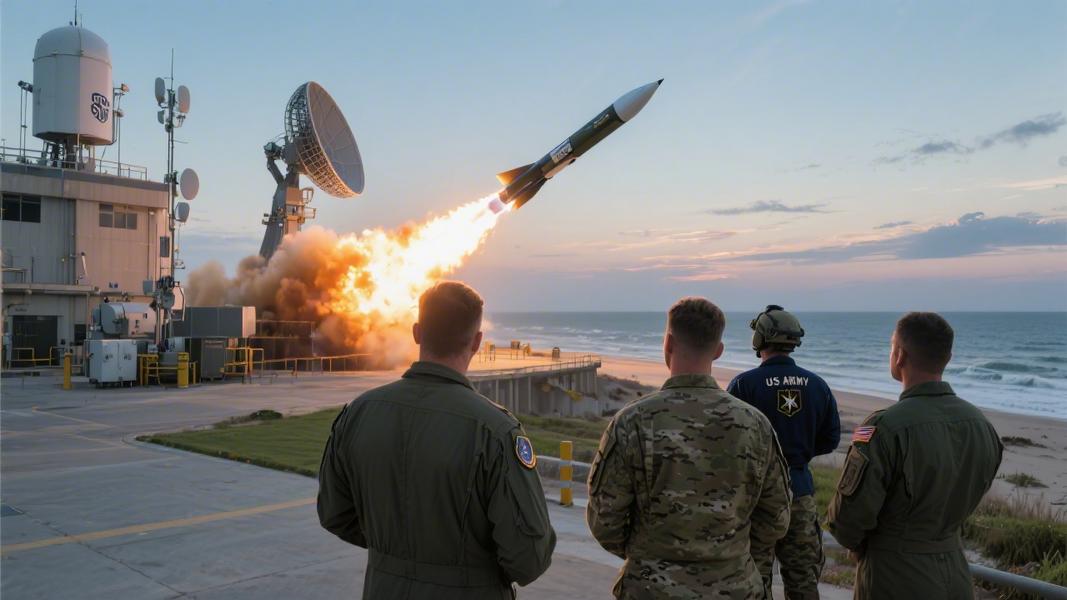
America’s hypersonic ambitions just cleared another major hurdle — and this time, the Army and Navy did it together.
On March 26, 2026, the U.S. Army’s Portfolio Acquisition Executive Fires and the U.S. Navy’s Portfolio Acquisition Executive Strategic Systems Programs jointly launched a common hypersonic missile from Cape Canaveral Space Force Station in Florida, marking a significant milestone in the Pentagon’s push to field next-generation strike weapons across multiple platforms. The test wasn’t just a technical achievement — it was a statement about where American military doctrine is heading, and fast.
A Shared Weapon for a Two-Service Strategy
The logic behind the Army-Navy partnership is straightforward, even if the engineering behind it isn’t. By developing a common hypersonic glide body — the same core weapon adapted for both land- and sea-based platforms — the Pentagon aims to accelerate timelines, cut costs, and deliver a credible strike capability against time-sensitive, heavily defended targets. We’re talking speeds exceeding Mach 5 — fast enough that traditional air defenses struggle to respond.
For the Army, that weapon is called Dark Eagle, formally known as the Long-Range Hypersonic Weapon, or LRHW. For the Navy, it’s the Conventional Prompt Strike program. Different names, different launchers — but the same hypersonic glide body at the heart of both. It’s a rare instance of genuine interservice hardware convergence, and the March test suggests it’s actually working.
Years in the Making — With Some Stumbles Along the Way
Dark Eagle didn’t get here easily. The program suffered a string of prior test failures that pushed deployment timelines back and drew scrutiny from defense analysts watching China and Russia race ahead in hypersonic development. But two successful end-to-end flight tests — first from Kauai, Hawaii in June 2024, then from Cape Canaveral in December 2024 — helped restore confidence in the program.
That December 2024 test was particularly notable. It was the first live-fire conducted using the Battery Operations Center and Transporter Erector Launcher — the actual field hardware soldiers would use — rather than a controlled laboratory configuration. In other words, the Army wasn’t just testing the missile. It was testing the whole system, paired with the Navy’s 34.5-inch booster, designed for targets at ranges exceeding 1,725 miles.
From Test Range to the Field
So when does this actually become operational? Fielding activities for Dark Eagle began in December 2025 and were expected to wrap in early 2026. Pentagon officials weren’t shy about explaining what that process involves. “Fielding activities include the required integration, safety, and readiness steps to ensure soldiers receive a system that is reliable, sustainable, and effective in operational environments and are on track for completion in early 2026,” the Army confirmed earlier this year.
That’s bureaucratic language for a very real transition: taking a weapon that works on a test range and making sure it works in the hands of actual soldiers, under real-world conditions. It’s the part of weapons development that rarely makes headlines — and often determines whether a program ultimately succeeds or quietly fades.
Boots on the Ground, Hypersonics in the Mix
Even before formal fielding completed, the Army was already integrating Dark Eagle into exercises. During the Resolute Hunter 24-2 field exercise at Naval Air Station Fallon, Nevada — held June 25 through 27 — long-range hypersonic weapon batteries were embedded alongside conventional forces, giving commanders a chance to work through the operational and logistical realities of deploying a weapon that, until recently, existed mostly on paper and in PowerPoint briefings.
Still, the exercise underscored a broader shift in Army thinking — one that sees hypersonic weapons not as exotic curiosities but as practical tools for the modern battlespace, particularly in theaters like the Pacific where distances are vast and windows of opportunity narrow.
What Comes Next
The March 2026 joint launch from Cape Canaveral wasn’t the end of the testing campaign. Observers tracking launches from the Florida coast noted what appeared to be additional Dark Eagle activity, suggesting the services are pressing ahead with a sustained evaluation program rather than a one-and-done demonstration. And the Missile Defense Advocacy Alliance had previously flagged the Army’s intention to keep testing at pace — a cadence that reflects both urgency and hard lessons learned from earlier setbacks.
The broader context here matters. The National Defense Strategy explicitly calls for accelerating the delivery of capabilities against heavily defended, time-sensitive targets — the kind of targets that, in a potential conflict with a near-peer adversary, might exist for only minutes before they move or go underground. A weapon traveling at hypersonic speeds doesn’t give defenders much time to think.
That’s precisely the point. And if the testing record over the past year is any indication, the Pentagon is getting a lot closer to making it a reality.
