
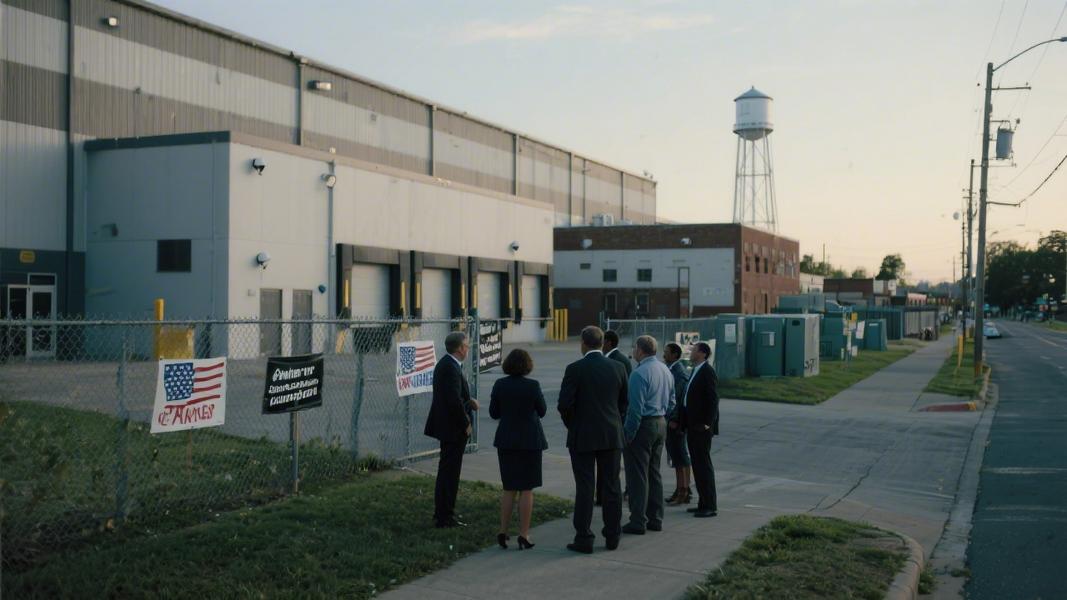
The federal government’s ambitious — and expensive — plan to warehouse immigrants across the country is hitting the brakes, at least temporarily. The Department of Homeland Security has paused new warehouse purchases for immigrant detention as its new secretary takes a hard look at the deals his predecessor left behind.
The pause comes after Markwayne Mullin was sworn in as Homeland Security Secretary on April 1, 2026, inheriting a sprawling detention expansion initiative that critics and some local governments have already begun pushing back against. As reported, DHS is now scrutinizing every contract signed under former Secretary Kristi Noem before committing to any further real estate purchases.
A $38 Billion Blueprint Under the Microscope
The scale of what Mullin walked into is staggering. He inherited a $38.3 billion plan to expand detention capacity to 92,000 beds — built around eight massive detention centers capable of housing between 7,000 and 10,000 detainees each, plus 16 smaller regional processing centers scattered across the country. It’s the kind of infrastructure overhaul that takes years to execute and, apparently, not much longer to complicate.
So far, 11 warehouses have been purchased across eight states — Arizona, Georgia, Maryland, Michigan, New Jersey, Pennsylvania, Texas, and Utah — at a combined cost of $1.074 billion. That’s not nothing. And it’s already generating legal headaches: lawsuits are pending in three of those states, with local communities and advocates challenging the federal government’s rapid land grabs.
Not Everyone Was Selling
Here’s a detail that doesn’t get enough attention: eight warehouse deals simply fell apart because property owners decided they didn’t want to sell. That includes sites in Kansas City, Missouri. No lawsuit, no protest — just a hard no from the seller. In a multibillion-dollar federal initiative, that’s a quietly remarkable speed bump.
The plans that did move forward aren’t all playing out as originally envisioned, either. In the Phoenix suburb of Surprise, Arizona, a warehouse that was supposed to serve as a 1,500-bed processing site has been significantly scaled back. Surprise Mayor Kevin Sarter announced Monday that DHS now plans to cap occupied beds at just 542 — less than a third of the original projection. It’s the kind of revision that suggests the on-the-ground reality of these facilities is messier than the blueprint ever anticipated.
Mullin’s Softer Pitch
Mullin, for his part, is striking a notably different tone than his predecessor. “We’ve got to protect the homeland and we’re going to do that,” he said. “But obviously we want to work with community leaders.” That’s a far cry from the blunt, go-it-alone posture that defined much of the Noem era’s rollout.
Part of that shift is practical. Mullin has been candid about a basic logistical problem: most municipalities simply don’t have the water and waste infrastructure to support a facility housing thousands of detainees. “It’s important that we’re talking to the communities,” he noted, “and if we’re having additional needs, we can work with the cities.” Sounds reasonable. Whether city leaders who’ve already lawyered up will see it that way is another question entirely.
What Comes Next
The pause on new purchases doesn’t mean the broader detention expansion is dead — far from it. The administration has made clear that increasing detention capacity remains a core priority. But the contract review signals, at minimum, that someone at DHS is asking whether the Noem-era deals were structured wisely, priced fairly, and legally defensible. Given the lawsuits already in motion, those aren’t idle questions.
Still, billions have already been spent, warehouses have already been purchased, and communities across the country are already dealing with the consequences of decisions made at speed in Washington. A pause and a review can recalibrate direction — but they can’t undo a billion dollars of real estate transactions already on the books.
The real test for Mullin won’t be whether he can slow things down. It’s whether he can actually build something that works — and that communities, courts, and Congress will ultimately allow to stand.
