
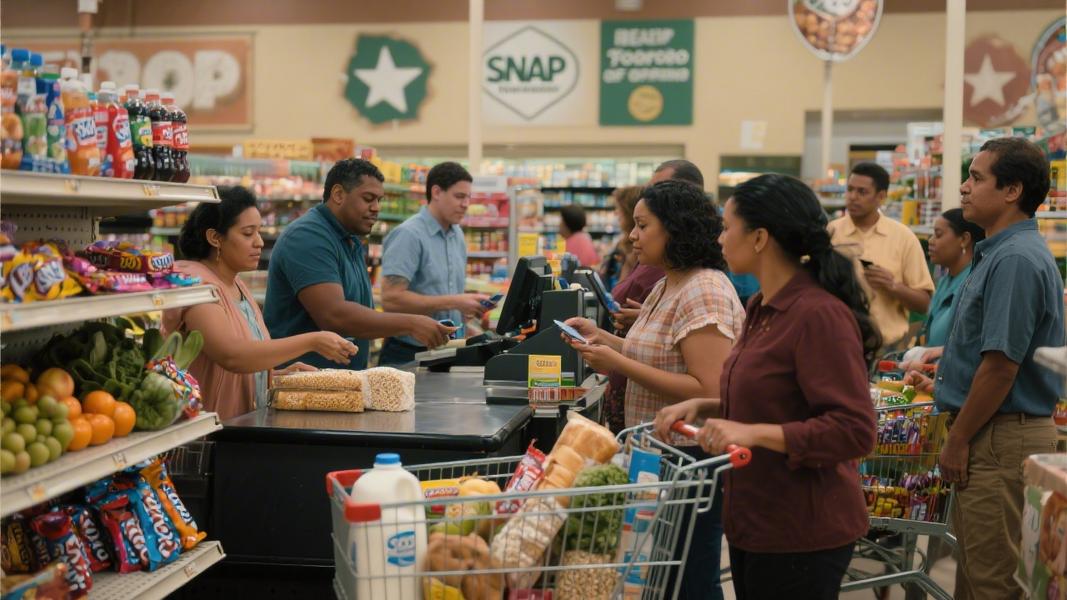
Millions of Texans on food assistance woke up Wednesday to a new reality at the checkout line — one where reaching for a Snickers bar or a two-liter of Coke could mean paying out of pocket.
Starting April 1, 2026, new restrictions on the Supplemental Nutrition Assistance Program took effect across Texas, barring recipients from using their benefits to purchase candy and a broad category of sweetened beverages. The changes, backed by state law and a federal waiver, represent one of the most sweeping overhauls to SNAP purchasing rules in the state’s history — and they affect roughly 3.5 million Texans.
What’s Off the Table
The rules are fairly specific, if not exhaustive. Under the new guidelines, SNAP recipients can no longer buy sodas, sweetened drinks containing five grams or more of added sugar, beverages with artificial sweeteners, or candy — including chocolate bars and chewing gum. What’s still covered? The staples: fruits, vegetables, meat, dairy, bread, and cereal. The core of what most people would call a grocery run remains intact, at least for now.
The policy traces back to Senate Bill 379, passed during Texas’s 89th Legislative Session in 2025 and authored by State Sen. Mayes Middleton, a Republican from Galveston. The bill directed the state to seek a federal waiver from the USDA — which it got — to impose the restrictions on what’s considered low-nutritional-value food and drink. The legislation set a hard deadline: April 1, 2026.
Abbott’s Pitch, and the Politics Behind It
Gov. Greg Abbott has been vocal about the move, framing it squarely as a fiscal and public health argument. “The new SNAP guidelines will ensure taxpayer dollars are used to purchase foods that provide real nutritional value,” Abbott said in a statement last year. “By restricting unhealthy foods from being purchased with SNAP benefits, Texas can help ensure the health and well-being of Texans.”
The Texas Health and Human Services Commission echoed that sentiment. Executive Commissioner Stephanie Muth thanked Abbott and the legislature, saying the changes “will lead to healthier food choices and support the development of healthy eating habits that last a lifetime,” according to a press release from HHSC. Grocery chains like H-E-B reportedly prepared their teams ahead of the rollout to handle the product eligibility changes at point of sale.
A Bridge, Not a Punishment
Not everyone sees it quite so cleanly. Advocacy groups have been careful in how they’ve responded — supportive of nutrition in principle, but sharply focused on making sure recipients aren’t left confused or blindsided at the register.
Celia Cole, chief executive officer of Feeding Texas, put it plainly. “SNAP is an essential resource that helps families across Texas put food on the table and maintain good health,” she said. “SNAP acts as a bridge to stability during periods when household income can’t keep up with rising living expenses. For the 3.5 million children, seniors, veterans and working families served by SNAP, clear information about these new purchase restrictions is important so households can make informed decisions at the grocery store.”
That word — bridge — does a lot of work. Cole isn’t pushing back on the restrictions outright, but she’s drawing a careful line: whatever the policy intent, the people most affected are often one paycheck away from not eating at all. Confusion at checkout isn’t just an inconvenience for this population. It’s a real problem.
Measuring What Happens Next
Here’s something worth watching. Under Senate Bill 379, the state is required to survey SNAP recipients both before and after the April 1 implementation date to assess whether the restrictions are actually nudging people toward healthier choices. That data, once collected, could shape how other states — and the federal government — think about similar proposals. Texas isn’t the first to try this, but it’s now among the largest states to actually pull it off.
Whether the surveys will capture the full picture is another question. Behavioral change is notoriously hard to measure, and a recipient who can’t buy a soda with SNAP doesn’t necessarily stop buying soda — they might just pay cash. Still, the mandate for data collection is a more rigorous accountability mechanism than many such policy rollouts tend to include.
Ultimately, what Texas is testing isn’t just a nutrition policy. It’s a theory about how government benefits should work — and who gets to decide what “healthy” means for families already navigating a system that wasn’t built with much margin for error.
