
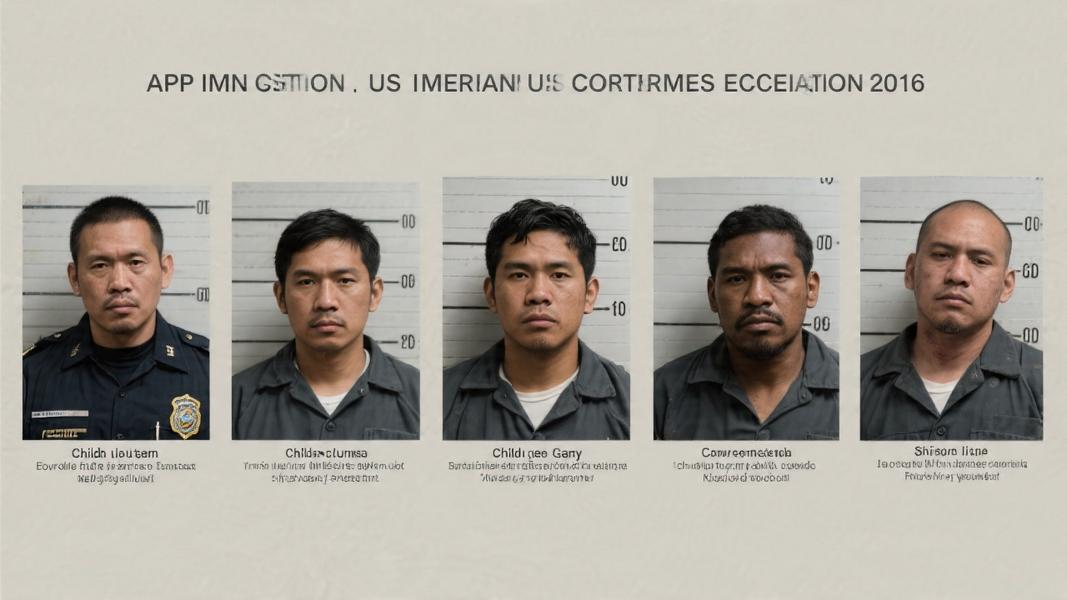
Federal immigration agents fanned out across the country on April 16, arresting a group of undocumented immigrants convicted of serious crimes — and the Department of Homeland Security didn’t waste a moment making sure everyone heard about it.
The sweep, announced by DHS on April 17, 2026, targeted individuals with prior convictions ranging from child cruelty and kidnapping to armed robbery and domestic battery. Acting Assistant Secretary Lauren Bis framed the operation in stark terms, saying, “Just yesterday, ICE arrested criminal illegal aliens across the country convicted for despicable crimes, including a Fullerton Tokers Town gang member. Every day, DHS law enforcement is risking their lives to protect American communities. Nearly 70% of ICE arrests are of illegal aliens charged or convicted of a crime in the U.S. We will not sit and allow criminals to terrorize American citizens.”
Among those taken into custody: Dara Nin, a Cambodian national living in Long Beach, California, convicted of child cruelty with possible injury or death. Fabricio Ruiz-Higareda, a Mexican national from Fullerton, California, identified as a member of the Fullerton Tokers Town gang and convicted of battery against a spouse. Debaba Raymond Alimasi, from the Democratic Republic of the Congo, convicted of kidnapping in Ada County, Idaho. And Manuel Ordonez-Chitic, a Guatemalan national arrested in Kennett Square, Pennsylvania, carrying a robbery conviction involving the threat of imminent bodily harm.
Texas and other states weren’t spared either. Kelbin Edgardo Castillo-Aguilera, a Honduran national, was arrested in Dallas County on an aggravated robbery conviction. Five countries, five states, five men — all with records that made for easy, damning headlines.
The Bigger Picture — And the Catch
That’s the catch, though. The administration’s framing leans hard on the word “criminal,” but the broader data on who’s actually sitting in ICE detention tells a more complicated story. As of April 4, 2026, ICE was holding 60,311 people in its detention network. According to researchers tracking immigration data in real time, 70.8% of those detainees have no criminal conviction at all.
A separate analysis from the Cato Institute found that only 5% of ICE detainees have violent convictions, while 73% have no convictions whatsoever. So when officials point to the 70% arrest figure as evidence of focused enforcement, critics note it doesn’t square with who’s actually being held.
Still, the administration’s supporters would argue that arrests and detention populations are two different metrics — and they’d be right, technically. ICE does prioritize criminal cases for arrest. But the detention system casts a far wider net once those enforcement operations are underway.
A System Under Scrutiny
How bad is it inside that system? Troubling, by several accounts. A Senate report documented at least 41 credible reports of physical and sexual abuse of individuals held in U.S. immigration detention. That report, authored by Sen. Jon Ossoff’s office, raised alarm about conditions that advocates have long described as deteriorating.
And it’s not only detainees raising red flags. The Associated Press documented that at least two dozen ICE employees and contractors have been charged with crimes since 2020, including physical abuse, sexual misconduct, and corruption — a reminder that accountability gaps run in multiple directions inside an enforcement agency operating at unprecedented scale.
The American Immigration Council has described the ICE detention system under the current Trump administration as having grown larger, more abusive, and more opaque — a characterization the administration flatly rejects, pointing instead to operations like Thursday’s sweep as proof of a system working exactly as intended.
The Tension Isn’t Going Away
Nobody disputes that the men arrested on April 16 had serious criminal records. Child cruelty. Kidnapping. Armed robbery. Those aren’t technicalities — they’re the kinds of cases that are genuinely hard to argue against, and the administration knows it. That’s why they lead with them.
But the gap between the headline arrests and the full scope of who ends up detained — and under what conditions — is where the real policy debate lives. It’s a debate that’s unlikely to get quieter as detention numbers climb and oversight mechanisms remain under pressure.
In the meantime, DHS will keep announcing sweeps, advocates will keep citing the data, and somewhere in the middle, the truth about what this enforcement machine actually looks like — and who it actually catches — will keep being contested, one press release at a time.
