
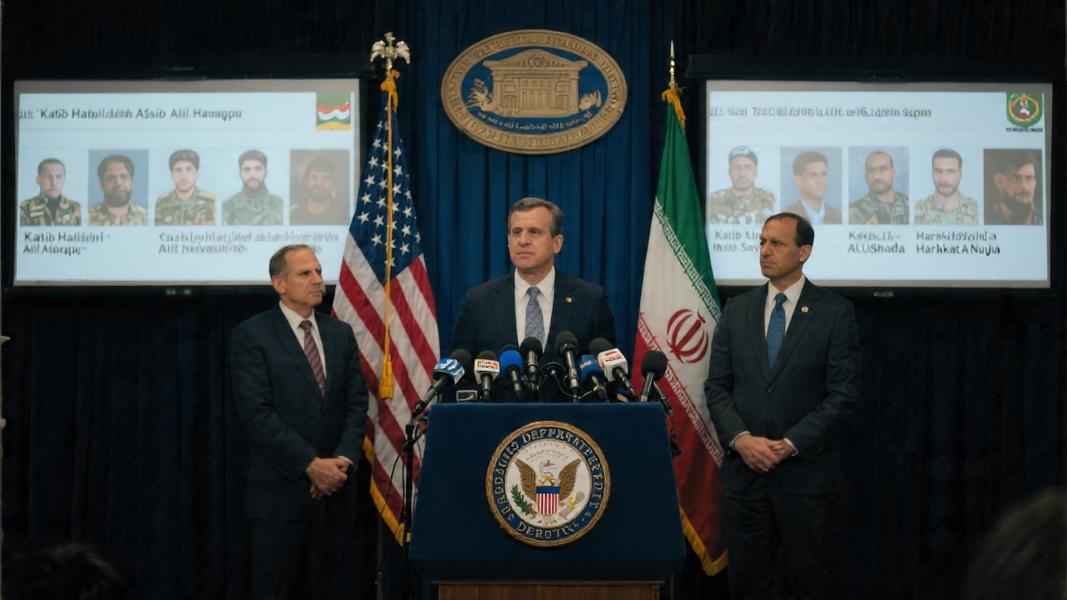
The United States isn’t waiting for the next attack. Washington is going after the money.
In a sweeping escalation of financial pressure against Iran and its regional proxies, the U.S. Treasury Department announced a wave of sanctions targeting Iranian oil smuggling networks and Iraqi militia commanders responsible for attacks on American personnel — a campaign now operating under the pointed label “Operation Economic Fury.” The move signals a deliberate strategic pivot: instead of missiles, the administration is deploying asset freezes, blacklists, and economic strangulation.
Militia Commanders in the Crosshairs
The Treasury’s Office of Foreign Assets Control designated seven Iraqi militia commanders drawn from four Iran-backed groups: Kata’ib Hizballah, Kata’ib Sayyid Al-Shuhada, Harakat Al-Nujaba, and Asa’ib Ahl Al-Haqq. Each has been implicated in attacks targeting U.S. forces and American interests in the region.
Kata’ib Hizballah isn’t new to this list. The group has been claiming responsibility for attacks in Iraq since its founding in 2006, operating with consistent financial and military backing from Tehran. Asa’ib Ahl Al-Haqq has a similarly grim résumé — thousands of documented attacks against U.S. and Coalition forces over nearly two decades. And as recently as March 2026, the group was reported to have used Iranian-supplied drones to strike U.S. and Coalition positions in northern Iraq. These aren’t dormant threats.
Secretary of the Treasury Scott Bessent made the administration’s posture unmistakably clear. “We will not allow Iraq’s terrorist militias, backed by Iran, to threaten American lives or interests,” he said. “Those who enable these militias’ violence will be held accountable.” Short sentences. Blunt message. Intentional.
Following the Oil Money
But militia commanders are only part of the story. The broader Economic Fury operation also took aim at a sprawling illicit oil-shipping network tied to Mohammad Hossein Shamkhani, described by officials as an Iranian oil shipping magnate with deep connections to the regime. OFAC sanctioned more than two dozen individuals, companies, and vessels operating within his network — the kind of layered financial architecture that keeps Iranian crude moving despite years of export restrictions.
Bessent didn’t mince words there either. “Treasury is moving aggressively with Economic Fury by targeting regime elites like the Shamkhani family that attempt to profit at the expense of the Iranian people,” he said. It’s a framing worth noting — casting the sanctions not just as a national security tool, but as a form of accountability to ordinary Iranians squeezed by their own government’s corruption.
A Thousand Designations and Counting
How big has this campaign actually gotten? Bigger than most people realize. Since the issuance of National Security Presidential Memorandum-2 — which set the legal and strategic framework for maximum economic pressure on Iran — OFAC has sanctioned over 1,000 persons, vessels, and aircraft. That’s not a targeted strike. That’s a systematic effort to map and dismantle Iran’s financial infrastructure, piece by piece.
Still, the question hanging over all of it is whether economic warfare can actually change behavior in Tehran. Sanctions have been a fixture of U.S. Iran policy for decades, and the Islamic Republic has proven remarkably resilient — or at least remarkably adaptive — at finding workarounds. Shadow fleets. Front companies. Cryptocurrency. The Shamkhani network itself is a testament to how sophisticated these evasion mechanisms have become.
That said, the sheer scale of the current campaign does represent something qualitatively different. Operation Economic Fury isn’t just a sanctions list — it’s a declared doctrine, complete with a name and a narrative. The administration appears to be betting that financial pressure, applied broadly and relentlessly, can accomplish what military engagement cannot: force a reckoning without firing a shot.
The Stakes Beneath the Surface
There’s a harder edge to all this, too. The militia commanders sanctioned on April 17, 2026 aren’t abstractions. They represent a network of armed groups that have killed and wounded American service members over the past several years — attacks that have repeatedly tested the patience of successive administrations. Designating their leaders is partly punitive, partly symbolic. Whether it degrades their operational capacity is a different question entirely.
What’s clear is that the U.S. has made a deliberate choice — at least for now — to pursue this fight through financial channels rather than kinetic ones. It’s a restrained posture dressed in aggressive language, and the tension between those two things is precisely what makes it worth watching.
In Washington’s new calculus, the most powerful weapon against Iran might not be a missile. It might be a wire transfer that never clears.
