
The White House wants America to stop, open a Bible, and pray — and it’s making that request official.
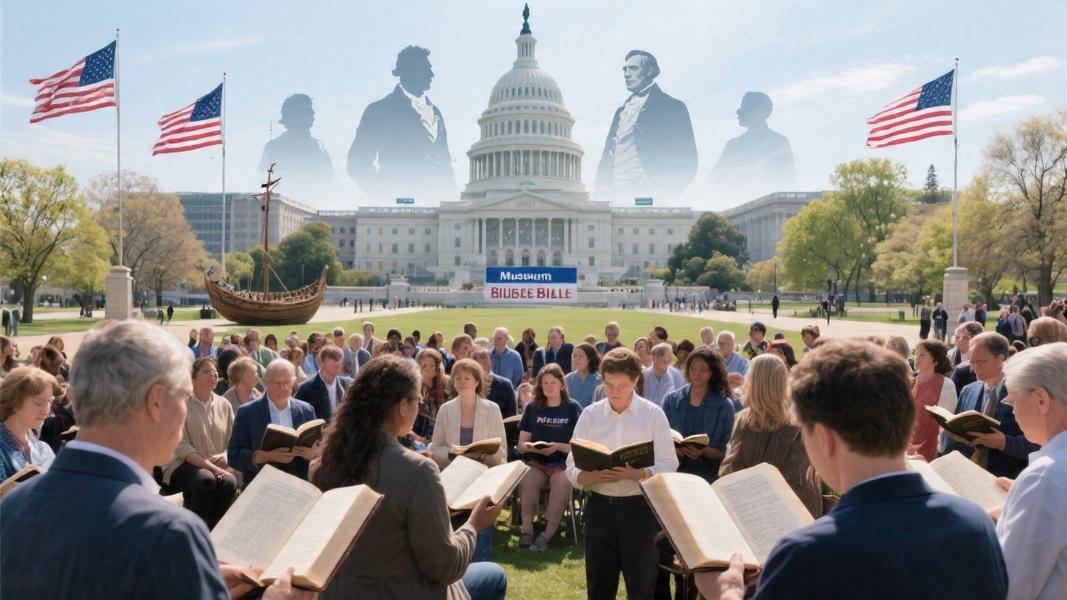
In a sweeping Presidential Message issued April 17, 2026, the Trump administration marked 250 years of the Bible in America with a pair of interlocking initiatives — America Reads the Bible and America Prays — that together represent one of the most explicitly faith-forward gestures from a sitting president in modern memory. Nearly 500 Americans will read the entire Bible aloud and publicly over the course of one week at the Museum of the Bible in Washington, D.C., and at sites across the country. The effort is timed to the nation’s approaching 250th birthday and is backed by an unusual coalition of evangelical ministries, Catholic prayer apps, and humanitarian organizations.
Whether you see it as a genuine spiritual revival or a savvy cultural signal, there’s no question the administration is leaning in hard.
A Nation’s Founding Text, Revisited
The presidential message itself reads less like a policy document and more like a sermon — a deliberate one. It opens with John Winthrop, the Puritan governor who, nearly 400 years ago and a decade after the Mayflower landed, invoked Jesus Christ’s Sermon on the Mount to describe the settlers’ mission: “We must consider that we shall be as a city upon a hill. The eyes of all people are upon us.” From there, it traces a direct line through the founding era, arguing that Scripture didn’t just inspire the founders — it shaped the architecture of American self-governance.
The Declaration of Independence, stated the message, echoed Holy Scripture in its most famous passage: “We hold these truths to be self-evident, that all men are created equal, that they are endowed by their Creator with certain unalienable Rights, that among these are Life, Liberty and the pursuit of Happiness.” The 1787 Northwest Ordinance gets a mention too — its assertion that “Religion, morality, and knowledge, being necessary to good government and the happiness of mankind, schools and the means of education shall forever be encouraged” — a quote that lands differently in 2026 than it might have a decade ago.
The parade of founding-era endorsements doesn’t stop there. John Adams wrote to Benjamin Rush that “the Bible contains the most profound Philosophy, the most perfect Morality, and the most refined Policy, that ever was conceived upon Earth.” George Washington placed his left hand on the Bible at his first inauguration, kissed it afterward, and told the assembled crowd that “no people can be bound to acknowledge and adore the Invisible Hand which conducts the affairs of men more than those of the United States.” Heavy stuff, even by 18th-century standards.
Lincoln, Roosevelt, Reagan — and Now Trump
History, the message argues, keeps returning to this well. Abraham Lincoln‘s Second Inaugural Address — delivered as the Civil War was grinding toward its end — quoted the Bible four times, mentioned God fourteen times, and invoked prayer three times. Franklin D. Roosevelt went on national radio the morning of D-Day and prayed aloud for God’s blessing over American troops as more than 70,000 men prepared to storm the beaches of Normandy against what he called “unholy forces.” And Ronald Reagan proclaimed 1983 the Year of the Bible, declaring that “of the many influences that have shaped the United States of America into a distinctive Nation and people, none may be said to be more fundamental and enduring than the Bible.”
The current administration is clearly comfortable in that lineage. According to the White House, President Trump has invited America’s religious communities to pray for the nation as it approaches its semiquincentennial. In his own words: “From the beginning, this has always been a country sustained and strengthened by prayer. So important, if we bring religion back stronger, you’re going to see everything get better and better and better.” It’s a vintage Trump construction — the repetition, the confidence, the promise of improvement — grafted onto a theological frame.
A Movement With Infrastructure
This isn’t just rhetoric. The America Prays initiative launched formally at the Museum of the Bible and calls Americans to pray weekly for the country. Its partners include Samaritan’s Purse, the prayer apps Pray.com and Hallow, the National Religious Broadcasters, the Faith and Freedom Coalition, and dozens of churches and ministries across the country. That’s a real organizational footprint — the kind that can move people and, arguably, votes.
Still, the policy substance is real too. The Trump White House has established a White House Faith Office — described as the first such office physically located in the West Wing — dedicated to advancing faith-based priorities across the federal government. A separate Task Force to Eradicate Anti-Christian Bias has also been stood up, a move that drew strong support from evangelical communities and sharp criticism from civil liberties advocates. The president has also pardoned Christians and pro-life activists who were prosecuted for praying outside abortion clinics, and directed federal agencies to protect religious expression in the workplace.
That’s a lot of institutional machinery for what the White House frames as a spiritual moment.
Saints, Scripture, and the Long Game
The faith-forward posture isn’t limited to big anniversaries. In March, the White House released a presidential message on the Feast of Saint Joseph, honoring him as “the earthly father of Jesus Christ and one of the most revered figures in the Bible” — a gesture directed explicitly at Catholic Americans, a constituency the administration has worked carefully to court. It’s a reminder that this isn’t a single-event push. It’s a sustained, layered effort to position faith — and specifically Christianity — as central to the American story the administration wants to tell heading into the nation’s 250th year.
Washington himself might have approved of the framing. In his Farewell Address, the first president warned that “of all the dispositions and habits which lead to political prosperity, religion and morality are indispensable supports,” adding that anyone who tried to undermine those pillars couldn’t honestly call himself a patriot. The current White House has that quote on its website. It’s not subtle about where it thinks the line is drawn.
As the country prepares to blow out 250 candles, the question the administration is quietly — and not so quietly — posing is whether America’s next chapter gets written with a Bible in hand. For roughly half the country, that sounds like a promise. For the other half, it sounds like a warning. Either way, they’re paying attention — which, as Winthrop himself might have noted, was always rather the point.
