
Drones over prison yards. Officers on the payroll. A contraband pipeline stretching across state lines. America’s correctional system is facing a crisis it can no longer quietly contain.
From Texas to Idaho to Pennsylvania, a wave of arrests in late 2025 and early 2026 has exposed the alarming depth of smuggling networks operating in and around the country’s prisons and jails — many of them run not despite corrections staff, but because of them. The pattern is consistent: drugs, cellphones, and cash moving through facilities with inside help. What’s changed is the scale, the sophistication, and the willingness of prosecutors to go after the people sworn to keep those walls secure.
Texas Sting Grounds a Drone-Fueled Contraband Ring
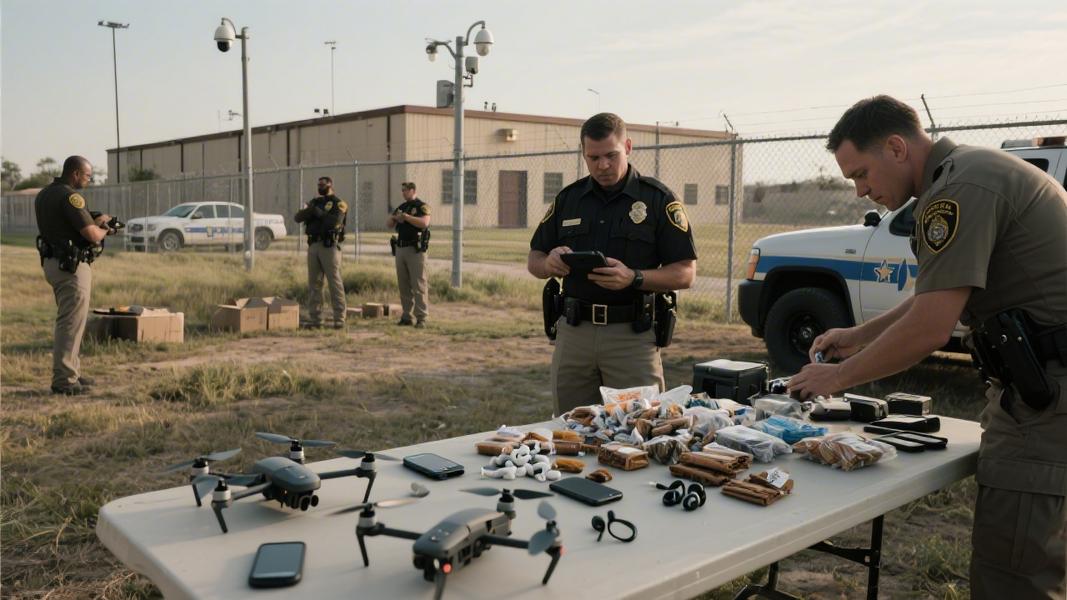
The most dramatic bust came in January 2026, when a sweeping sting operation at the Mark W. Michael Unit in Tennessee Colony, Texas, led to the arrest of seven civilians — including two former correctional officers. Investigators seized more than 100 cellphones, methamphetamines, synthetic cannabinoids, and an assortment of other narcotics. The delivery method? Drones, flying contraband directly over fences and into the hands of inmates.
Three of the seven arrested have ties to North Texas. Alyson Wells of Plano and John Pina of Krum were among those taken into custody, along with Mari Cazares of Dallas — a former officer with the Texas Department of Criminal Justice. When investigators searched Cazares’ apartment, what they found painted a vivid picture of the operation’s scope: 30 pounds of loose tobacco, four new cellphones, receipts for dozens more, Bluetooth earbuds, 50 inmate-style property bags, and white clothing associated with smuggling.
That’s not a side hustle. That’s a business.
The other four arrested were Dalen Bright of Webster, Amber Smith of Missouri City, Joshua Rider of Houston, and former TDCJ officer Janet Gutherie of DeKalb. TDCJ Executive Director Bobby Lumpkin didn’t mince words in the aftermath, saying, “This operation underscores both the risks posed by contraband and the strength of our response. We will remain relentless in our fight to stop illegal narcotics from entering and harming those in our facilities.” Prosecutors echoed the sentiment, warning that “if you try to smuggle contraband into TDCJ correctional facilities, you will be caught, and you will be held accountable.”
A National Problem With Local Faces
Texas isn’t alone. Not even close. In Idaho, seven people — including correctional officers — were hit with federal charges for allegedly conspiring in a drug and contraband smuggling scheme spanning multiple state prisons. In Florida, eight people including corrections officers were indicted for running a jail smuggling ring — drugs, cellphones, bribes — allegedly organized from the inside by an inmate named Ernest Grimaldi, who apparently had no shortage of willing accomplices on the outside of the bars.
Still, it’d be a mistake to frame this purely as a smuggling story. The corruption inside some facilities goes well beyond drugs and phones. At Lackawanna County Prison in Pennsylvania, seven current and former corrections officers were arrested on charges of sexually abusing or assaulting female inmates — a gut-punch reminder that the abuse of institutional power can take many forms, and that the most vulnerable people in custody are often the least protected. The allegations sent shockwaves through the region and renewed calls for independent oversight of county jails.
When the Guards Become the Threat
How bad does it have to get before it registers as a systemic failure? Consider the case of Christopher Castro, a handcuffed inmate beaten by seven corrections officers — one of whom, a lieutenant, now faces charges of tampering with evidence. “This was done by the people that were supposed to be protecting him,” a source close to the case said. It’s a line that lands differently when you consider how rarely cases like this result in charges at all.
Meanwhile, in California, a multi-agency operation on February 12, 2026, resulted in the arrest of 15 targets and the apprehension of seven supervised persons at-large. Agents also recovered eight weapons and ammunition during what authorities called Operation Salinas Iron Key — a sign that parole enforcement and prison security are increasingly tangled in the same web of criminal networks that don’t stop operating just because someone gets released.
The Bigger Picture
What connects all of these cases isn’t geography or method — it’s access. Prisons are only as secure as the people who work in them. When officers become participants in the very criminal enterprises they’re supposed to suppress, the entire premise of incarceration starts to unravel. And the evidence increasingly suggests that this isn’t a matter of a few bad apples. It’s structural. Underpaid staff. Understaffed facilities. Limited oversight. It creates conditions where corruption doesn’t just happen — it finds fertile ground.
Prosecutions like these are necessary. But they’re also, in a sense, the easy part. Arresting individuals is one thing. Reckoning with why so many of them ended up on the wrong side of the law in the first place — that’s the harder conversation nobody seems eager to have.
As Lumpkin put it, the fight will be “relentless.” Whether the system backing that fight is up to the task remains, for now, an open question.
