
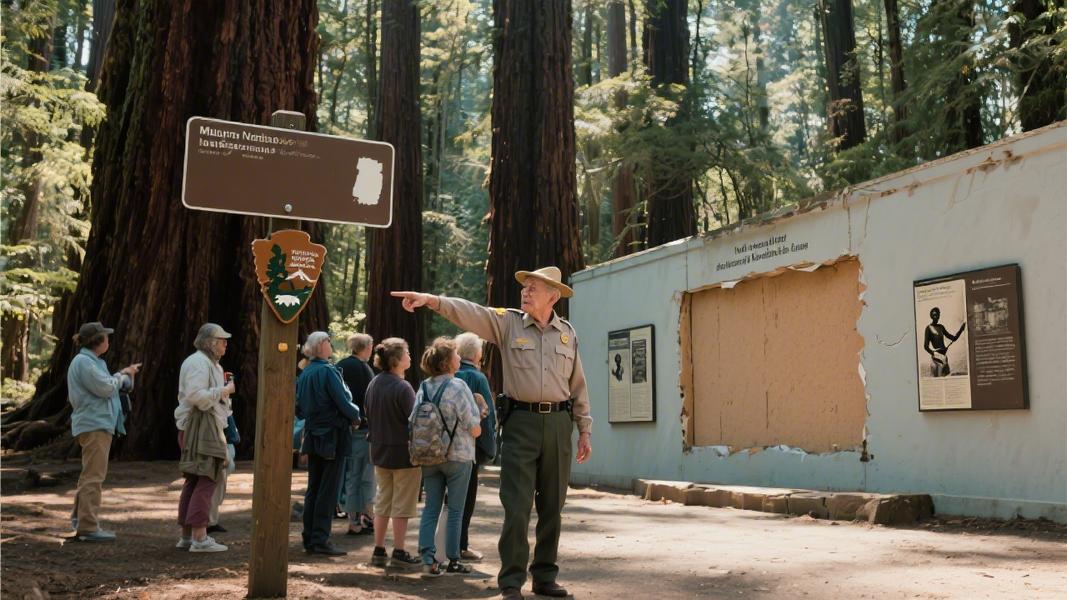
The signs are coming down. Quietly, systematically, and in some cases under direct order from the White House, interpretive panels at some of America’s most iconic national parks are disappearing — taking with them stories that took generations to tell.
At the heart of it is a 2025 executive order signed by President Donald Trump titled “Restoring Truth and Sanity to American History,” which directs the National Park Service to strip out displays the administration characterizes as promoting “divisive narratives” and “corrosive ideology.” The practical result, critics say, is something far blunter: the erasure of inconvenient history and established science from the public lands that belong to every American. The removals span parks from Arizona to Montana, and the full scope of what’s been flagged — or quietly pulled — is only now coming into focus.
What’s Actually Being Removed
The list of affected sites reads like a tour of American heritage. At Muir Woods National Monument in California, signs explaining climate change’s measurable impact on coastal redwoods were taken down. So were panels honoring the historical contributions of women and Native Americans to the region. At Independence National Historical Park in Philadelphia — the symbolic birthplace of American democracy — a sign about Ona Judge, an enslaved woman who escaped from George Washington’s household, was removed. A federal judge ordered it restored on February 16, 2026. And at Fort Smith National Historic Site in Arkansas, a map was updated to replace “Gulf of Mexico” with “Gulf of America,” in line with a separate Trump directive.
In Utah alone, 37 interpretive panels and materials were flagged for potential removal, including signs at Zion National Park addressing climate change, wildfires, and flash floods — natural phenomena that, it should be noted, are already happening in those very landscapes. The flagging covers parks in at least six states: Arizona, Texas, Colorado, Utah, Montana, and Wyoming.
“Disappointing, and Embarrassing”
Retired U.S. Park Ranger Lucy Scott, who spent years walking visitors through Muir Woods, didn’t mince words when speaking to CBS News. “The fact that they’re taking down whole groups of signs about climate change and our nation’s history is disappointing, and embarrassing,” she said. It’s the kind of quote that lands harder coming from someone who built a career helping the public understand these places — not a partisan operative, just a ranger who knows what those signs were for.
The National Parks Conservation Association has been louder still. The nonprofit, which has filed legal action against the Department of the Interior, argues the administration isn’t just reshaping a narrative — it’s actively suppressing verified fact. “The administration is suppressing truth, facts, and science at our national parks,” the organization warned, “and that should alarm every single American.” That’s a strong statement. But given what’s been documented, it’s not an easy one to dismiss.
Inside the NPS: Confusion, Missed Deadlines, and a Dissolved Team
How bad is it behind the scenes? According to internal reporting, the National Park Service has been struggling to keep pace with its own directives. An internal spreadsheet tracking materials slated for removal or editing reportedly ballooned to over 600 entries. Deadlines were missed. A review team assembled to manage the process was subsequently dissolved, leaving individual park staff to navigate the fallout with limited guidance. Politico detailed the institutional disarray in a March 2026 report — a portrait of an agency caught between political mandate and operational reality.
That’s the catch. Even if you accept the administration’s framing that some signage crossed into advocacy, the mechanism being used to correct it is, by any measure, a blunt instrument. Climate science isn’t ideology. The story of an enslaved woman who ran for her freedom isn’t a “negative” portrayal of America — it’s America, in all its complicated, unresolved truth.
A Broader Reckoning
Jim Axelrod’s reporting for CBS News, published March 22, 2026, captured something that numbers and policy memos can’t quite convey: the quiet strangeness of walking through Muir Woods or standing at the Liberty Bell and finding the context — the hard-earned, carefully researched context — simply gone. No replacement. No alternative version. Just a blank space where a story used to be.
National parks have always been more than scenery. They’re where the country goes to reckon with itself — its grandeur, its failures, its ongoing arguments about who belongs in the story. Removing the signs doesn’t end those arguments. It just makes them harder to have. And in a country already struggling to agree on its own history, that’s not a small thing to lose.
As one legal brief from the proceedings surrounding the Fort Smith changes quietly noted: history doesn’t become more comfortable by becoming less complete. It just becomes less honest.
