
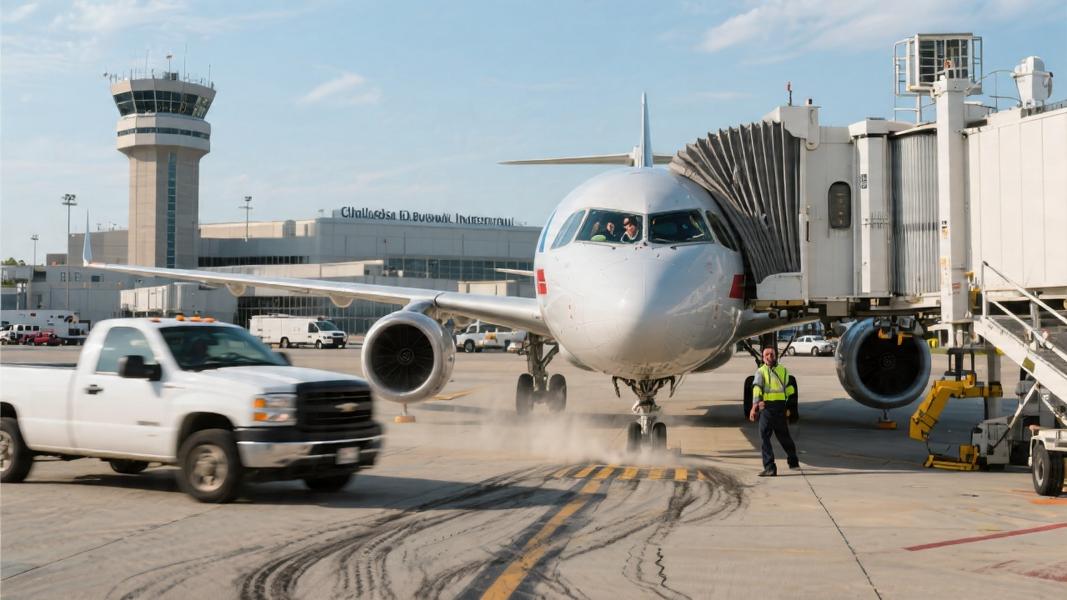
A close call on the tarmac at one of the country’s busiest airports is raising fresh questions about ground safety — and it was the pilot’s quick reflexes, not a warning system, that prevented what could have been a serious accident.
On Wednesday morning, an American Airlines Flight 1197 crew at Charlotte Douglas International Airport (CLT) had to slam on the brakes after a white-and-black operations pickup truck cut directly across the aircraft’s path while the plane was taxiing toward the runway. The flight was bound for Ronald Reagan National Airport in Washington, D.C. — and it had departed on time, which makes the chaos that followed all the more jarring.
What Happened on the Taxiway
The pilot didn’t mince words on the radio. “So, that white-black truck, they just went right in front of us, and we nearly hit them,” the captain reported over air traffic control. “I had to slam on our brakes. We had our taxi light on, and we had started moving. They need to be someone’s … got to be notified right away. That was really bad.”
FlightRadar24 data confirmed the plane was moving at no more than 15 mph at the time — slow by any standard, but still more than enough to cause catastrophic damage to a vehicle or its occupants in a collision with a commercial airliner. The aircraft had been moving from the concourse area toward the runway when the truck crossed its path without warning. Air traffic control recordings corroborate the pilot’s account.
That’s the catch with tarmac incidents — they often happen in the low-drama, procedural stretches of a flight. Not during takeoff or landing. Not in bad weather. Just a slow, routine taxi that turns dangerous in a matter of seconds.
Airlines and Airport Respond
American Airlines was quick to back its crew. “We’re proud of the professionalism of our crew and the action they took when a ground vehicle not affiliated with American Airlines entered the aircraft’s path on a taxiway,” the airline stated. The airline was careful to note that the truck did not belong to them — a detail that matters when investigators start tracing accountability.
Charlotte Douglas confirmed the vehicle was a CLT ground vehicle, meaning it was airport-operated. The airport’s statement was measured but direct: “Safety and security are top priorities at CLT. This incident is being investigated in accordance with safety standards,” officials said. The FAA is also involved in the investigation.
A Pattern Worth Watching
Is this a one-off? Probably not. A nearly identical incident unfolded recently at Los Angeles International Airport, where a Frontier Airlines flight preparing for takeoff to Atlanta had to brake hard after two trucks crossed the tarmac in front of the aircraft. The footage is startling — and uncomfortably familiar.
Still, aviation safety experts would point out that the system worked here, in the most human way possible. No automated collision avoidance technology flagged the truck. No alarm sounded in the cockpit. A pilot saw something wrong, reacted fast, and averted a disaster that most passengers on board likely never even knew was happening.
The investigation at CLT is ongoing. But the real question isn’t just what the truck was doing in the aircraft’s path — it’s why, at a major American airport in 2024, a commercial airliner and a ground vehicle can still find themselves on a collision course with nothing but a pilot’s instincts standing between routine and tragedy.
