
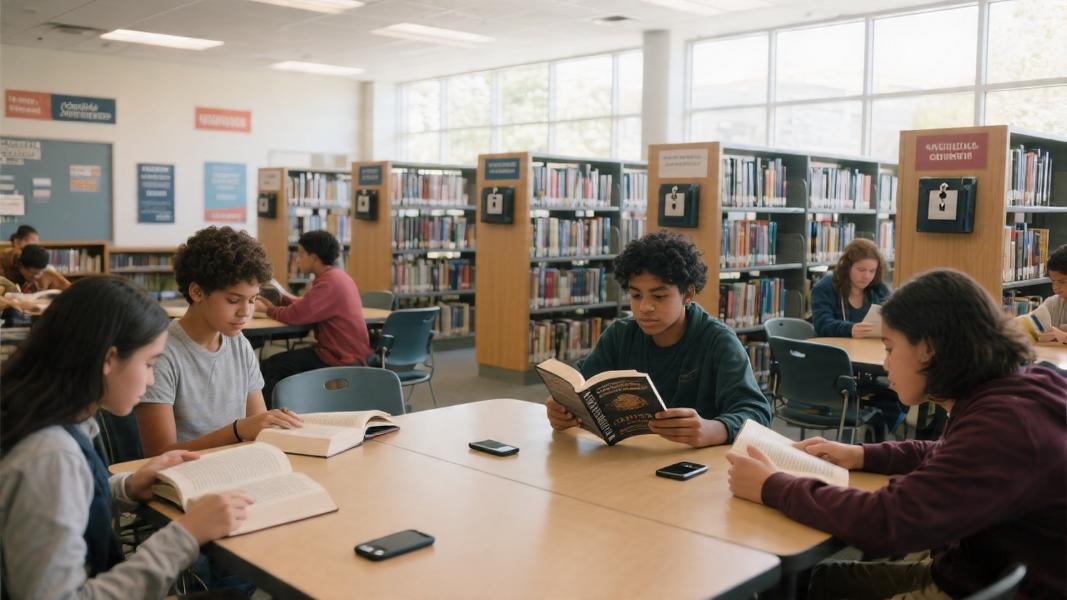
Dallas students are checking out library books at a record-breaking pace — and school officials say a statewide cellphone ban deserves much of the credit.
In a striking sign that screen-free school policies may be reshaping student habits in unexpected ways, Dallas Independent School District has reported a 24.35% surge in library circulation since the start of the 2025-2026 school year. From the first day of school through March 31, 2026, the district logged 1,084,837 total checkouts — compared to 872,430 during the same stretch the year before. That’s more than 200,000 additional books in students’ hands, and administrators are taking notice.
A Million-Book Goal — Already Within Reach
The numbers didn’t arrive overnight. In just the first quarter of the 2025-2026 school year alone, Dallas ISD recorded 356,624 book checkouts — more than 62,000 higher than the same period the previous year, the district noted. The district had set a goal of reaching one million checkouts by year’s end. At this pace, they’ve blown past it.
Librarians across the district describe a noticeable shift in the atmosphere of their buildings — more foot traffic, more browsing, more kids actually sitting down and reading. “This increase in circulation is very valuable for our kids,” one district official said. “We want students to be well-read and prepared — not just for school, but for the world.”
The Phone Ban Factor
So what changed? Texas lawmakers passed HB 1481 in 2025, a device-free school policy that restricts cellphone use during school hours across the state. It’s the kind of legislation that drew plenty of eye-rolls when it was proposed — another top-down mandate, skeptics said, that kids would find ways around. But the library numbers suggest something different is happening.
“Students are using their technology a little more responsibly,” one district librarian observed. “Without phones as a distraction, they’re discovering more about what’s on the shelves, and in their Sora e-book app.” The Sora digital platform alone accounted for 233,819 checkouts year-to-date, while physical book checkouts climbed 21% districtwide to a total of 766,548, the district reported.
Still, it’s worth asking: is the phone ban the whole story, or are schools doing something else right?
Inside Hillcrest High School’s Library Reinvention
At Hillcrest High School, the transformation has been almost hard to believe. The school went from roughly 500 book checkouts in the first nine weeks of 2024-2025 to about 1,800 during the same window this year. Student visits nearly doubled — jumping from 439 in 2024 to 864 in 2025, CBS found.
Media specialist Nina Canales didn’t just wait for students to wander in. She redesigned the library to feel less like a quiet institutional space and more like a neighborhood bookstore — creative displays, cozy seating, a browsable layout. Her instinct paid off. “I started hearing, ‘Oh, I’m so bored. I can’t get on my phone after I do my work or during lunchtime,'” she recalled. That boredom, it turns out, was an opening. “Once they lock into these stories,” she added, “they don’t seem to care about their phones at all.”
Campuses Across the District Are Seeing It Too
Hillcrest isn’t an outlier. The gains are showing up across Dallas ISD’s campus map in ways that are hard to dismiss. Walker Middle School saw an 89% increase in checkouts — climbing from roughly 3,500 books to more than 6,700. Young Women’s Leadership School posted a 42% increase, and Yvonne A. Ewell Townview Magnet Center recorded a 63% jump, according to data cited by local media. In some buildings, officials say, library use has effectively doubled.
That’s not a rounding error. That’s a cultural shift — or at least the beginning of one.
What It Might Mean Beyond Dallas
The broader implications are worth sitting with. Across the country, educators and parents have debated whether pulling phones out of classrooms would help or hurt student engagement. Dallas ISD’s library data doesn’t settle every argument — correlation isn’t causation, and other factors like library redesigns and targeted reading initiatives clearly played a role. But the numbers offer something concrete in a debate that’s often run on anecdote and anxiety.
When students aren’t scrolling, some of them are apparently reading. And in a district of hundreds of thousands of kids, that’s not nothing.
As one librarian put it, watching a student disappear into a book after spending years glued to a screen: once they lock in, the phone doesn’t stand a chance.
