
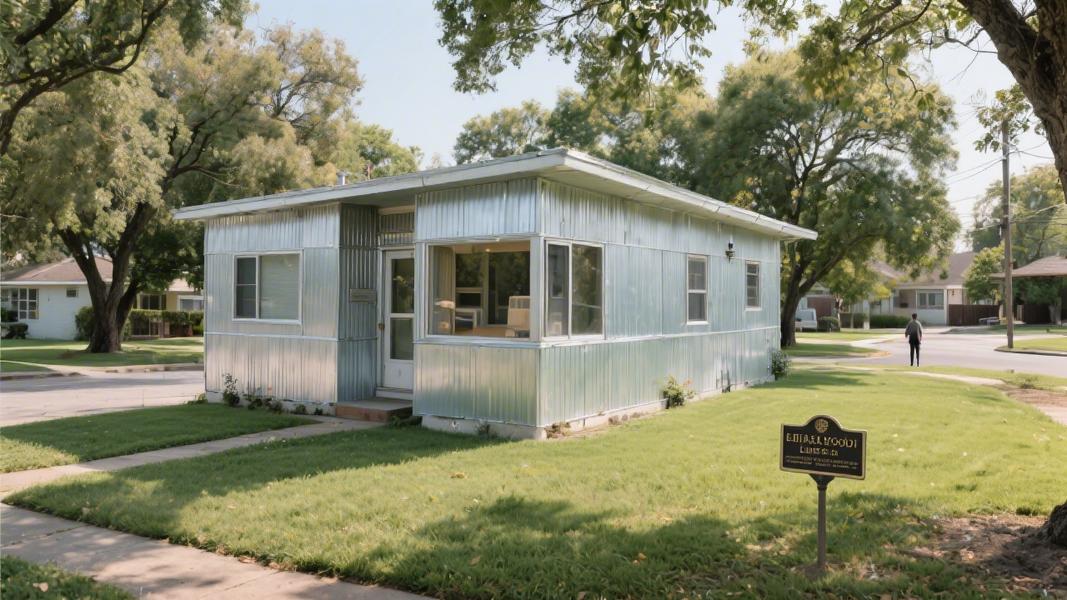
A small steel house in North Dallas is quietly making a big case for why it deserves to survive. And if you’ve never heard of a Lustron home, that’s exactly the problem.
Tucked inside the Briarwood neighborhood, a 1949 Lustron steel home — one of only three ever built in Texas — is at the center of a preservation push for historic landmark status, spurred in part by a minor fire that rattled the community and raised urgent questions about the structure’s future. It’s a small house with a remarkable story, and preservationists aren’t ready to let that story end.
A Post-War Dream, Pressed in Steel
To understand why this matters, you have to go back to Columbus, Ohio, circa 1948. That’s where the Lustron Corporation began stamping out what it promised would be the future of American housing — fully prefabricated, all-steel homes designed to solve the massive housing shortage that followed World War II. They were marketed as virtually indestructible: fireproof, rodent-proof, and, perhaps most appealingly to the postwar homeowner, requiring absolutely no repainting. Ever.
The pitch wasn’t just clever marketing. These homes were genuinely radical for their time — snapped together from enameled steel panels like a life-sized kit, shipped flat and assembled on-site. They looked like something between a ranch house and a refrigerator, in the best possible way. Retro-futuristic before that phrase even existed.
Still, the Lustron Corporation itself didn’t survive long enough to enjoy its own legacy. Production ran from 1948 to 1950, and in that narrow window, only about 2,500 homes were built nationwide. Today, somewhere between 1,400 and 1,500 are believed to still be standing — a number that keeps shrinking.
Rare Doesn’t Begin to Cover It
Three in all of Texas. Three. That’s not scarcity — that’s near-extinction. And with one of those three now dealing with fire damage and an uncertain ownership future, the clock is ticking in a way that has local historians and national preservation groups paying close attention.
The Briarwood home is a two-bedroom model, typical of the Lustron line, which was never designed for grandeur. These weren’t mansions. They were modest, efficient, and built for returning veterans and their young families — people who needed a solid roof over their heads and couldn’t wait years for traditional construction. That modesty is part of what makes them so endearing now, and so easy to overlook.
Across the country, the story keeps repeating itself. A Lustron home in North Carolina has similarly been flagged as a rare example at serious risk of demolition — a reminder, as documented by architectural historians, that these structures are disappearing faster than most people realize. Each demolition isn’t just a loss of a house. It’s the erasure of a very specific chapter in American social and industrial history.
The Fight for Landmark Status
That’s the catch. Historic designation doesn’t guarantee survival, but it’s often the only tool preservationists have. A landmark label can slow demolition, attract restoration funding, and — maybe most importantly — force a conversation before a wrecking crew shows up.
Docomomo US, an organization dedicated to preserving modern architecture and its heritage, has highlighted the Dallas home as a significant example of mid-century prefabricated design worth protecting. The fire, minor as it reportedly was, served as an unwelcome reminder of how quickly things can change — and how little time preservation advocates sometimes have to act.
It’s worth noting that the very feature Lustron promoted most — the steel construction, the fireproof shell — may have helped limit the damage. There’s a certain irony in that. A home built to be fireproof survives a fire, and now needs saving anyway.
Why It Still Matters
Plenty of people will ask whether it’s worth fighting over a two-bedroom steel house from 1949. Fair question. But architecture, especially vernacular architecture — the kind built for regular people, not posterity — has a way of disappearing before anyone decides it mattered. By the time the consensus forms that something was worth keeping, it’s already gone.
Lustron homes represent a specific, fleeting American optimism: the belief, right after the worst war in human history, that technology could solve almost anything. That a family could live comfortably, affordably, and permanently in a house that arrived on a flatbed truck. It didn’t work out quite as planned — the company went bankrupt, the dream stalled — but the houses remained. Quietly. On ordinary streets, in ordinary neighborhoods, long after everyone forgot what they were.
The one in Briarwood is still standing. For now, that’s enough to work with.
