
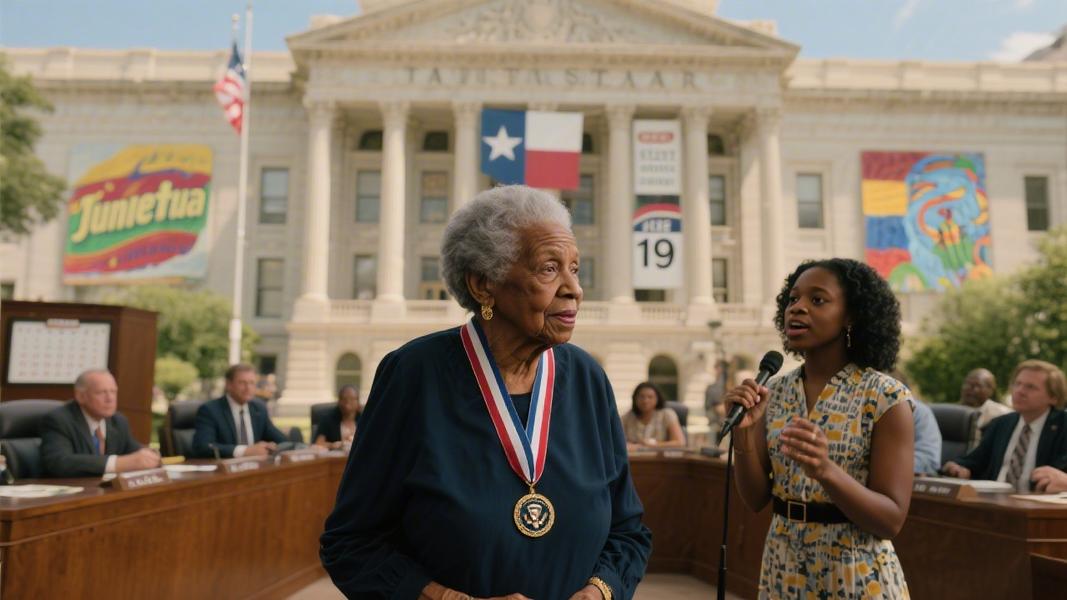
A nearly 100-year-old woman from Fort Worth has spent decades walking — literally and figuratively — toward a single goal. Now her granddaughter wants to make sure the history books catch up.
On April 8, 2026, Dione Sims stood before the Texas State Board of Education and made the case that her grandmother, Dr. Opal Lee — widely known as the “Grandmother of Juneteenth” — deserves a mandatory place in the state’s Juneteenth curriculum. The board is expected to render a final decision in June. Given that Texas is where the holiday’s story begins, the stakes feel particularly pointed.
A Petition, a Podium, and a Personal Ask
Sims didn’t mince words before the board. “I want to petition for her to be a required person to study Juneteenth,” she told the panel. “People that have to do with freedom, liberty, and unity; she’s the embodiment of that. Helping to get Juneteenth as a national holiday, I think deserves to be mentioned.” It’s a hard argument to dismiss — though, in Texas politics, harder things have been dismissed before.
Dr. Lee, who was born in 1926 in Texas and experienced racism firsthand as a child, has spent much of her long life pushing for Juneteenth to receive the federal recognition she always believed it deserved. That recognition finally came on June 18, 2021, when President Biden signed the Juneteenth National Independence Day Act into law — with Dr. Lee standing right beside him at the White House. She had helped get him there, in a sense: her online petition had gathered more than 1.6 million signatures, a number that would later take on a life of its own in her activism.
When the pen met the paper that day, Dr. Lee summed it up with characteristic clarity: “Now we can celebrate freedom from the 19th of June to the 4th of July!” she declared. Simple. Joyful. Exactly on point.
The Walk That Started It All
How does an 88-year-old woman launch a national movement? She laces up her shoes and starts walking. Back in 2016, Dr. Lee began holding annual 2.5-mile walks — each mile representing roughly a year of the 2.5 years it took for news of emancipation to reach enslaved people in Texas after the Civil War ended. It was a simple, physical act of remembrance, and it caught on. By 2017, she had walked 1,400 miles to Washington, D.C., petition signatures in hand, carrying the weight of a cause that had waited long enough.
In 2024, the nation offered its own formal acknowledgment: Dr. Lee received the Presidential Medal of Freedom, the country’s highest civilian honor. She was, at that point, already a living piece of American history. She still is.
1.6 Million Steps Forward
Still, Sims isn’t content to let her grandmother’s legacy rest in ceremony alone. As President and Founder of Unity Unlimited, Inc. — and a candidate for Congress — Sims has been pushing the annual Freedom Walk challenge to a new scale. The goal: get 1.6 million people walking and posting on social media, mirroring the petition count that helped change federal law.
“We want folks to go on their social media and post that. Let us see that, let her see that. We’re really trying to get 1.6 million folks walking for Juneteenth, that we got signing the petition,” Sims explained. It’s participatory history — a way of keeping the momentum tactile, personal, and visible in a media landscape that moves fast and forgets faster.
Sims also pointed to the broader ambitions of the National Juneteenth Museum, which she sees as a platform far beyond Fort Worth’s city limits. “The ability for us to impact, you know, not just Fort Worth, but the nation, with the story of Emancipation, wherever it happened — I think that’s the beauty of the National Juneteenth Museum,” she said. Dr. Lee, for her part, holds the distinction of being the oldest living board member of the National Juneteenth Observance Foundation, a role that reflects just how central she remains to the movement she helped build.
What the Curriculum Fight Really Means
That’s the catch, though. Federal holidays and presidential medals are one thing. What gets taught in a Texas classroom — what children are required to learn — is another matter entirely, and it’s often where history gets quietly negotiated. The Texas State Board of Education has a long and complicated relationship with curriculum standards, and the record on how it handles matters of race and American history is, to put it gently, mixed.
Sims knows this. That’s precisely why she showed up. A woman who collected 1.6 million signatures and walked across the country didn’t raise a granddaughter who stays home when there’s a hearing to attend.
The board’s decision is expected in June — the same month the nation pauses, however briefly, to mark the day freedom finally arrived in Texas. Whether Dr. Opal Lee’s name will be woven into how the next generation learns that story remains, for now, an open question. But if her granddaughter has anything to say about it, the answer won’t be left to chance.
As Dr. Lee herself might put it: freedom doesn’t deliver itself. Somebody has to walk it there.
