
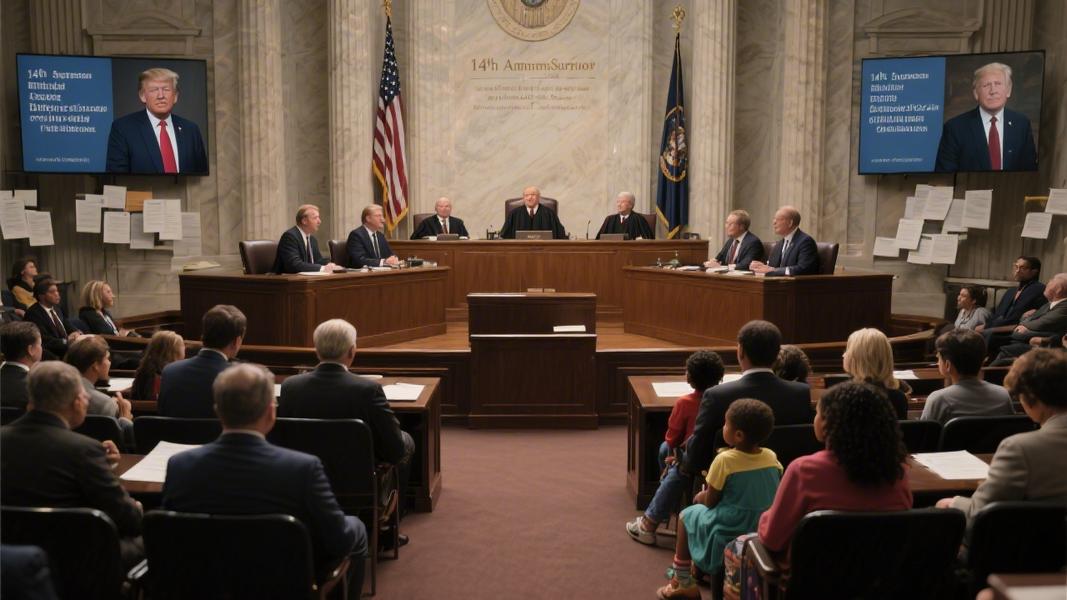
The Supreme Court is about to take on one of the most consequential constitutional questions in a generation — and the answer could redraw the meaning of American citizenship itself.
The justices are scheduled to hear oral arguments on April 1, 2026, in Trump v. Barbara, a direct challenge to President Donald Trump’s executive order that would deny automatic citizenship to children born on U.S. soil if their parents lack citizenship or permanent legal status. It’s a case that touches something foundational — the idea, baked into the Constitution for more than 150 years, that being born here means being from here. Full stop.
The Order That Started It All
On his very first day back in the Oval Office, Trump moved fast. Executive Order No. 14160, signed on January 20, 2025, targeted two categories of newborns: children born to mothers who are unlawfully present in the United States if the father is not a citizen or permanent resident, and children born to mothers on temporary visas if the father similarly lacks citizenship or a green card. Any baby born after February 19, 2025, falling into either category would, under the order, no longer receive automatic citizenship. As noted by ACLU President Deborah Archer, “On January 20th, 2025, his first day back in office, President Trump signed an executive order to limit birthright citizenship.”
The order never took effect. Federal courts moved quickly, issuing nationwide injunctions blocking its enforcement. But the legal battle it ignited has now reached the highest court in the land — and a ruling is expected by summer 2026.
The Constitutional Argument at the Heart of the Fight
The administration’s legal theory hinges on four words tucked inside the Fourteenth Amendment: “subject to the jurisdiction thereof.” Solicitor General D. John Sauer argues that full political jurisdiction — and a duty of direct allegiance to the United States — is required for birthright citizenship to apply, and that children of undocumented immigrants or those on temporary visas simply don’t meet that threshold. The government’s position, as outlined in its filings, is blunt: “The Fourteenth Amendment has always excluded from birthright citizenship persons who were born in the United States but not ‘subject to the jurisdiction thereof.'”
Sauer goes further, framing the status quo as something close to an exploit. Without the order, he argues, “aliens could obtain the priceless gift of U.S. citizenship for their children by violating the United States’ immigration laws — and by jumping in line ahead of others who are complying with the law.” It’s a politically potent framing, however contested it may be among constitutional scholars.
A 126-Year-Old Precedent in the Crosshairs
Here’s the problem for the administration: the Supreme Court already answered this question. Or so the plaintiffs say.
In United States v. Wong Kim Ark, decided in 1898, the Court held that a child born in San Francisco to Chinese parents — who were themselves ineligible for citizenship under the laws of that era — was nonetheless a U.S. citizen by birth. The ruling has been widely understood as settling the matter for more than a century. The ACLU and its co-plaintiffs argue the executive order tramples directly on that precedent, and on the plain text of the Citizenship Clause itself. In their filings, they warn that the government is asking for “nothing less than a remaking of our Nation’s constitutional foundations.”
That’s not hyperbole, at least not entirely. The order’s reach is broader than some realize. It would affect not just children of undocumented immigrants, but also those born to parents on H-1B work visas, student visas, and other temporary legal statuses — people who followed every rule, waited in every line, and still wouldn’t be able to pass citizenship to a child born on American soil, according to advocates tracking the case.
What Comes Next
Still, the Court’s current composition is not the same one that decided Wong Kim Ark. The conservative supermajority has shown a willingness to revisit long-settled legal questions — a fact that makes even some legal observers who consider the administration’s argument a stretch reluctant to predict the outcome with confidence.
The injunctions blocking the order remain in place for now, meaning no child has yet been denied citizenship under it. But that could change depending on how the Court rules — and the implications would ripple far beyond immigration policy. A decision affirming the order would almost certainly prompt immediate legislative and legal chaos, touching millions of people whose citizenship status could suddenly be thrown into question.
April 1st. The date the Court chose to hear arguments on whether the Constitution means what it has been understood to mean for over a century. Whether or not that’s ironic depends, perhaps, on who wins.
