
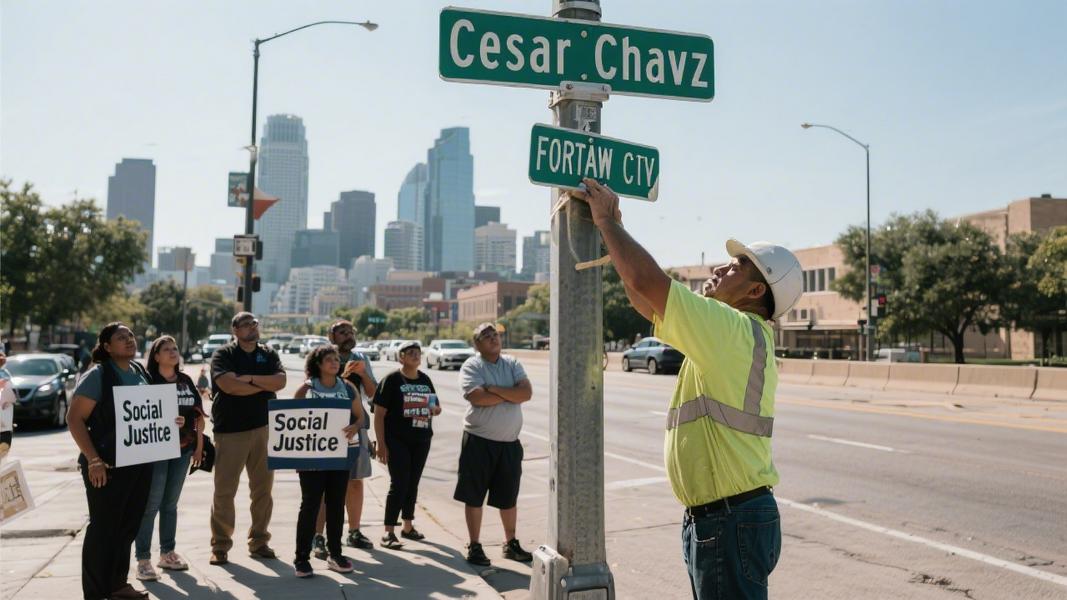
Street signs are coming down. Marches are canceled. And a labor icon’s legacy is fracturing in real time across Texas.
In the weeks surrounding what would have been Cesar Chavez Day on March 31, cities and institutions across the state have been quietly — and sometimes not so quietly — distancing themselves from the name of one of America’s most celebrated labor organizers. The cause: a wave of sexual misconduct allegations targeting Chavez, including claims involving minors, that have sent advocacy groups, elected officials, and longtime supporters scrambling to respond. The fallout has been swift, widespread, and, for many in the Chicano community, deeply painful.
Fort Worth Acts First
Fort Worth didn’t wait long. The city removed street toppers honoring Chavez from both northbound and southbound I-35W — signs that had been installed under a 2020 city resolution. Toppers honoring Dolores Huerta, Chavez’s longtime co-organizer, remain in place for now.
Mayor Pro Tem Carlos Flores, who represents District 2, was blunt about the reasoning. “The city has already removed the street toppers that give the honorary designation for Cesar Chavez,” he said. “If we don’t take this action, I think it sends the wrong message.” It’s a line that captures the broader political calculation playing out in cities across Texas — act fast, or risk looking like you’re not taking the allegations seriously.
Celebrations Canceled, Identities Redrawn
The ripple effects go well beyond Fort Worth. Annual Cesar Chavez marches — a fixture of late March in Texas for decades — were scrapped in San Antonio, Corpus Christi, Laredo, and Houston. El Paso moved on its own, renaming its March 31 observance Community & Labor Heritage Day. Cities including San Antonio, Austin, and Dallas are weighing whether to rename streets that carry his name.
Still, some names prove harder to remove than others. César Chávez Learning Center in Dallas ISD, César Chávez Primary and Elementary Schools in Fort Worth ISD, and César Chávez Boulevard in Dallas remain unchanged — at least for now. Renaming a school is not like pulling down a street topper. It takes votes, community input, money, and time.
One organization chose to reinvent itself entirely. The Cesar Chavez and Dolores Huerta Committee of Tarrant County rebranded as the ¡Sí Se Puede! Committee of Tarrant County, canceling its signature March for Justice and pivoting to participate in a No Kings Day rally on March 28. “It is of utmost importance to continue working for social justice,” said Maricela Jimenez, the organization’s president. “And that is what we are moving forward with, that vision.” The name change is symbolic, yes — but symbols, in this moment, are exactly what’s being fought over.
Abbott Makes It Official — Or Tries To
Texas Gov. Greg Abbott announced that the state would not observe Cesar Chavez Day this year, and said he intends to make that permanent by pushing to remove it from state law entirely during the 2027 legislative session. It’s a move that, predictably, lands differently depending on who you ask — a principled stand to some, opportunistic politics to others.
The Mexican American Legislative Caucus (MALC) staked out a more nuanced position, calling for Chavez Day to be replaced — not erased — with a holiday honoring labor leaders like Dolores Huerta. “When a leader puts himself ahead of the people and the movement he was meant to serve,” MALC’s statement read, “that is a profound betrayal of the very values that movement was built on.”
The UFW and the Foundation Respond
The organizations most closely tied to Chavez’s life work have not been able to stay silent. The United Farm Workers announced it will not participate in Cesar Chavez Day activities, citing the allegations directly. “Some of the reports are family issues, and not our story to tell or our place to comment on,” the UFW said. “Far more troubling are allegations involving abuse of young women or minors.” The union encouraged supporters to redirect their energy toward immigration justice and community service instead.
The language the UFW used to describe the most serious allegations was stark. “Allegations that very young women or girls may have been victimized are crushing,” the union said in a separate statement. The Cesar Chavez Foundation, meanwhile, said it was shocked by allegations of inappropriate sexual behavior with women and minors during Chavez’s time as UFW president, and announced it is establishing a confidential reporting process for anyone who wishes to come forward.
Dolores Huerta Speaks
Through all of it, Dolores Huerta herself has offered perhaps the most measured — and most quietly powerful — response. “The farmworker movement has always been bigger and far more important than any one individual,” she said in a statement. “Cesar’s actions do not diminish the permanent improvements achieved for farmworkers with the help of thousands of people. We must continue to engage and support our community, which needs advocacy and activism now more than ever.”
It’s a careful line to walk — honoring a movement while refusing to defend the man who became its face. And it raises a question that nobody in Texas politics seems fully ready to answer: What do you do with a legacy that’s real, and so is the harm?
A Reckoning — and a Caution
Not everyone believes the current pace of removal is the right approach. Karma Chavez, a professor at the University of Texas at Austin, urged a slower, more deliberate reckoning — one that centers the movement over the man and brings the broader community into the conversation before decisions are made. “We have in this culture, in this country, a habit of putting a lot into individuals, usually great men,” she noted. “And I think this is an opportunity for us to think about how we might not do that going forward.”
That’s the tension that’s going to outlast every press release and every renamed street. The farmworker movement was real. The suffering of those who may have been victimized is real. And the communities that built their identity around ¡Sí Se Puede! — yes, we can — are left holding both truths at once, figuring out what to carry forward and what to finally set down.
