
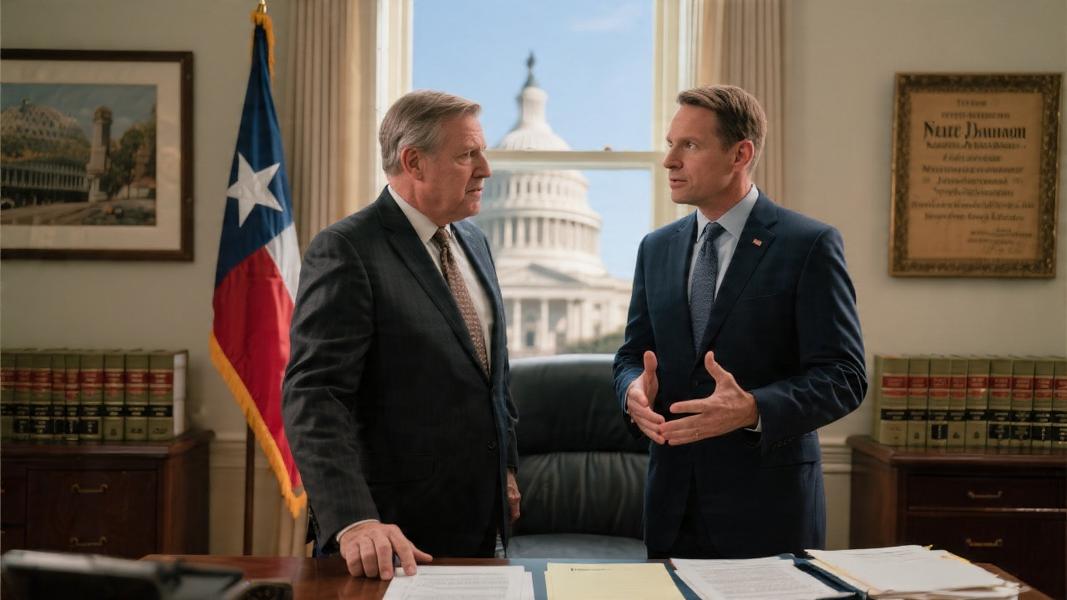
Texas’s new school choice program is already facing legal fire — and it hasn’t even handed out a dollar yet.
Two Democratic candidates vying for Texas Attorney General are publicly vowing to challenge the constitutionality of the state’s landmark Texas Education Freedom Accounts program, known as TEFA, as well as a separate law requiring the Ten Commandments to be displayed in public school classrooms. The challenges signal that the legal battle over Texas’s most ambitious education overhaul in decades could be long, loud, and politically combustible.
What TEFA Actually Does
Joe Jaworski and Nathan Johnson, both Democrats seeking the AG seat, argue the program runs headlong into the Texas Constitution. Jaworski was blunt about it. “Absolutely,” he said. “If you look at the Texas Constitution, it’s very clear that the legislature shall make suitable provision for an efficient system of free public education and defunding public education. Taking yours and my tax dollars and saying you can use this in a private school is unconstitutional.”
That’s a pointed argument — and one that’s likely to get tested in court sooner or later. TEFA was created by Senate Bill 2 during the 89th Texas Legislative Session in 2025, and it’s not a small program. It provides eligible families with up to $10,000 per student per year to spend on private school tuition and related education expenses, with a staggering $1 billion appropriated for fiscal years 2026 through 2027. Governor Greg Abbott signed the bill into law, calling it a historic moment for the state.
But it’s not that simple. The road to SB 2’s passage was anything but smooth. The voucher concept had been blocked for years by a coalition of rural Republicans and Democrats who feared the financial consequences for their local public schools. Abbott eventually replaced enough of those House critics — through primaries and appointments — to push it through. That political maneuvering, documented extensively, underscores just how hard the governor had to fight for this.
Who Gets In — And When
So who actually qualifies? The program is technically universal in eligibility, but it does prioritize two groups: children with special needs, and families earning below $162,000 annually for a household of four. Officials estimate somewhere between 80,000 and 100,000 students could participate in the first year, which is set to begin in Fall 2026. More details on eligibility and school participation are already circulating in the private school community.
Acting Comptroller Kelly Hancock adopted the final rules for the program earlier this year, with applications officially opening on February 6, 2026. Hancock struck a tone of institutional efficiency. “Our mission is to execute SB 2 responsibly, transparently and quickly,” he stated when the rules were finalized. Whether that efficiency will survive a constitutional challenge is another matter entirely.
The Fault Lines Are Familiar
Voucher debates have a habit of following the same script: supporters say competition improves education and families deserve options; opponents say it bleeds public schools dry. Texas is no different. Critics point out that rural and lower-income districts — already stretched thin — stand to lose the most if enrollment migrates to private institutions. Supporters counter that low-income families have long been trapped in underperforming schools while wealthier parents simply move to better districts or pay private tuition out of pocket.
Still, the constitutional question Jaworski and Johnson are raising isn’t just political noise. Texas has a specific and somewhat unusual constitutional mandate regarding public education, and courts have historically taken it seriously. A legal analysis of the comptroller’s role in administering TEFA already surfaced questions about program structure that hint at the complexity ahead.
The Ten Commandments law — a separate but symbolically loaded fight — adds another front to what’s shaping up as a broad culture-war legal campaign. Both candidates see it as equally vulnerable under the First Amendment’s Establishment Clause, giving them a two-pronged platform heading into what promises to be a bruising AG race.
A billion dollars, a constitutional clause, and two candidates with subpoena ambitions. Texas’s school choice experiment hasn’t officially started — and it’s already in the crosshairs.
