
Washington is moving to put guardrails on artificial intelligence in banking — and for once, the industry seems to actually want them.
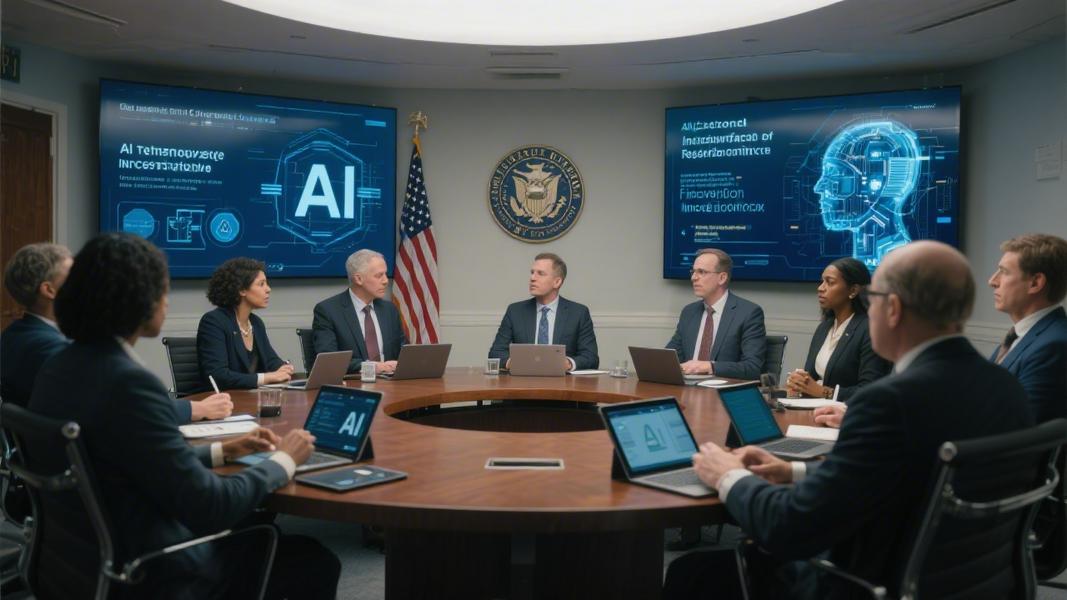
The U.S. Treasury Department has announced plans to release six resources aimed at enabling secure and resilient AI adoption across the American financial system, developed through a sweeping public-private partnership called the Artificial Intelligence Executive Oversight Group. Two of those resources dropped on February 19, 2026 — and they’re already reshaping how banks, regulators, and vendors are thinking about the technology. This isn’t just another policy white paper. It’s an attempt to build a common playbook for an industry that’s been improvising at scale.
A Framework Built for the Real World
The two resources released in February — a Financial Services AI Risk Management Framework and an AI Lexicon — are designed to do something deceptively simple: get everyone in the room speaking the same language. The financial sector has been deploying AI for years, but without standardized terminology or shared risk protocols, the results have been inconsistent at best and dangerously opaque at worst. Treasury stated that “by establishing a common language for AI and a tailored framework for managing AI risks in financial services, these deliverables help protect consumers while supporting responsible innovation.”
That’s a careful balancing act — and not an easy one to pull off. The framework is explicitly non-binding, meaning no institution is legally required to follow it. But don’t mistake voluntary for toothless. Legal analysts noted that for companies deploying AI in regulated financial services, “these resources are likely to become an important reference in examinations, internal audit expectations, third-party oversight, and contract negotiations, even where no regulator expressly incorporates them.” In other words: technically optional, practically unavoidable.
Who’s Behind This — and Why It Matters
The AIEOG isn’t a typical government task force. It’s a hybrid body that brought together senior executives from financial institutions alongside federal and state financial regulators — convened through partnerships with the Financial and Banking Information Infrastructure Committee and the Financial Services Sector Coordinating Council. Treasury described it as a group that “brought together senior executives from financial institutions, federal and state financial regulators, and other key stakeholders.” That cross-sector composition is deliberate. The thinking is that rules built only inside government rarely survive contact with the private sector — and vice versa.
The AIEOG’s work is organized around five priority areas: governance, data practices, transparency, fraud, and digital identity. Taken together, these aren’t just compliance checkboxes. They reflect the actual fault lines where AI in finance tends to break down — biased models, opaque decision-making, identity fraud enabled by synthetic data. The framework addresses them “in an integrated way,” according to Treasury’s own release, rather than treating each problem as a silo.
AI on the Front Lines of Financial Crime
Here’s where things get genuinely interesting — and a little unsettling. Treasury’s parallel work on digital assets reveals just how aggressively financial institutions are already deploying AI to fight illicit finance. Banks are using traditional machine learning and generative AI to enhance transaction monitoring, cut down on false positives, strengthen sanctions screening, and — perhaps most strikingly — detect synthetic identities and deepfakes. The technology, in other words, is already in the field. The governance frameworks are playing catch-up.
Still, it’s not a clean picture. Treasury’s digital assets report identifies real friction points: data quality problems, model opacity, high implementation costs, and persistent regulatory uncertainty. Those aren’t minor obstacles. An AI system that flags illicit transactions but can’t explain why it flagged them is a liability in a courtroom — and a headache for compliance teams.
The breadth of industry engagement here is also notable. Treasury received more than 220 responses to its public comment request on using innovative technologies to counter illicit finance in digital assets, drawing input from financial institutions, industry associations, technology firms, and blockchain analytics companies. That kind of response volume signals something: the private sector isn’t waiting to be told what to do. It wants a seat at the table while the rules are still being written.
Practical Guidance Over Prescription
So what’s the actual philosophy driving all of this? Treasury has been fairly explicit. “By focusing on practical implementation rather than prescriptive requirements,” the department explained, “the resources are intended to help financial institutions adopt AI more confidently and securely, strengthening resilience and cybersecurity while supporting innovation across the sector.” That’s a notably different posture than what’s emerged in some corners of global AI regulation, where prescriptive mandates have generated as much confusion as clarity.
That said, “practical” guidance can only go so far without enforcement muscle behind it. The coming months will reveal whether financial regulators lean into these frameworks during examinations — or treat them as background reading. Either way, institutions that ignore them are making a calculated bet that their examiners won’t notice. That’s a bet fewer compliance officers are likely to take willingly.
Four more resources from the AIEOG are still forthcoming, and the financial sector is watching closely. The question isn’t really whether AI will transform banking — it already has. The question is whether the frameworks being built right now are sturdy enough to keep up with what the technology is already doing inside the walls of the world’s largest financial institutions.
