
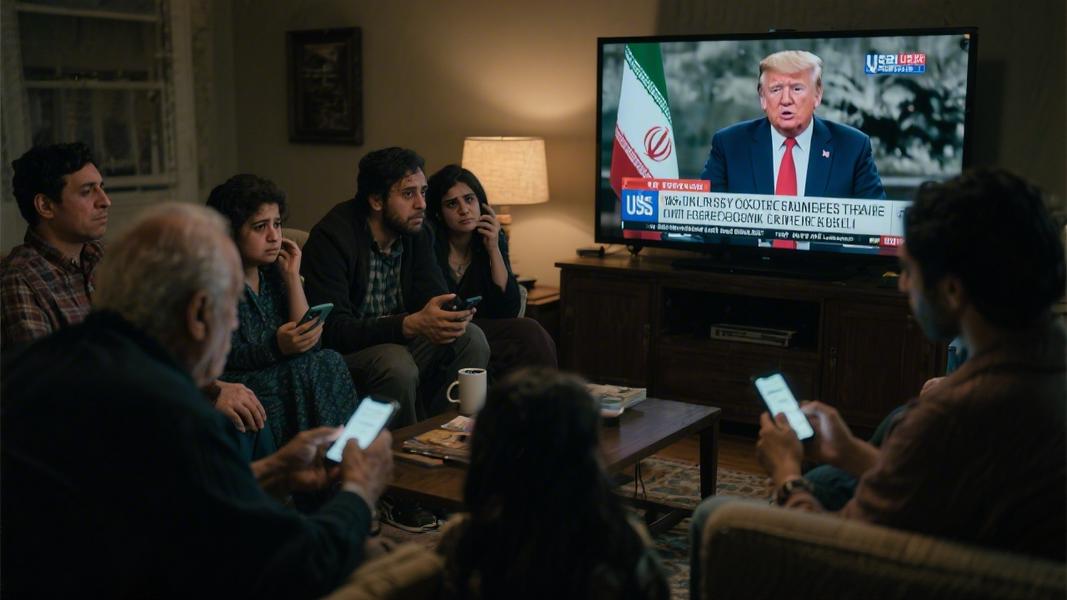
A two-week ceasefire. Conditional. Brokered, of all places, by Pakistan. That’s where things stand between the United States and Iran — and for Iranian Americans watching from thousands of miles away, it’s hardly reassuring.
President Trump announced this week that he would suspend military action against Iran for fourteen days, writing on Truth Social, “I agree to suspend the bombing and attack of Iran for a period of two weeks.” The pause, he stated, came at Pakistan’s request — but it comes with a hard condition: Iran must agree to the “COMPLETE, IMMEDIATE, and SAFE OPENING of the Strait of Hormuz.” Whether Tehran will comply, and what happens if it doesn’t, remains dangerously unclear.
Fear at Home, Silence From Abroad
For members of the Iranian American diaspora, the ceasefire announcement offers little comfort. Homeira Hesami, chairwoman for the Iranian American Community of North Texas, described a situation that’s part wartime anxiety, part communication blackout. “We’re in a wartime, so everyone’s worried and following the news,” she said. “The internet’s still being down, you know, we don’t have a very secure way to communicate with our family and friends back home, so sometimes, you know, they may be able to call out, but it’s very patchy.”
That’s the reality beneath the geopolitical headlines — families separated by an ocean and an unreliable signal, waiting for a voice on the other end of a call that may or may not connect. It’s not abstract. It’s a phone that rings and rings.
What the Worst Case Looks Like
How bad could it get? Ralph Carter, a political science professor at TCU, didn’t mince words. “In the worst-case scenario, President Trump carries out massive attacks against civilian targets, killing thousands or even millions of people,” he warned, adding that such a scenario would force Congressional intervention and could constitute a war crime under international law.
Still, Carter doesn’t believe Iran would simply collapse under the weight of American military power. Quite the opposite. “I do think that Iran will survive, whatever happens,” he said. “I think the Iranian people will be united in a rally around the flag phenomenon to defend their homeland against an aggressor.” His broader point was pointed and historically grounded: “This is one of those things where a weaker power outlasts a stronger power, because the stronger power gets tired of the price they have to pay to try to get a victory.” Vietnam. Afghanistan. The pattern isn’t new.
Not Every Problem Has a Military Solution
But it’s not that simple — and Hesami, for one, is pushing back against the idea that bombs are the answer to Iran’s political crisis. She’s seen what war does. “War has proven that sometimes it is not the solution,” she emphasized, “and the solution is relying on the Iranian people and their organized resistance.”
It’s a view that cuts against both the hawkish impulse in Washington and the kind of fatalism that sets in when diplomacy seems exhausted. The people inside Iran, she argues, are not passive actors waiting to be liberated by foreign firepower. They’re organizing. They’re resisting. And they’re doing it without a reliable internet connection.
A Ceasefire Built on Conditions
For now, the guns are quiet — at least officially. But a ceasefire tied to the opening of one of the world’s most strategically critical waterways is less a peace offer than a pressure tactic with a deadline. Two weeks is not a long time. And the gap between where Iran and the United States currently stand isn’t something that closes easily, or quickly.
As Carter put it, a weaker power can outlast a stronger one. Tehran has been playing that particular long game for decades. Whether this pause leads somewhere real, or simply resets the clock on a conflict that’s far from over — that’s the question nobody in Washington, or Dallas, or Tehran seems ready to answer just yet.
