
Washington’s most hawkish Asia hand just landed in New Delhi — and he didn’t come empty-handed.
Elbridge Colby, the Under Secretary of War for Policy and one of the Trump administration’s most vocal architects of great-power competition strategy, wrapped up a high-stakes visit to India this week that touched nearly every nerve in the two countries’ deepening defense relationship. The meetings, the speeches, the framework — all of it points to a partnership that both sides are now treating less like a diplomatic courtesy and more like a strategic necessity.
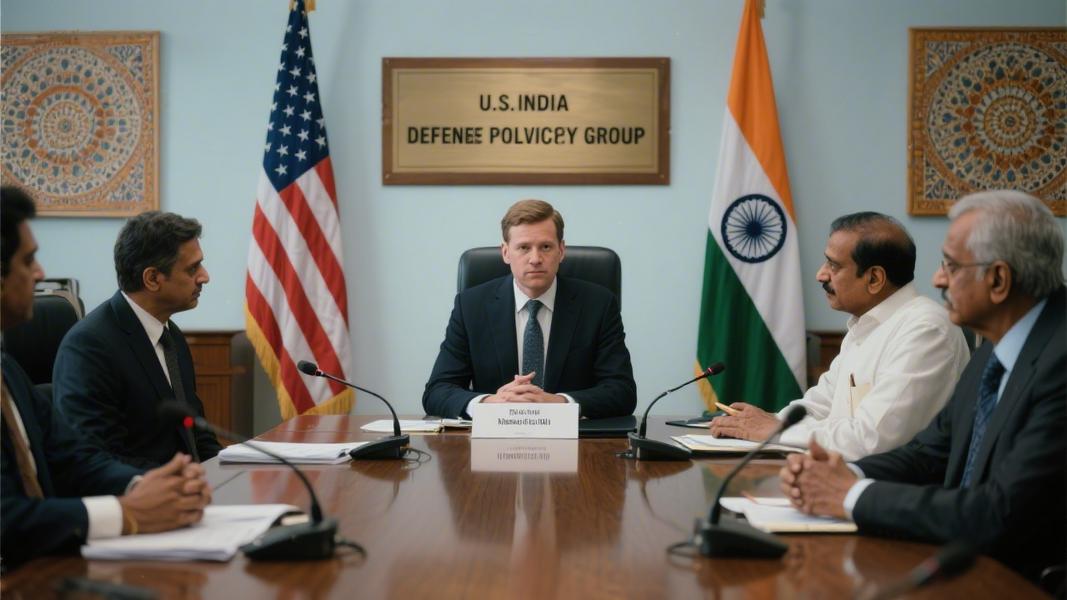
Colby met with External Affairs Minister S. Jaishankar and Foreign Secretary Vikram Misri, and co-chaired the U.S.-India Defense Policy Group alongside Indian Defense Secretary Rajesh Kumar Singh. The agenda: advancing the 2026 National Defense Strategy and building on the Framework for the U.S.-India Major Defense Partnership, which was signed back in October 2025. That framework — broad in its ambitions — calls for expanded operational coordination, deeper information sharing, and serious defense industrial and technology cooperation, according to remarks delivered at the Ananta Centre in New Delhi.
India as a Pillar, Not a Partner of Convenience
The language Colby used throughout the trip was deliberate — and notably warmer than the transactional tone that sometimes defines Trump-era diplomacy. “The United States views India with deep respect — as a republic of continental scale, as a nation with a proud strategic tradition, and as a country whose decisions will profoundly shape the future of the Indo-Pacific and the international landscape more broadly,” he stated. That’s not boilerplate. For an official whose worldview is built around hard-nosed threat calculus, it signals genuine strategic weight being assigned to New Delhi.
And he went further. Colby made clear the U.S. sees India’s strength as directly tied to American interests. “The United States believes that India will play a central role in ensuring a favourable balance of power in the Indo-Pacific,” he was quoted as saying. “In this context, a strong, confident India is not only good for the Indian people. It is good for Americans as well.” Blunt, direct — and intentional.
Respect for the ‘India Way’
But it’s not that simple. India has never been easy to corral into alliances, and Washington knows it. For decades, New Delhi’s foreign policy has been defined by strategic autonomy — a polite way of saying India doesn’t take orders, not from Moscow, not from Beijing, and certainly not from Washington. Colby seemed to go out of his way to acknowledge that reality rather than paper over it.
“The United States clearly recognises that India has its own interests, its own strategic culture, and its own priorities, and that India is not shy about advancing them,” he was noted as saying. That’s a remarkable admission from a senior U.S. defense official — essentially telling India: we see you, we’re not trying to change you, let’s work with what we’ve got.
He even drew a direct parallel between the Trump administration’s own foreign policy posture and India’s. “Like America First and flexible realism, Bharat First and the India way emphasise the centrality of a realistic approach to foreign policy, an unabashed willingness to put one’s own national priorities first, and a results-oriented mindset about international politics,” Colby told the audience. It was a clever rhetorical move — framing two very different countries as operating from the same philosophical playbook.
Real Capability, Not Just Rhetoric
So what does the partnership actually look like on the ground? Colby got specific. The U.S. committed to enhancing collaboration with India across long-range precision fires, resilient logistics, maritime domain awareness, and anti-submarine warfare — a list that reads less like a wish list and more like a checklist tailored to counter Chinese naval expansion in the Indian Ocean and beyond. The emphasis on real military capability enhancement, rather than symbolic cooperation, reflects what Colby has long argued: that paper partnerships don’t deter anyone.
Still, plenty of questions hang in the air. India still buys Russian weapons systems. It still maintains ties with Moscow that Washington finds uncomfortable. And while the October 2025 framework set ambitious goals, frameworks have a way of gathering dust when geopolitical winds shift. The real test of this partnership won’t be measured in speeches at think tanks — it’ll be measured in hardware, intelligence sharing, and what happens the next time Chinese warships test the boundaries of the Indian Ocean region.
For now, though, both sides appear to be leaning in. And if Colby’s trip accomplished anything, it’s this: the message to New Delhi was delivered in person, at the highest levels, with unusual candor. America needs India in its corner — and for once, it seems willing to say so out loud.
As Colby put it, a strong India isn’t charity. It’s strategy.
