
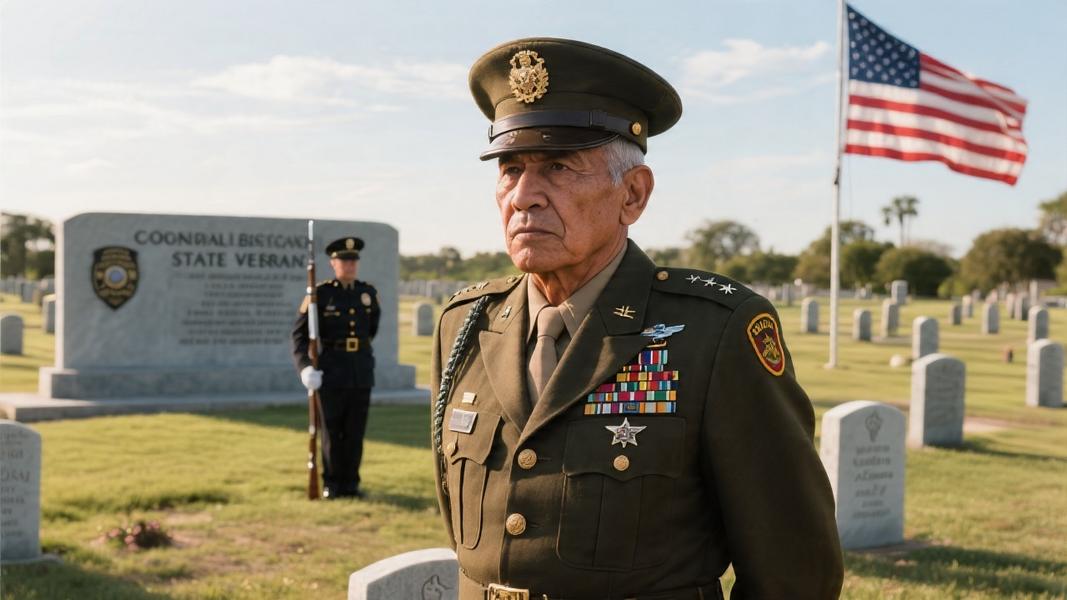
Two men. Two wars. One name — and a legacy of service that refuses to be forgotten.
The name Acevedo appears twice in the annals of American military history, separated by nearly three decades of conflict but united by an uncommon thread: duty carried out under conditions that would break most people. One kept a secret diary in a Nazi slave labor camp. The other drove through the streets of wartime Saigon. Together, their stories offer a window into the quiet, often overlooked contributions of Latino veterans in the American military.
A Diary Written in the Dark
Anthony Claude Acevedo was born on July 31, 1924, in California to Mexican immigrant parents. He was drafted into the U.S. Army and served as a medic in Company B, 275th Infantry Regiment, 70th Infantry Division during World War II. His war ended — or rather, transformed into something worse — on January 6, 1945, when he was captured during the Battle of the Bulge. He was 20 years old. What followed was a chapter of American history that took decades to fully surface, as documented by the National WWII Museum.
Acevedo was sent first to Stalag IXB and then to Berga an der Elster, a satellite camp of Buchenwald where American POWs were forced into slave labor alongside Jewish concentration camp prisoners. The conditions were brutal. Men were starved, beaten, and worked to death in tunnel excavations meant to fuel the Reich’s final, desperate war machine. It’s the kind of history that doesn’t make it into the clean version of the story.
But Acevedo did something extraordinary. He kept a diary — hidden, meticulous, dangerous. In it, he recorded the names of fellow prisoners who died, the dates, the causes, the suffering. It was an act of witness as much as it was an act of defiance. Getting caught with that diary could have cost him his life. He kept writing anyway.
He was one of more than 500,000 Latinos who served in World War II — a figure that rarely gets the headline space it deserves. As one profile of Acevedo noted, these men and women served a country that, in many cases, didn’t fully recognize them as citizens in any meaningful social sense. They served regardless. Acevedo survived the war, came home, and spent much of his later life ensuring that what happened at Berga would not simply dissolve into the fog of classified military records — many of which were, for years, deliberately suppressed by the U.S. government. He died on February 11, 2018, at the age of 93.
The biography maintained by the National Museum of the United States Army describes him plainly: Corporal, medic, prisoner of war, survivor. Those four words carry more weight than most résumés ever will.
Saigon, Decades Later
Fast forward nearly thirty years. A different war, a different Acevedo — though the parallels in character are hard to ignore.
Specialist Cayetano “Tony” Acevedo was drafted into the U.S. Army in 1972, arriving in Vietnam as the war ground through its final, grinding years. His assignment was logistical but no less essential: transporting soldiers, equipment, supplies, and classified messages through the streets and outposts of Saigon. Not glamorous work. Not the kind of service that fills war movies. But the kind that keeps everything else moving — and the kind where a wrong turn or a bad day could end everything.
Years later, Tony Acevedo found another form of service. He became a member of the Memorial Service Detachment Honor Guard at the Coastal Bend State Veterans Cemetery in Texas, a role administered under the Texas Veterans Land Board. It’s a quiet, deliberate kind of commitment — showing up to honor the dead, again and again, long after the uniforms are folded away.
In an oral history recorded by the Texas General Land Office, he opened with something that felt less like a formal statement and more like a man genuinely moved to be heard. “Before I begin this interview, I want to just want to thank you and the Veterans Land Board for allowing me this opportunity to express my memories after being a member of the MSD at the Coastal Bend State Veterans Cemetery. I am very honored and proud to be a part of this. It’s an honor for me to be here in this interview with you, and I want to thank you all.” There’s no irony in those words. No performance. Just a veteran, grateful for the space to speak.
Why It Matters Now
What do these two men share beyond a surname and a uniform? Honestly — quite a lot. Both served in conflicts defined by ambiguity and political tension. Both performed their duties without fanfare. And both, in their own ways, made sure the record existed: one through a hidden diary scratched out in a Nazi labor camp, the other through an oral history preserved in a state archive.
That’s not a coincidence of character. That’s a pattern. Latino veterans have long been among the most decorated and least recognized groups in American military history. Their stories get told in fragments, in footnotes, in oral history projects that depend on someone having the foresight to ask before it’s too late.
Still, the stories are there — if you look. Anthony Acevedo’s diary is real. Tony Acevedo’s words are recorded. The least a reader can do is sit with them for a moment.
A man who survived Berga once wrote down the names of the dying so they wouldn’t be forgotten. Decades later, another man stood at gravesides to honor veterans who might otherwise pass without ceremony. Different wars. Same instinct. Someone has to remember.
