
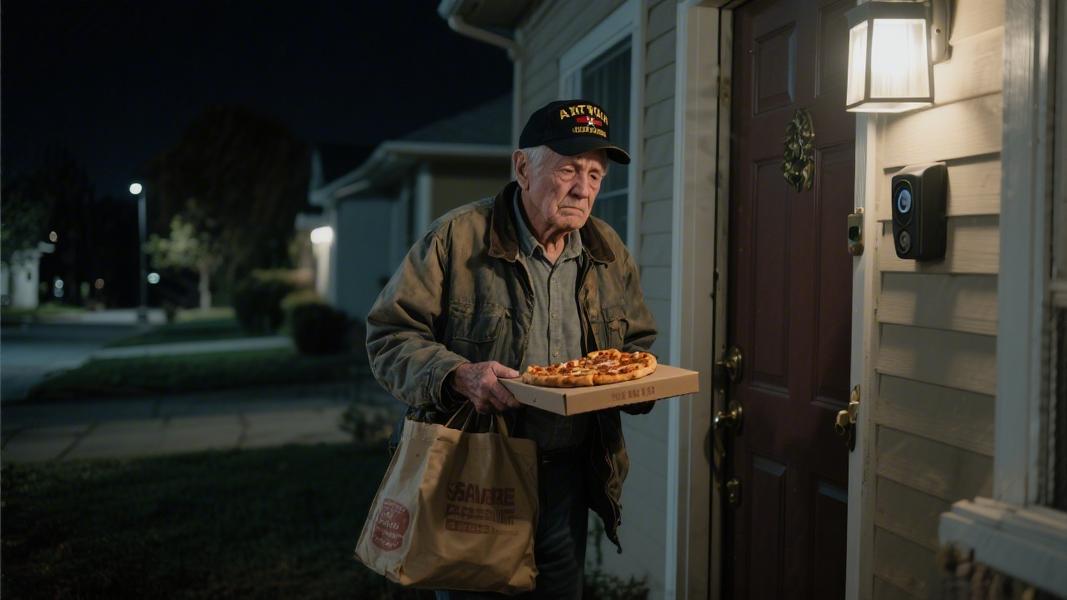
They’re in their seventies, delivering food late at night, and most of us wouldn’t even notice — until a doorbell camera catches everything.
Across the country, a quiet and troubling pattern has emerged: elderly Americans, many of them veterans, are turning to gig economy jobs like DoorDash not out of boredom or a desire to stay busy, but out of sheer financial necessity. Two stories in particular — one out of North Texas, one from Tennessee — have cut through the noise of social media and landed somewhere closer to the conscience. Both involve elderly men delivering food well past midnight. Both went viral. And both forced a national conversation about what retirement actually looks like for millions of Americans when Social Security simply isn’t enough.
A Late-Night Delivery, A Second Look
It was 10:30 PM when Savannah Saulters glanced at her doorbell camera and saw an elderly man standing at her door with a pizza. She didn’t think much of it at first. Then it hit her. “I was like, ‘There should be no reason that a 76-year-old man is delivering my pizza at 10:30 at nighttime,'” Saulters said. She posted the footage to social media, asking her followers to help identify him.
They did. The man was Larry Phillip Colvin, a 76-year-old Vietnam veteran from Mabank, Texas. His story, once it came out, was both ordinary and devastating in equal measure. “My Social Security just wasn’t cutting it anymore,” Colvin explained. “I had to do something, and I can’t hold down a regular job.”
So he drives for DoorDash. Six nights a week — Monday, Tuesday, Thursday, Friday, Saturday, and Sunday. He works nights because that’s when the money is better, even if it isn’t what he’d choose. “I wish I didn’t have to do it at night because that’s when you make the most money,” he noted, with the weary logic of someone who’s done the math and accepted the answer.
The Weight Behind the Deliveries
Colvin isn’t just covering his own expenses. His wife is facing multiple surgeries. His son is living with three autoimmune diseases — lupus and dystonia among them. “My wife is looking at a couple of surgeries, my son has three autoimmune diseases, lupus and dystonia,” Colvin told reporters. That’s not one medical crisis. That’s a household in a constant state of one.
Still, the response from strangers was swift. Saulters launched an online donation fund, and within days it had raised nearly $9,000. Colvin was visibly moved. “I love you, I’m so grateful for you,” he said. “What you’ve done has helped our family tremendously … I’m very grateful. It’ll help pay off some bills.”
Nine thousand dollars. For a family drowning in medical debt, it’s meaningful. It’s also, in the context of what healthcare costs in America, a drop in the bucket.
Tennessee’s Version of the Same Story
Half a country away, a strikingly similar scene played out — only this time, the internet’s response was staggering in scale. Richard Pulley, a 78-year-old DoorDash driver from Tennessee, was caught on a ring camera making a delivery. He hadn’t planned to be back in the workforce. Retirement had been the plan. But when his wife lost her job, the plan changed, and Pulley found himself behind the wheel, night after night, completing food deliveries to make ends meet.
By the time Britney Smith saw his delivery on her doorbell camera and launched a fundraiser, the goal was a modest $20,000. What happened next was something else entirely. In just five days, more than 30,000 donations poured in. The fundraiser raised nearly $1 million. Pulley, clearly overwhelmed, said it was “just really difficult to believe that there’s that many people that are that generous to try to help us.”
The numbers reported across coverage varied — some outlets noted nearly $570,000, others pegged it at over $500,000 — but every account told the same essential story: a retired man, his wife Brenda riding along to help him navigate, completing over 6,000 deliveries to cover medical bills and medication costs. Six thousand deliveries. Let that number sit for a moment.
What These Stories Say — And What They Don’t
It’s easy to feel good about these fundraisers. And there’s nothing wrong with that — generosity is generosity, and both Colvin and Pulley’s families are genuinely better off because strangers cared. But it’s worth asking the harder question lurking underneath the viral warmth: why are veterans and retirees in their late seventies delivering food at midnight in the first place?
That’s the catch. The viral fundraiser is the feel-good ending. The policy failure is the story that doesn’t trend. Social Security benefits that haven’t kept pace with inflation. Healthcare costs that can hollow out a lifetime of savings in a matter of months. A gig economy that is, technically, open to everyone — including people who probably shouldn’t have to use it.
Pulley and Colvin are not anomalies. They’re visible ones. For every elderly driver who ends up on a doorbell camera and goes viral, there are countless others making the same quiet, exhausting calculation every night — and no one is filming.
As for Larry Colvin, he put it simply, with the kind of plainspoken dignity that tends to stay with you: he served his country, raised a family, and at 76, he’s still showing up. Still delivering. Still grateful when someone notices.
