
Twenty-one years after his death, Pope Saint John Paul II is still commanding attention from the world’s most powerful offices — including, once again, the White House.
On April 2, 2026, the White House issued a formal Presidential Message marking the anniversary of the Polish pope’s passing, honoring his legacy of moral courage, spiritual defiance, and enduring influence on human freedom. The message arrives as the United States marks its 250th year of independence — a pairing that, intentional or not, carries its own symbolic weight.
Forged Under Occupation
To understand why John Paul II’s memory still resonates in presidential correspondence, you have to go back to where his character was formed. Long before the Vatican, long before the white cassock and the global pilgrimages, there was a young Karol Wojtyła living under Nazi occupation in Poland — a crucible that didn’t break him. It sharpened him. The conscience he built during those years, grounded in holiness, virtue, and what can only be called a kind of moral stubbornness, would define everything that followed.
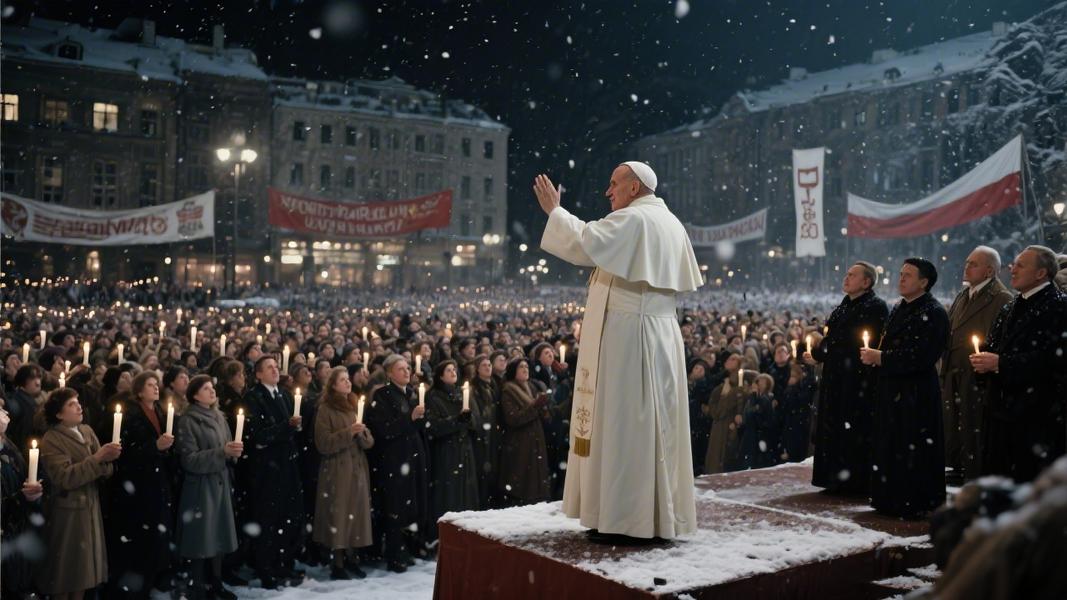
That formation became unmistakably visible in 1979, just eight months after he ascended to the papacy. He returned to communist Poland — walked right back into the belly of a regime that had every reason to fear him — and delivered a sermon that stopped the country cold. “Man is incapable of understanding himself fully without Christ,” he told the crowd. “He cannot understand who he is, nor what his true dignity is, nor what his vocation is, nor what his final end is. He cannot understand any of this without Christ.” It wasn’t a theological abstraction. It was a direct challenge to a government that had spent decades insisting the opposite.
A Mass That Moved History
That moment — specifically his June 2, 1979 Mass in Warsaw — has since been recognized as one of the most consequential religious events of the twentieth century. On June 2, 2019, the White House issued a Presidential Message marking its 40th anniversary, acknowledging that the Mass didn’t just inspire Poles — it lit the fuse for resistance movements that would eventually unravel communist control across Eastern Europe. Solidarity. The Berlin Wall. The whole cascade. Historians still argue about precise causes, but few dismiss the role of a pope who told an occupied people, in plain terms, that no government has the right to separate them from God.
President George W. Bush put it plainly when John Paul II died on April 2, 2005. “Laura and I join people across the Earth in mourning the passing of Pope John Paul II,” he stated, crediting the pope with launching a democratic revolution in Poland that swept across an entire continent. Later, in remarks that have since become among the more quoted of his presidency, Bush described the pope as someone who “left the throne of Saint Peter in the same way he ascended to it: as a witness to the dignity of human life.” That’s not political boilerplate. That’s a eulogy with real conviction behind it.
A Reach That Crossed Every Border
Here’s what’s easy to forget: John Paul II’s moral authority wasn’t limited to the West, or to Catholics, or even to those who agreed with him on everything. When September 11, 2001 happened, it was the pope who opened his general audience the very next day with a statement that cut through the noise. “I cannot begin this audience without expressing my profound sorrow at the terrorist attacks which yesterday brought death and destruction to America,” he said — direct, unhedged, and immediate in a way that world leaders often struggle to be.
Even Vladimir Putin — not exactly known for warm ecumenical sentiment — sent condolences upon the pope’s death. “I felt great sorrow at the tragic news of the death of His Holiness Pope John Paul II,” Putin wrote, calling him “a leading figure of the modern world.” Whether that praise was sincere or diplomatic is, perhaps, a question worth sitting with.
The Shrine Visit and the Symbolism
Still, the commemorations have taken on a distinctly American character in recent years. On June 2, 2020 — the 41st anniversary of that historic Warsaw pilgrimage — President Trump and First Lady Melania Trump visited the St. John Paul II National Shrine in Washington, D.C., a gesture noted at the time for its deliberate timing. The symbolism wasn’t subtle. It didn’t try to be.
The 2026 Presidential Message continues that tradition, urging Americans to keep the pope’s memory alive as the nation enters its semiquincentennial year. That framing — linking a Polish-born pontiff to the American founding spirit — might raise an eyebrow or two. But it’s not entirely without logic. Both stories, at their core, are about what people do when they refuse to let power define their dignity.
Why It Still Matters
Twenty-one years is a long time. Long enough, usually, for the world to quietly move on. The fact that it hasn’t — that presidents of both parties, world leaders across ideological lines, and now a White House marking America’s 250th birthday are still invoking this man’s name — says something. Maybe it says something about the scarcity of figures who genuinely changed the moral temperature of an era. Or maybe it just says that some lives cast shadows long enough to outlast the people who cast them.
As John Paul II himself might have put it: a person’s final end is not something any government — or any anniversary — gets to determine.
