
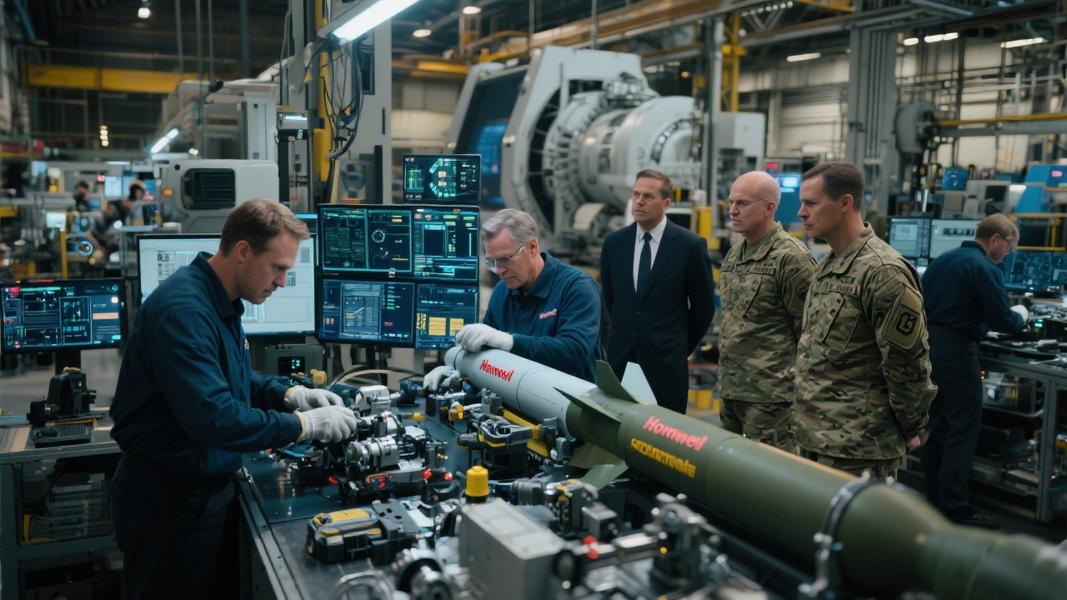
The U.S. military is moving fast to arm its next generation of autonomous aircraft — and it’s writing some very large checks to do it.
In a series of contracts and agreements spanning engine prototypes, navigation systems, and high-end munitions, the Pentagon has been quietly assembling the industrial backbone for a new era of warfare. The common thread running through much of it: Honeywell Aerospace, a company that’s positioned itself as one of the defense sector’s most indispensable suppliers — and whose recent contract wins suggest the military agrees.
Drone Wingmen Get Their Engines
The U.S. Air Force has awarded Honeywell a prototype contract to develop a small propulsion engine for its Collaborative Combat Aircraft program — the Pentagon’s ambitious push to deploy autonomous drone “wingmen” alongside crewed fighter jets. The engine is adapted from Honeywell’s existing SkyShot 1600 design, a detail that matters: it signals the military wants something proven, not experimental, powering these platforms as they move toward production.
Honeywell didn’t undersell the moment. “We’ve combined decades of proven technologies with the latest advancements to create an engine that can keep pace with cost, speed and performance demands of next-generation platforms,” the company said in a statement. That’s the kind of language companies use when they know they’re competing for something bigger than a prototype deal.
The CCA program has been one of the Air Force’s most closely watched modernization efforts, with the service envisioning fleets of unmanned aircraft that can fly alongside — and extend the reach of — manned fighters like the F-35. Getting the propulsion right is foundational. Everything else depends on it.
Half a Billion Dollars for the Home Front
The drone engine contract is only part of the picture. Honeywell Aerospace separately signed a $500 million defense production agreement with the U.S. government, targeting increased output of navigation systems, Assure actuators, and electronic warfare solutions. The scale of that agreement — and its breadth across product lines — suggests the Pentagon isn’t just buying hardware. It’s buying capacity.
That distinction matters more than it might seem. In the years since Russia’s invasion of Ukraine exposed the West’s munitions stockpile vulnerabilities, the U.S. defense establishment has become acutely aware that production rates, not just technological superiority, determine outcomes in prolonged conflicts. A sophisticated missile system that takes two years to manufacture is only as good as the factory floor behind it.
Honeywell’s longer-term numbers tell the same story. The company disclosed that from 2022 to 2025, it was awarded contracts expected to generate over $90 billion in revenue across the life of various aerospace and defense platforms. “From 2022 to 2025, we were awarded contracts that we expect will contribute over $90 billion of revenue during the life of these platforms,” the company stated in investor materials. That’s not a contractor riding a wave — that’s a contractor who helped build it.
Quadrupling the Arsenal
Still, Honeywell isn’t the only company being asked to sprint. In what may be the most striking signal yet of Washington’s urgency, defense giants including Lockheed Martin have agreed to dramatically scale up production of what officials have taken to calling “exquisite class” weaponry — high-end, precision munitions that are expensive, complex, and suddenly in very high demand.
Previous multiyear deals had already committed to tripling production of PAC-3 missile interceptors and quadrupling output of THAAD interceptors. Now the targets have expanded further. “They have agreed to quadruple production of the ‘Exquisite Class’ Weaponry in that we want to reach, as rapidly as possible, the highest levels of quantity,” the Trump administration announced, adding that expansion had already begun three months prior to the announcement and that “plants and production of many of these weapons are already under way.”
That’s a notable detail. The factories aren’t waiting for the ink to dry — they’re already running.
The Bigger Picture
What does it all add up to? A defense industrial base that’s being pushed — urgently and deliberately — to produce more of everything, faster than it ever has in the post-Cold War era. Autonomous aircraft. Interceptor missiles. Navigation systems. Electronic warfare tools. The list reads like a checklist for a military preparing not just for one conflict, but for a range of simultaneous contingencies.
The contracts flowing to Honeywell and Lockheed are individually significant. Taken together, they’re something else: a statement about where American defense strategy is headed and how quickly the government believes it needs to get there. Whether industry can actually meet those timelines — and sustain them — is a question the next few years will answer.
For now, the checks are written. The plants are running. And somewhere on a drawing board, the drone wingmen are waiting for their engines.
