
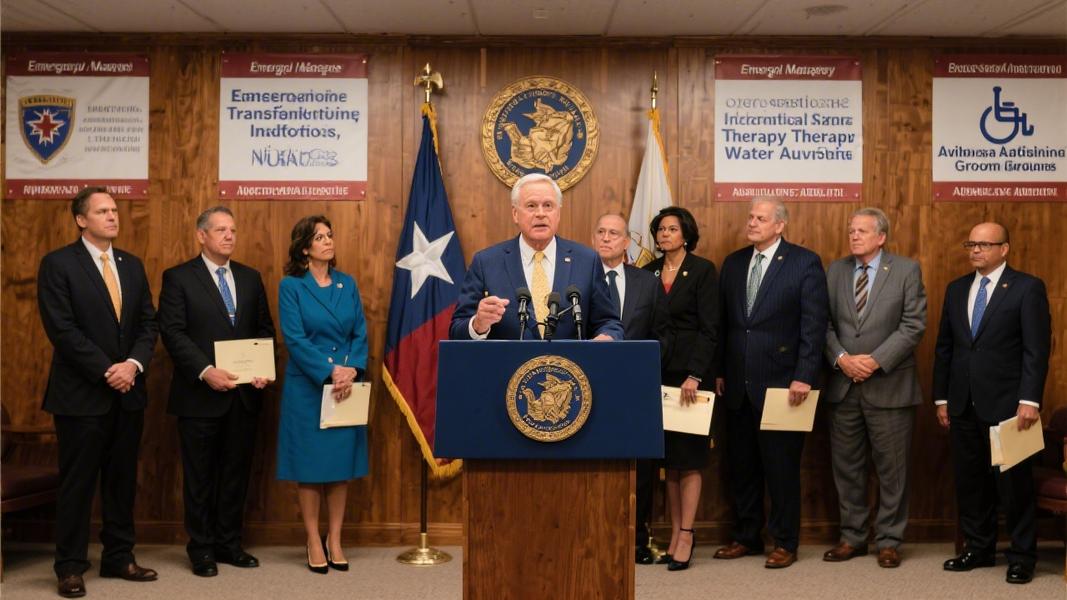
Governor Greg Abbott didn’t waste time this week, rolling out a sweeping slate of appointments and reappointments that touch everything from 9-1-1 services and river water rights to law enforcement standards and vocational rehabilitation for Texans with disabilities.
The announcements, released by the Governor’s office, span more than a dozen state bodies — filling seats on regional transportation authorities, advisory councils, and regulatory commissions that shape daily life across Texas in ways most residents never see. Taken together, they represent one of the broader appointment rounds Abbott’s office has put forward in recent months.
Emergency Management and Disaster Recovery
Leading off the list, Matthew Powell was reappointed to the Business Advisory Council to the Texas Division of Emergency Management, with his term running through February 1, 2030. The Council’s mandate is straightforward but critical — it provides advice and expertise on the actions state and local governments can take to help businesses get back on their feet after a disaster. Given Texas’s well-documented vulnerability to hurricanes, floods, and extreme weather events, it’s not exactly a ceremonial post.
Transportation Infrastructure
Two regional mobility authority appointments rounded out the transportation-focused picks. Frank Parker, Jr. was reappointed as presiding officer of the Cameron County Regional Mobility Authority for a term expiring February 1, 2028. The authority functions as a political subdivision, giving local transportation planners the ability to partner directly with the state on infrastructure delivery in Cameron County — a border region with distinct logistical demands.
Up in the north, Jed Alton Brown was reappointed as presiding officer of the Webb County – City of Laredo Regional Mobility Authority, also through February 1, 2028. Both reappointments signal continuity in two of Texas’s most strategically important border corridors.
Health, Rehabilitation, and Independent Living
Several appointments targeted agencies that serve Texans with disabilities or health-related needs — a cluster that, quietly, affects hundreds of thousands of people across the state.
Manoranjan “Mano” Mahadeva was reappointed to the Executive Council of Physical Therapy and Occupational Therapy Examiners through February 1, 2027. The Council isn’t just a licensing body — it’s charged with protecting the health, safety, and welfare of Texans by supporting the boards that regulate physical and occupational therapy practitioners and the facilities where they work.
On the rehabilitation front, Governor Abbott appointed Leslie Cantu, Marla Williams, Elizabeth “Elle” Holtzman, and Jeanie Beaman — and reappointed Peggy Schmidt — to the Rehabilitation Council of Texas, all for terms expiring October 29, 2028. The Council partners with the Texas Workforce Commission to advocate for people with disabilities navigating the vocational rehabilitation process. Five appointments to a single body in one round is notable, suggesting the Governor’s office is doing some meaningful reshaping there.
Three more Texans — Dana L. McGrath, Patrick Sturdivant, and Tiffany Walker — were reappointed to the State Independent Living Council through October 24, 2028. That body develops the State Plan for Independent Living and serves as a resource for state and local organizations on issues affecting persons with disabilities. It’s the kind of council that doesn’t generate many headlines, but its work is foundational.
Water Resources
Water — always a flashpoint in Texas — got attention in two separate appointments.
William Carbonara was reappointed to the Guadalupe-Blanco River Authority Board of Directors for a term running through February 1, 2031. The GBRA oversees water resources for communities across a ten-county district in central Texas, a region that has faced recurring drought and flood pressures in recent years.
Meanwhile, Abbott made four moves at the Red River Authority Board of Directors. Tonya Detten was reappointed, while Ron Mullins and Troy Weber were newly appointed — all three with terms expiring August 11, 2031. Ruben Arias was also appointed, though his term runs only through August 11, 2027. The Red River Authority controls, conserves, and develops the watershed and water resources of the Red River and its Texas tributaries, a mission that carries outsized importance for the communities along that northern stretch of the state.
Public Safety and Emergency Communications
Here’s where the appointments hit perhaps the most visceral public-safety nerve. Clinton Sawyer was reappointed to the State Commission on Emergency Communications for a term through September 1, 2031. The Commission administers the state’s 9-1-1 service program and the statewide poison control program — two systems that most Texans never think about until the moment they desperately need them.
On the law enforcement side, Abbott appointed David Criner, Jason Griffin, and Rita Watkins, Ed.D. to the Texas Commission on Law Enforcement, all through August 30, 2031. The Commission sets and enforces standards to ensure that law enforcement, corrections, and telecommunications personnel across Texas are — as the official language puts it — highly trained and ethical. At a time when policing standards are under national scrutiny, these aren’t seats that go unnoticed.
Offender Supervision
One appointment stood apart from the rest in its terms. Pamela Pacher was named Interstate Compact Administrator for Adult Offender Supervision — a position that carries no fixed expiration date, serving instead at the pleasure of the Governor. The role coordinates the supervision of adult offenders who move between states, a function that sits at the intersection of criminal justice and interstate law.
That’s a lot of ground covered in a single week. Whether any of these appointments signal a broader policy direction — or whether they’re simply the routine business of keeping Texas’s sprawling governmental machinery staffed — may only become clear once these councils and commissions get to work. But as any Texan who’s ever called 9-1-1, filed for vocational rehabilitation, or watched a river flood their property knows, the people sitting in these seats tend to matter more than the headlines they generate.
