
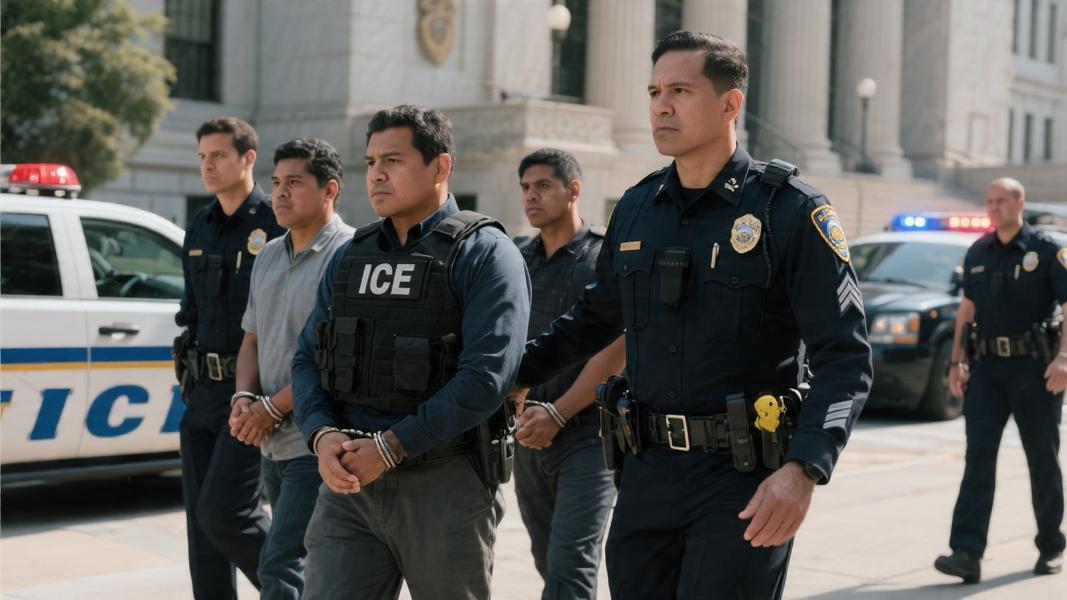
Federal immigration agents fanned out across multiple states over the weekend, arresting a string of foreign nationals convicted of some of the most disturbing crimes on the books — child rape, sex trafficking, and kidnapping among them.
U.S. Immigration and Customs Enforcement confirmed the sweep in a statement that pulled no punches. The agency said agents took into custody criminal illegal aliens whose prior convictions included sexual assault of a child, human trafficking for sexual servitude, sexual solicitation of a minor, rape, and kidnapping. The arrests spanned at least three states and unfolded over a single weekend — a detail officials were quick to highlight as a show of institutional resolve, as reported by the Department of Homeland Security.
Who Was Arrested — and Where
Two names surfaced publicly in connection with the operation. Miguel Lopez-Jimenz, a Mexican national, was arrested in Larimer County, Colorado, following prior convictions for sexual assault on a child and human trafficking for sexual servitude. The second, Charles Amofa of Ghana, was taken into custody in Prince George’s County, Maryland. His record included convictions for sexual solicitation of a minor, kidnapping, attempted second-degree sexual offense, and fourth-degree sexual contact. These aren’t minor infractions buried in a rap sheet. They’re the kind of charges that define careers — and end childhoods.
Meanwhile, up in Minnesota, it wasn’t just one arrest that drew attention. ICE’s Homeland Security Investigations unit — the agency’s criminal investigative arm — nabbed three foreign nationals convicted of sex crimes against children in a single day, according to DHS announcements. Three in one day, one state. Officials framed it as a testament to operational tempo. Critics of immigration enforcement might frame it differently. But the underlying convictions are difficult to dispute.
“Some of the Worst Crimes Imaginable”
Acting Assistant Secretary Lauren Bis didn’t mince words. “Over the weekend, the heroic men and women of ICE arrested criminal illegal aliens convicted for some of the worst crimes imaginable, including sex trafficking, child rape, and kidnapping,” she said in a formal statement. She added that ICE agents “never take a day off — even on the weekends — from removing criminal illegal aliens from American communities,” and called on the public to thank officers when they see them in the field. It’s the kind of statement designed as much for political consumption as operational transparency — but the underlying arrests, the data suggests, are real.
Beyond the named individuals, the broader sweep also netted foreign nationals convicted of child cruelty with possible injury or death, battery against a spouse, and additional kidnapping charges. The full scope of the operation — total arrests, jurisdictions involved, and whether charges are pending — has not been fully disclosed.
The Larger Picture
Still, context matters here. ICE enforcement operations have become a charged political flashpoint, with supporters arguing the agency is finally prioritizing the most dangerous offenders and critics raising questions about due process, community impact, and the selective release of information designed to maximize public support. Both things can be true at once.
What isn’t really in dispute? The individuals named in this weekend’s sweep had already been convicted — not accused, not suspected — of violent and sexually predatory crimes against children and adults. That’s a distinction worth holding onto, regardless of where you stand on broader immigration policy.
ICE arrests hundreds of individuals with criminal records every week. Most don’t make headlines. The ones that do tend to share a common thread: they’re the cases officials believe will resonate — and in this instance, it’s hard to argue they miscalculated the public’s reaction to child rape convictions.
As Acting Assistant Secretary Bis put it, thanking ICE officers is now apparently an official ask from the federal government. Whether the public obliges is another matter — but for the families of the victims in these cases, this particular weekend’s work probably needed no press release to feel significant.
