
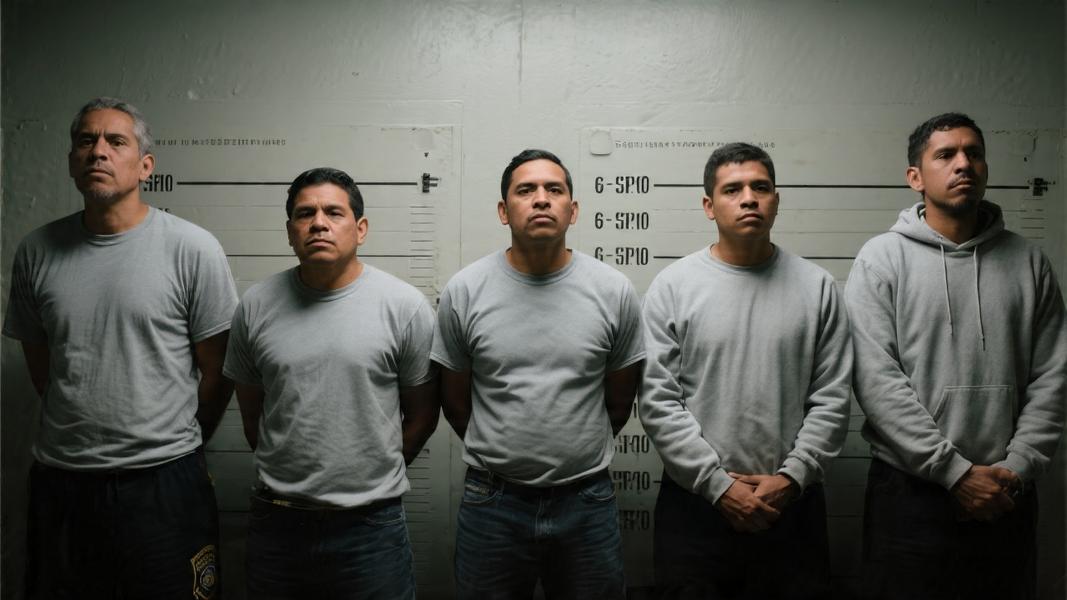
Federal immigration officers arrested a string of convicted criminals — among them child molesters, rapists, and drug traffickers — in a series of enforcement actions that the Department of Homeland Security is framing as a direct message to illegal immigrants with criminal records: the clock is running out.
U.S. Immigration and Customs Enforcement announced the sweeps in connection with National Crime Victims Week, detailing arrests made on April 20, 2026, that spanned multiple states and involved offenses ranging from possession of child pornography to aggravated assault. The announcement is part of a broader enforcement posture under the Trump Administration, which has made the arrest and deportation of criminal illegal aliens a centerpiece of its immigration agenda since taking office.
Who Was Arrested — and Where
The April 20 arrests read like a grim catalogue of harm. Domingo Montejo Perez, a Mexican national, was taken into custody in Santa Barbara, California, on charges of annoying or molesting a child. In Fairfax, Virginia, agents arrested Gherson Djorkaeff Gonzales Hernandez of Honduras, who faced three separate counts of possession of child pornography. Over in Brooklyn, New York, Stiven Munoz-Rodriguez — a Dominican Republic national — was arrested on a rape conviction. Out west in Salt Lake City, two more arrests were made: Santos Lemuz-Ortega of Honduras, on charges of possession of heroin and cocaine with intent to distribute, and Moises DeJesus Ramirez-Alvarez of Mexico, on aggravated assault.
Five arrests. Five different states. Five different crimes. It’s the kind of breadth that ICE clearly wants the public to notice.
Acting Assistant Secretary Lauren Bis didn’t mince words. “Our law enforcement officers are on the frontlines arresting pedophiles, rapists, and drug traffickers,” she said, invoking the names of Sheridan Gorman, Laken Riley, and Jocelyn Nungaray — victims whose cases have become rallying points for advocates pushing stricter enforcement against undocumented individuals with criminal records. “The victims of illegal aliens like Sheridan Gorman, Laken Riley, and Jocelyn Nungaray are why we fight,” she said.
A Pattern, Not a One-Off
This wasn’t the first time ICE made headlines with a similar announcement. Back on March 17, 2026, agents arrested Sergio Colin-Aviles, a Mexican national wanted in Crosby County, Texas, on homicide or manslaughter charges. That same day, Jose Gregorio Torres of Venezuela was picked up in the Eastern District of Michigan on federal charges of coercion and enticement of a minor — one of the uglier entries on any law enforcement blotter.
Bis was equally blunt about those arrests. “Yesterday, ICE arrested criminal illegal alien murderers, pedophiles, and sex criminals — the very definition of depraved,” she declared, adding that under President Trump, illegal entry combined with criminal conduct would result in arrest, full stop. “There is nothing that will stop ICE from putting American families, American children, and American lives FIRST.”
DHS has also pointed to a broader statistic it wants people to absorb: nearly 70% of ICE arrests involve individuals who have been charged or convicted of crimes inside the United States. That figure, if accurate, significantly complicates the political debate over who, exactly, is being swept up in immigration enforcement operations.
The Larger Context
Still, context matters. Immigration enforcement has always been a politically charged enterprise, and the language coming out of DHS — “depraved,” “pedophiles,” “murderers” — is calibrated as much for public consumption as for prosecutorial precision. Critics of aggressive ICE operations have long argued that enforcement rhetoric can paint an entire population with too broad a brush. Supporters counter that one preventable crime is one too many.
That’s the tension that never quite resolves. And it’s unlikely to any time soon.
What’s harder to argue with are the individual case files — a child pornography conviction, a rape charge, a homicide. Whatever one thinks about immigration policy writ large, the people arrested in these particular sweeps weren’t caught jaywalking. The crimes attached to their names are serious, and the victims they left behind are real.
What Comes Next
ICE has signaled that these enforcement actions are not episodic — they’re ongoing. The agency has used weekly press releases and named-victim rhetoric to build a sustained public narrative around criminal alien arrests, a strategy that keeps the issue visible between major policy announcements. Whether that translates into measurable public safety outcomes, or whether it functions primarily as political theater, is a question that data analysts and immigration researchers are still working to answer.
For now, the arrests stand as a matter of record. And as National Crime Victims Week draws attention to those harmed by all manner of criminal conduct, DHS appears intent on making sure one particular category of perpetrator — the undocumented criminal — stays front and center in the national conversation.
The names of the victims invoked by Acting Secretary Bis — Gorman, Riley, Nungaray — are a reminder that behind every enforcement statistic, there’s a story that started long before anyone called ICE.
