
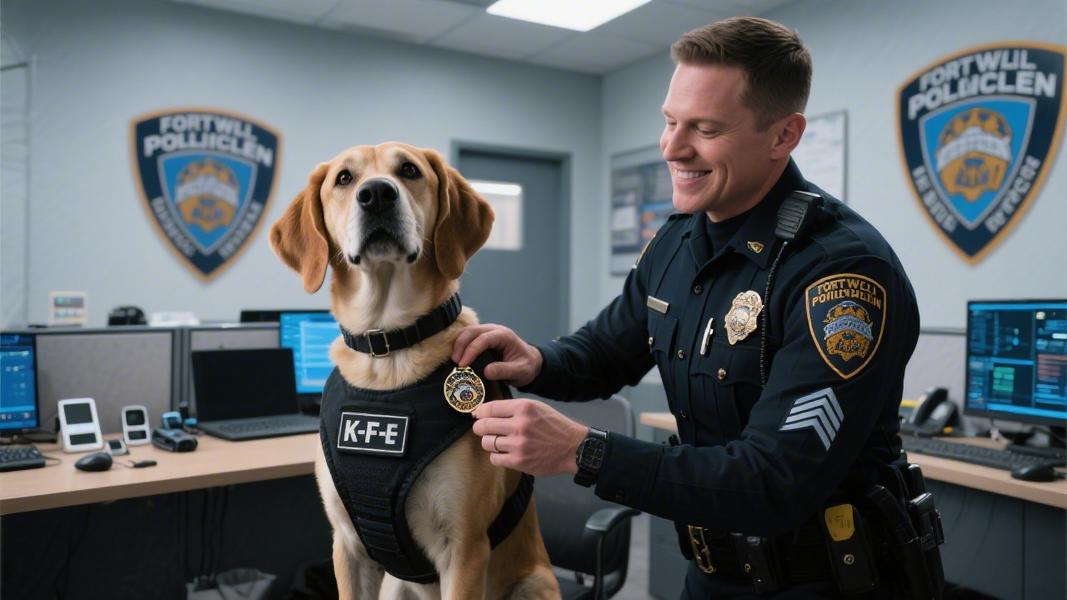
He’s got floppy ears, a nose that doesn’t quit, and a badge to prove it. Meet K-9 Copper, Fort Worth’s newest weapon in the fight against child exploitation — and he works for kibble.
On March 25, 2026, the Fort Worth Police Department officially badged Copper during a formal ceremony, where Police Chief Eddie Garcia personally pinned the shield on the four-legged officer. Copper had already been on the job since December, but the badging made it official: he’s a full member of the force, assigned to support the North Texas Internet Crimes Against Children (ICAC) Task Force. His specialty? Sniffing out the hidden electronic devices that predators use to store Child Sexual Abuse Material, better known as CSAM.
A Nose for the Digital Age
It sounds almost improbable — a dog finding a thumb drive tucked behind a wall panel or a micro SD card buried in a sock drawer. But that’s exactly what Electronic Storage Detection dogs are trained to do. They’re conditioned to pick up on the chemical compounds present in flash drives, cell phones, and other portable storage media. Copper is reported to be both a certified service animal and a working investigative asset — a rare dual designation that broadens where and how he can be deployed.
The department put it plainly: “Copper assists with child exploitation cases, where he can sniff out electronic devices that can store Child Sexual Abuse Material (CSAM), as well as being a certified service animal!” That exclamation point feels earned, honestly.
A Rare and Growing Specialty
How uncommon is this kind of dog? Quite. In Kentucky, for example, K-9 Flash is one of only six electronic storage detection dogs in the entire state. Flash was donated at no cost to law enforcement through the nonprofit Our Rescue, an organization that funds and places these animals with agencies that might not otherwise have the budget for such specialized training. As documented in coverage of Flash’s deployment, the dogs are trained on the specific chemical signatures found in consumer electronics — not just the devices themselves, but the compounds that make them detectable even when powered off and hidden from plain view.
That’s the catch with digital evidence in exploitation cases. It’s small. It’s concealable. A suspect can hide a micro SD card nearly anywhere, and a standard search — even a thorough one — might miss it entirely. These dogs don’t.
Part of a Broader K-9 Mission
Still, Copper isn’t Fort Worth PD’s only canine investment. The department’s K-9 unit maintains a rigorous training schedule — one dog at a time, every week — and its dogs are regularly used to help apprehend violent felons. Copper, then, represents something of an expansion of that mission: from the street to the server, from chasing suspects to sniffing out the evidence they try hardest to bury.
It’s a quiet but significant shift in how law enforcement is thinking about digital crimes. The perpetrators are increasingly sophisticated. The hiding spots are increasingly creative. And the stakes — child safety — couldn’t be higher.
Sometimes the best response to a high-tech problem is a wet nose and four good legs.
