
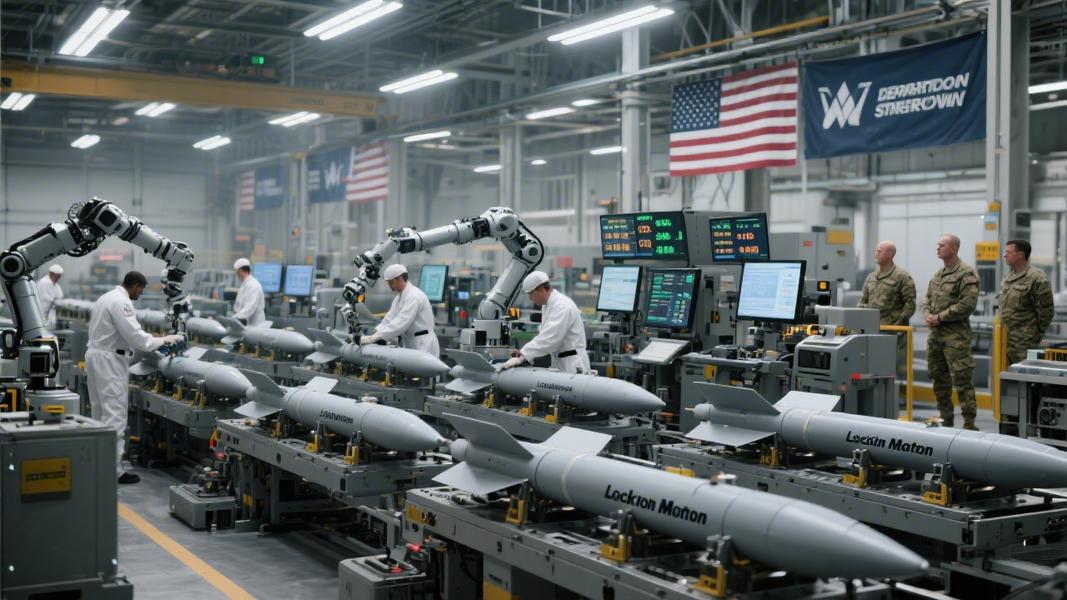
The Pentagon is moving fast — and it wants the defense industry to move faster. The Department of War has struck a sweeping set of framework agreements with Lockheed Martin and BAE Systems aimed at dramatically scaling up production of the Terminal High Altitude Area Defense system, better known as THAAD, as the United States races to fortify its missile defense posture against a new generation of advanced threats.
At the center of the push is a plan to quadruple annual THAAD interceptor production — from 96 to approximately 400 units per year — over the next seven years. The Lockheed Martin framework agreement, announced earlier this year, is the backbone of that effort. Now a parallel agreement with BAE Systems locks in the seeker production capacity that makes those interceptors actually work — a detail that sounds technical but is, in practice, the difference between having missiles on paper and having missiles in the field.
Sending a Signal Down the Supply Chain
That’s the part that doesn’t always get the headlines. Building more interceptors means nothing if the components aren’t there. The new seeker production deal with BAE Systems is designed to close exactly that gap, and the Department of War is making no secret of its intent. “Securing our supply chain is just as critical as our partnership with the prime contractors,” said Michael Duffey, Under Secretary of War for Acquisition and Sustainment. “This agreement with BAE Systems sends a clear, stable, long-term demand signal. We are providing the certainty our partners need to invest, expand, and hire. This is how we place the industrial base on a wartime footing.”
That phrase — wartime footing — is worth sitting with for a moment. It’s not the language of peacetime procurement. It’s a deliberate rhetorical choice, and it reflects how seriously the department is treating the current threat environment. The THAAD expansion is driven in large part by the proliferation of advanced ballistic and hypersonic missile systems — the kind of weapons that existing inventories were never sized to defeat at scale.
Lockheed’s Commitment — With One Caveat
Lockheed Martin has made its enthusiasm clear. The company already has more than 340,000 square feet of dedicated U.S. operations space supporting THAAD and employs more than 2,000 Americans on the program, according to the company’s own disclosures. Chairman, President and CEO Jim Taiclet put it plainly: “Today’s agreement to quadruple THAAD production means we will have more interceptors available than ever before to deter our adversaries.”
That’s the catch, though. The Lockheed framework agreement still requires finalization pending fiscal year 2026 Congressional appropriations, as noted at the time of the announcement. In other words, the ambition is real, but the money isn’t fully locked in yet. That’s not unusual in defense procurement — framework agreements are essentially letters of intent, not blank checks — but it does mean the timeline depends on Capitol Hill playing along.
Still, the momentum is hard to dismiss. The agreements are explicitly framed as part of the Department of War’s broader Acquisition Transformation Strategy, a push to modernize how the government buys weapons and builds relationships with contractors. Taiclet noted that the THAAD deal is intended as a template — “additional framework agreements for the critical munitions needed by the U.S. military and our allies” are already in the pipeline, he said.
L3Harris Gets a Piece of the Action Too
It’s not just BAE and Lockheed. L3Harris recently secured a contract worth nearly $400 million for solid rocket booster motors and Liquid Divert and Attitude systems for THAAD interceptors, confirming that the expansion is touching virtually every tier of the program’s industrial base. The message from Washington is consistent: if you’re in the THAAD supply chain, expect more work — and expect it to last.
The seeker agreement with BAE Systems, in particular, represents a recognition that the bottleneck in scaling missile production has often been the precision guidance components — not the airframe, not the motor, but the part that makes the interceptor smart enough to actually hit something. By locking in long-term demand with BAE, the department is essentially asking the company to build out manufacturing capacity before the contracts fully materialize, a bet that requires trust on both sides.
A Seven-Year Bet on Deterrence
What does it all add up to? Over seven years, if the production ramp holds, the United States would go from fielding fewer than 100 THAAD interceptors annually to more than 400 — a fourfold increase that would substantially change the calculus for any adversary considering a large-scale ballistic missile strike. Whether that’s enough, given the pace at which rivals are expanding their own arsenals, is a question the agreements themselves can’t answer.
As reported widely across the defense press, the scale of the commitment is unusual even by recent Pentagon standards. And as covered by outlets close to the military community, the announcement has been received as a serious signal — not just to allies who depend on THAAD coverage, but to adversaries who are watching the production numbers closely.
The earlier contract with L3Harris for propulsion components had already signaled that the expansion was moving beyond the planning phase. Now, with seekers, propulsion, and final assembly all under framework agreements, the architecture of a much larger THAAD industrial base is taking shape — on paper, at least. The next test is whether appropriators in Congress see it the same way.
Duffey’s phrase keeps echoing: wartime footing. Whether or not that framing is hyperbole, it’s increasingly clear that the Department of War is treating missile defense not as a legacy program to be managed, but as a capability gap to be closed — urgently, expensively, and with as much industrial firepower as it can muster.
