
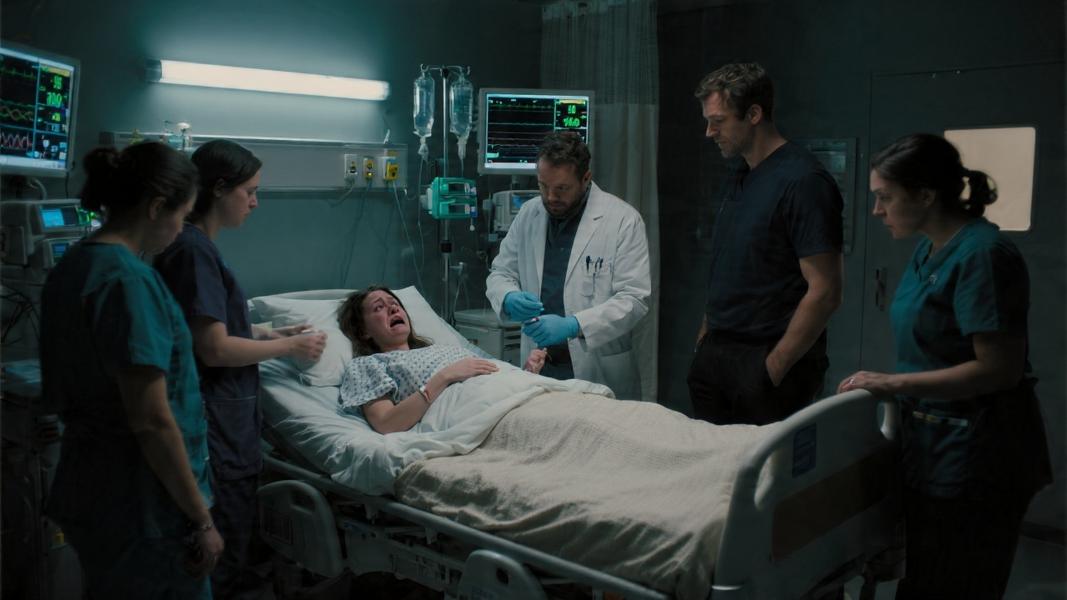
Casey Gould thought she was dying. She was right to be scared.
On November 1, 2024, Gould was in the final stretch of a grueling 36-hour labor when her body began to give out. Her son’s heart rate dropped. Then, far more alarmingly, so did the function of her own heart — her ejection fraction, the measure of how much blood the heart pumps with each beat, had collapsed to just 13 percent. The normal range sits between 55 and 70 percent. She was experiencing peripartum cardiomyopathy, a rare and potentially fatal form of heart failure that can strike in late pregnancy or in the weeks after delivery. “I think I’m about to die,” she recalled thinking.
A Condition That Doesn’t Announce Itself
Peripartum cardiomyopathy affects roughly 1 in every 5,000 pregnancies — rare enough that many people have never heard of it, but common enough that doctors who treat high-risk pregnancies know its devastation well. Risk factors include older maternal age, previous pregnancies, and socioeconomic variables, but the condition doesn’t play by clean rules. “You don’t really know when it’s going to happen,” one cardiologist noted, “which is kind of what’s so scary about it.”
That unpredictability is part of what makes it so dangerous. Warning signs — shortness of breath, fatigue, swelling — are easy to dismiss as ordinary pregnancy discomfort. Dr. Adam Small, associate medical director at NYU Langone, has explained that the overwhelming sense of dread patients sometimes feel may stem from fluid flooding the lungs or a sudden drop in blood pressure. The body, in other words, knows something is catastrophically wrong before the mind can fully process it.
An Impella Pump and a Two-Day Coma
Gould’s cardiologist, Dr. Amer Sayed, moved fast. He inserted an Impella pump — a small mechanical device threaded through the femoral artery directly into the heart to assist its pumping function — and placed Gould in a medically induced coma. For two days, she lay in the ICU on a ventilator, her newborn son somewhere in the same hospital, the two of them separated by the thinnest margin of medical intervention.
It’s a surreal kind of crisis. The moment that’s supposed to be a beginning becomes something else entirely.
Nine Days Later, a Different Story
She made it. After nine days in the ICU, Gould’s ejection fraction had returned to normal — a recovery that, by any clinical measure, is remarkable. “The fact that I went from where I was to where I am now is pretty miraculous,” she said.
Still, the story doesn’t end at discharge. Gould now requires lifelong cardiac medication and ongoing cardiology follow-ups. And if she ever considers another pregnancy, she’ll do so under the shadow of significantly elevated risk — even with her heart now functioning normally. Full recovery, it turns out, doesn’t mean a clean slate. It means a different kind of vigilance, permanently.
For the thousands of women who give birth each year without knowing this condition exists, Gould’s story is both a warning and, somehow, a form of hope — proof that when the right team is in the right room at the right moment, even a heart at 13 percent can find its way back.
