
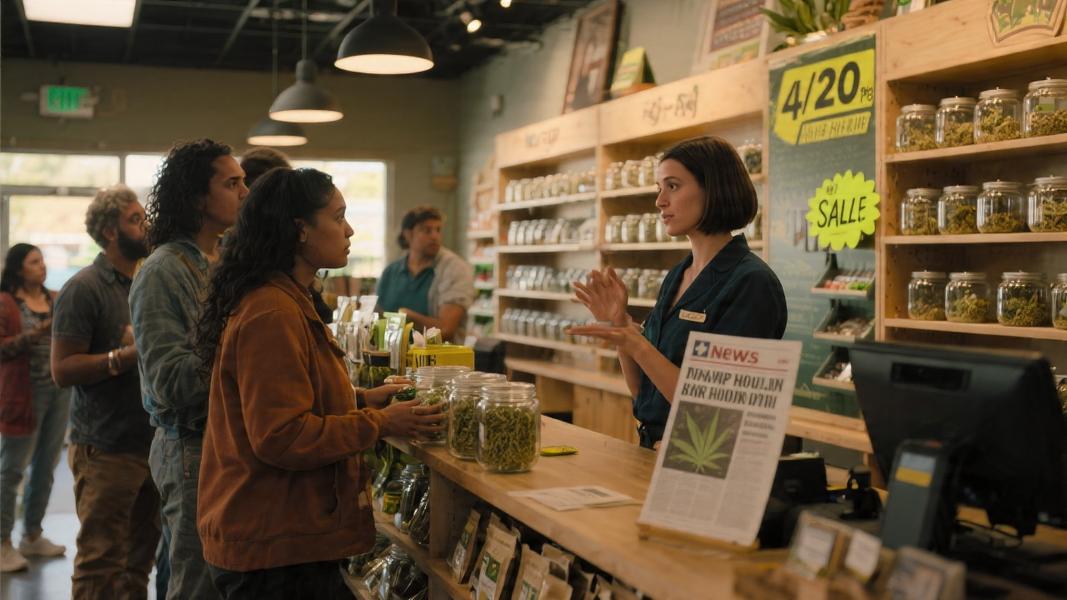
Texas hemp shop owners got a rare bit of good news this week — a judge hit pause on the state’s newly enacted ban on smokable hemp products, giving retailers a window to breathe and restock their shelves.
A Travis County judge issued a temporary restraining order blocking enforcement of the ban, which had taken effect just weeks earlier on March 31, 2026. The ruling means smokable hemp products — pre-rolls, flower, and other inhalable forms — can once again be sold legally in Texas shops, at least for now. The hemp industry, which had been scrambling since the rules dropped, is cautiously celebrating. But the fight is far from over.
How the Ban Came Together
The crackdown didn’t come out of nowhere. Earlier this year, the Texas Department of State Health Services (DSHS) adopted new rules changing how acceptable THC levels are calculated in consumable hemp products. The updated formula counts both delta-9 THC and THCA together — a shift that effectively pushed many smokable products over the legal threshold overnight, as documented by the Texas State Law Library.
The backstory is a little messier than that, though. The rule change came after Governor Greg Abbott vetoed a broader bill that would have enacted a total THC ban — legislation that had cleared the statehouse. Rather than let the issue die, state health officials moved to tighten regulations through administrative rule-making. The result: a ban that hit the industry hard, fast, and with relatively little transition time.
And the financial stakes weren’t limited to lost product. The new regulations also dramatically increased licensing and manufacturing costs. Manufacturer fees jumped from roughly $250 to $10,000. Retail registrations climbed from $155 to $5,000. For small independent shop owners already operating on thin margins, that’s not a speed bump — it’s a wall.
Shelves Cleared, Sales Stopped — Briefly
How bad was it on the ground? For many shops, the ban meant gutting nearly half their inventory in a matter of days. Smokable products, including pre-rolls, represent roughly 40% of some stores’ total stock. CBS News reported that retailers were forced to pull between 30 and 50 percent of their products from shelves — with some, like Moon Taxi in Dallas’s Lower Greenville neighborhood, boxing up inventory and hauling it to storage just to stay compliant.
“About 30% of our inventory had to go to storage,” said Tess Bratton-Rodriguez, a manager at Moon Taxi. Still, she wasn’t sitting around waiting for the courts to act. Sensing ongoing uncertainty — even after the restraining order — Bratton-Rodriguez launched an early 4/20 sale starting April 17, wanting customers to have a chance to buy while they still legally could. “I decided to start our 4/20 sale today on 4/17 just because I want people to get the opportunity,” she said. “They are still worried.”
That anxiety isn’t unfounded. A restraining order is not a permanent fix. It’s a temporary hold — a legal placeholder while the courts decide whether the underlying lawsuit has merit.
What Comes Next
The restraining order is described as a significant victory for the hemp industry, but the clock is already ticking. A court hearing is scheduled for April 23, 2026, where a judge will weigh whether to extend the order into a longer-term injunction and whether the lawsuit itself can move forward. Two weeks of relief, in other words, with no guarantees attached.
Bratton-Rodriguez said she’s hopeful — but she’s also realistic about what the industry actually needs. “We need to figure out a middle ground or stick to what we were doing prior because it’s working,” she said. It’s a sentiment that captures the frustration of an industry that operated legally for years under a framework that, by most accounts, was functioning without major incident — only to watch regulators shift the goalposts in a single rulemaking cycle.
That said, the state’s concerns aren’t entirely without basis. DSHS and lawmakers who supported tighter rules have long argued that high-THCA hemp products blur the line between legal hemp and illegal marijuana — a distinction that gets harder to enforce when the products look, smell, and smoke the same way. It’s not a simple debate, and the courts are now squarely in the middle of it.
A Industry Watching the Calendar
For now, the shelves are restocked, the pre-rolls are back, and Texas hemp retailers are selling again — with one eye on the calendar and the other on the courthouse. April 23 will tell a lot. But even if the injunction holds, the larger regulatory and legislative battle over Texas hemp isn’t going anywhere soon.
As Bratton-Rodriguez put it: the customers are still worried. And honestly, given everything that’s happened in the last month, that’s a pretty reasonable way to feel.
