
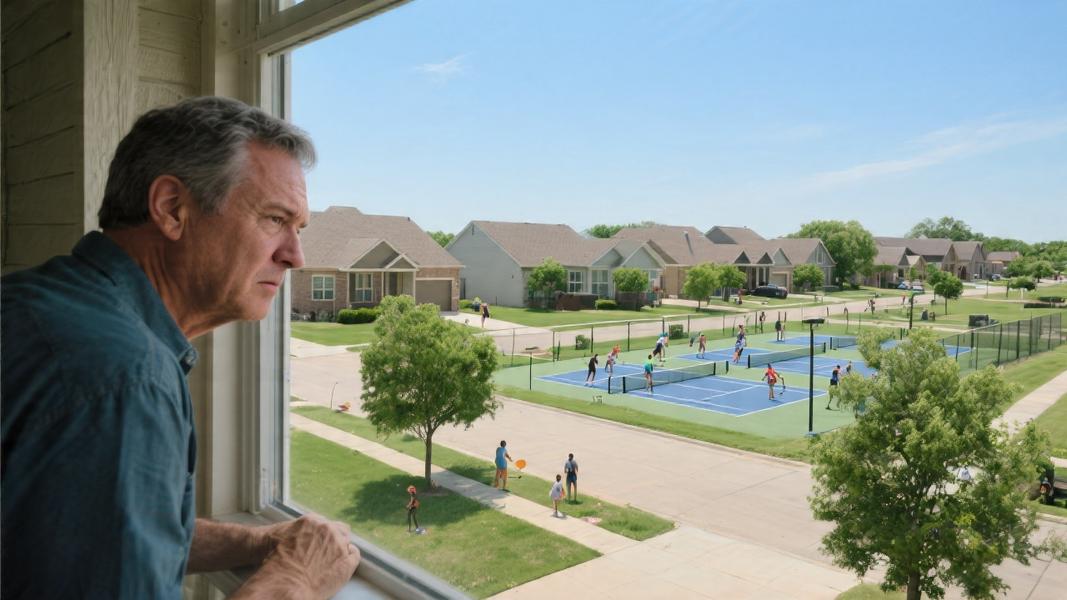
It sounds innocent enough — a hollow little pop, over and over again. But for a growing number of homeowners across the country, that sound has become the backdrop to a legal and civic nightmare.
Pickleball, America’s fastest-growing sport, is colliding hard with residential life. As courts multiply in HOA communities, public parks, and suburban backyards, neighbors are fighting back — filing lawsuits, petitioning city councils, and in at least one documented case, abandoning their homes entirely. The sport’s signature noise, a high-pitched paddle-on-plastic-ball crack, travels farther than most people expect and cuts through walls in ways that tennis, its quieter predecessor, never did.
A Sound That Travels
Jeff Kacines knows this better than most. The Allen, Texas homeowner found himself just 350 feet from a set of newly installed pickleball courts after his Twin Creeks HOA converted two tennis courts into six pickleball courts in July 2024. The decision was made by the board — no resident vote, no prior notice. “It’s a popping sound,” Kacines said. “A high-pitched popping sound. It’s not only an annoying sound, but it also travels further than other sounds.”
The courts were eventually converted back to tennis after enough residents complained. But Kacines wasn’t done. He took his concerns to the Allen City Council, arguing that the city’s noise ordinances don’t specifically address pickleball — and that the HOA governance structure gave residents almost no protection against a future board reversing course overnight. “The problem I had with that,” he explained, “is the next board could just change the rules tomorrow.”
He’s pushing for a 1,000-foot minimum setback between pickleball courts and residential homes — nearly double the 600-foot standard found in most existing ordinances. Whether Allen’s council acts on that recommendation remains to be seen.
Courts, Councils, and Costly Fixes
It’s not just Texas. In Punta Gorda, Florida, the city council was forced to address a wave of complaints about pickleball noise at Gilchrist Park, a neighborhood green space that residents say was never designed for that kind of traffic or intensity. The proposed remedies included acoustic fencing barriers at a cost of $16,000, cutting the number of courts in half — from eight down to four — and cracking down on parking violations that came with the crowds. One HOA representative put it bluntly: the noise, he noted, was only part of the problem. The sheer volume of people descending on what had always been a quiet neighborhood park was its own disruption.
How bad can it get? In Louisville, a lawsuit erupted after a homeowner converted a backyard tennis court to pickleball. Both sides in that case agreed on one thing: pickleball generates significantly more noise than tennis. The court ultimately ruled in the owner’s favor, but the case underscored just how fast these disputes are escalating — and how ill-prepared local legal frameworks are to handle them. At one point during proceedings, the noise from a nearby pickleball complex was compared to the sound of an ice cream truck. Charming in theory. Maddening on loop.
When It Gets Personal
Still, few cases capture the human toll quite like one documented on legal advice platform Avvo. A homeowner with autism reported that the persistent noise from nearby pickleball courts caused severe mental health impacts — enough that they ultimately sold their home and moved. The financial damage: a $100,000 loss. The HOA’s suggested solution before it came to that? Build a 12-foot wall. The builder, the homeowner argued, bore responsibility for constructing a residence so close to a future noise source without disclosure.
That’s the catch, legally speaking. Attorneys advising on these cases consistently point to the same hurdles: proving noise trespass, navigating HOA contract language, establishing nuisance claims, and — perhaps most practically — convincing a board to simply remove the courts before a lawsuit becomes necessary. It’s a slow, expensive road, and the guidance from legal professionals reflects just how murky the terrain remains.
A Sport Outpacing Its Own Rules
Pickleball’s explosive popularity — the sport now claims millions of players nationwide — has simply outrun the regulatory infrastructure meant to govern it. Municipalities are scrambling. HOAs are improvising. And homeowners are increasingly turning to the courts, both figuratively and literally. Legal action over pickleball noise has been climbing steadily, a trend that shows no signs of slowing as more courts get built in closer proximity to homes.
The sport’s advocates will argue — reasonably — that pickleball brings communities together, promotes physical activity, and fills a real recreational need. All true. But community, it turns out, has a decibel limit. And for the people living 350 feet from the baseline, no amount of enthusiasm for the game changes what they hear every morning through their bedroom window.
Pop. Pop. Pop.
