
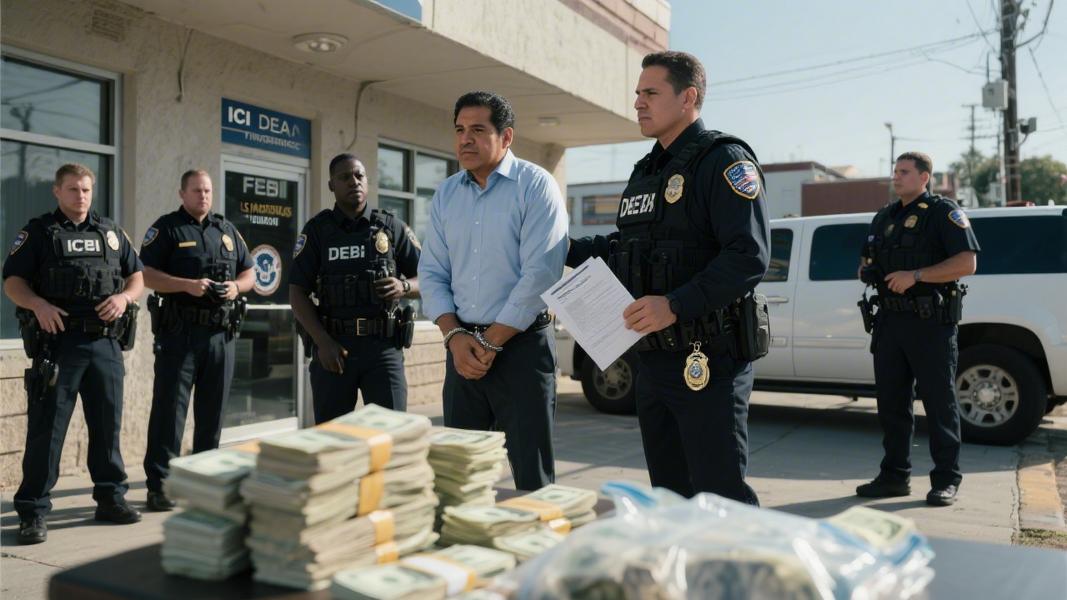
A Southern Oregon business owner is facing federal money laundering charges after investigators say he used a string of small storefronts — a tienda, a barber shop, a wire transfer counter — to funnel millions in drug proceeds straight back to Mexican narcotraffickers.
Jose Alonso Paramo-Arguello, 45, a Mexican citizen living unlawfully in the United States, was charged by criminal complaint on March 18, 2026, with laundering narcotics trafficking money through his Oregon-based money service businesses. Immigration and Customs Enforcement has since lodged a detainer with the U.S. Marshals Service, meaning he won’t be walking free anytime soon — if federal authorities have anything to say about it.
Small Businesses, Big Money
On the surface, Paramo-Arguello ran the kind of neighborhood businesses that anchor immigrant communities across the country. Tienda Santa Maria II LLC, Tienda Santa Maria, and Paramo’s Barber Shop were all operating in Southern Oregon. But according to federal prosecutors, those storefronts were doing a lot more than selling groceries and haircuts. Investigators say the businesses served as the infrastructure for a $13 million drug money laundering scheme, with over $7 million wired directly to narcotrafficking locations in Mexico.
Between November 2025 and January 2026 alone, Paramo-Arguello allegedly conducted 22 wire transfers totaling more than $45,000 in funds that a confidential informant had represented as drug trafficking proceeds. He reportedly took a 10% cut on each transaction — a fee he apparently called, with some candor, a bribe. That detail, buried in court documents, is the kind of thing that tends to stick with a jury.
His Own Words
What makes the case more striking is what Paramo-Arguello allegedly said during the investigation. Prosecutors noted a quote attributed to him that’s almost brazen in its simplicity: “You sell whatever you want, you’re a merchant, period.” It’s the kind of line that sounds like a philosophy — and, federal prosecutors would argue, it was exactly that.
Whether that statement came in a recorded conversation or was captured through other means hasn’t been fully detailed in public filings. Still, it’s the sort of remark investigators tend to save for trial.
Immigration History Adds Another Layer
Then there’s the immigration piece — and the federal government isn’t being subtle about it. DHS made a point of flagging that Paramo-Arguello had been issued a voluntary return to Mexico in 2003, meaning he’d agreed to leave and then came back anyway. A DHS spokesperson was direct about the agency’s view, stating: “He was issued a voluntary return in 2003 and chose to commit a felony by illegally reentering the United States.”
The statement went further, invoking the names of President Trump and Secretary Mullin directly: “Under President Trump and Secretary Mullin, we will not allow drug traffickers to profit off killing our children and grandchildren.” The language is pointed, clearly designed for a broader audience beyond the courtroom.
How Did This Come Together?
How does a barber shop end up at the center of a $13 million drug money probe? Slowly, and then all at once — the way these things usually do. Federal investigators used a confidential informant who posed as someone with drug proceeds needing to move. The informant made the approach, Paramo-Arguello allegedly took the bait, and over the course of roughly two months, the wire transfers piled up. By the time the complaint was filed, investigators say they had documented a pattern that stretched well beyond those initial test transactions, pointing to years of alleged criminal activity through his businesses.
ICE lodged its detainer with the U.S. Marshals Service after the charges were filed, ensuring that even if something shifted in the criminal case, Paramo-Arguello couldn’t simply be released back into the community. He’s appeared in court in the Rogue Valley region, where his businesses were based.
What Comes Next
The case is still in early stages — a criminal complaint is not a conviction, and Paramo-Arguello has not yet had the opportunity to enter a formal plea or mount a full defense. But the scope of what prosecutors are alleging is substantial. $13 million is not a rounding error. Twenty-two documented wire transfers in under three months is not a mistake. And a 10% commission on drug money, described by the defendant himself as a bribe, is the kind of evidence that tends to shape a case before it ever reaches a jury.
That said, federal money laundering cases are complex, and the road from complaint to conviction is rarely a straight line.
For now, what’s clear is this: a string of small storefronts in Southern Oregon allegedly became a pipeline for millions in narcotics money — and the man accused of running that pipeline called himself, simply, a merchant.
