
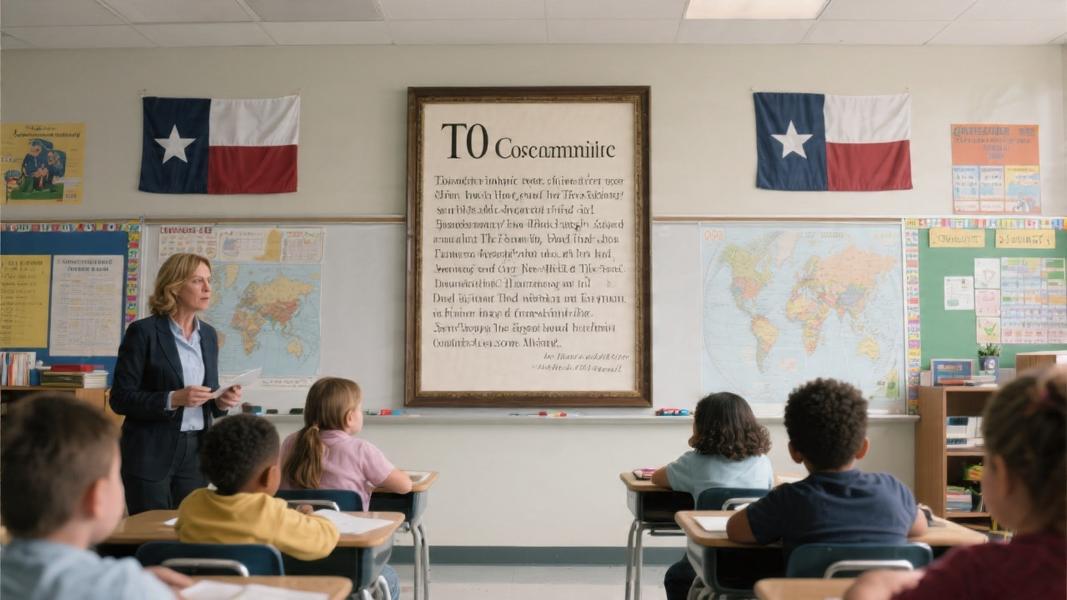
A federal appeals court has handed Texas a significant legal victory — and handed the nation’s church-state debate a fresh flashpoint. The Fifth Circuit Court of Appeals has upheld Texas Senate Bill 10, clearing the way for the Ten Commandments to hang in every public school classroom across the state.
Here’s the core of it: SB 10, signed into law by Gov. Greg Abbott in June 2025, requires public elementary and secondary schools to display a poster of the Ten Commandments — at least 16 inches wide by 20 inches tall — in a conspicuous place in every classroom. The Fifth Circuit’s ruling breathes new life into that mandate after months of legal turbulence, and it sets up what legal observers say could be an inevitable showdown before the U.S. Supreme Court.
A Law Born Into a Lawsuit
Abbott didn’t sign SB 10 into a legal vacuum. He signed it knowing full well a federal court had already struck down a nearly identical law in Louisiana. Texas became the third state — after Louisiana and Arkansas — to mandate Ten Commandments displays in public school classrooms, and the legal challenges followed almost immediately. Critics pointed to Stone v. Graham, the 1980 Supreme Court case that ruled such displays unconstitutional. Supporters argued the legal landscape had shifted — and they weren’t entirely wrong to think so.
Sixteen multi-faith and nonreligious Texas families, represented by the ACLU and allied groups, filed suit to block the law. Their objection wasn’t just procedural. The statute specifically mandates a Protestant version of the Ten Commandments — a detail that carries real weight in a state with a substantial Catholic, Jewish, and Muslim population, to say nothing of families with no religious affiliation at all. “The right to be free from government establishment of religion enshrined in the First Amendment is a bedrock principle of our republic,” said Jonathan Youngwood, global co-chair of Simpson Thacher’s Litigation Department, who argued that the law “violates both the ban on establishment of religion as well as the protections the First Amendment gives to free exercise of religion.” His firm helped represent the plaintiff families.
The Injunction That Wasn’t Quite Enough
For a moment, it looked like the courts might pump the brakes. On August 20, 2025, a federal judge temporarily blocked the law — but only for certain school districts involved in the lawsuit. That’s not nothing, but it’s also far from a statewide halt. A federal judge in San Antonio went further in his reasoning, ruling that SB 10 impermissibly takes sides on religious questions and crosses what he called the line from exposure to coercion. That’s a meaningful legal distinction — and one that may ultimately define how the Supreme Court frames the issue.
But not every district was covered. Hays Consolidated Independent School District, for one, was not subject to the injunction and kept right on going. The district accepted donated Ten Commandments posters from My Faith Votes/Million Voices and Restore American Schools and has been displaying them as required under the law. It’s a glimpse at what statewide compliance could look like — and how quickly institutions can move when the legal path, however contested, stays open.
What the Fifth Circuit’s Ruling Actually Means
The appeals court’s decision doesn’t end the litigation. It accelerates it. With the Fifth Circuit now on record backing the constitutionality of the mandate, the stage is set for a circuit split or a direct Supreme Court petition — and given the current composition of the high court, few legal scholars are willing to predict which way that goes with any confidence.
That said, it’s not just a legal story. It’s a story about what children see every day they walk into a classroom — and whose religious tradition, if any, the government is implicitly endorsing by putting it on the wall. The Texas Tribune has been tracking this legislation since its earliest stages, and the pattern is clear: Abbott and the Republican-controlled legislature knew this would be challenged, and they pushed forward anyway. That’s either principled conviction or calculated culture-war politics, depending on whom you ask.
Probably a little of both.
The deeper question — whether a democratic government can instruct a child, five days a week, to sit beneath a religious text without that constituting an endorsement of religion — is one the courts have wrestled with for decades. The Fifth Circuit just said yes. The Supreme Court may soon have the last word.
