
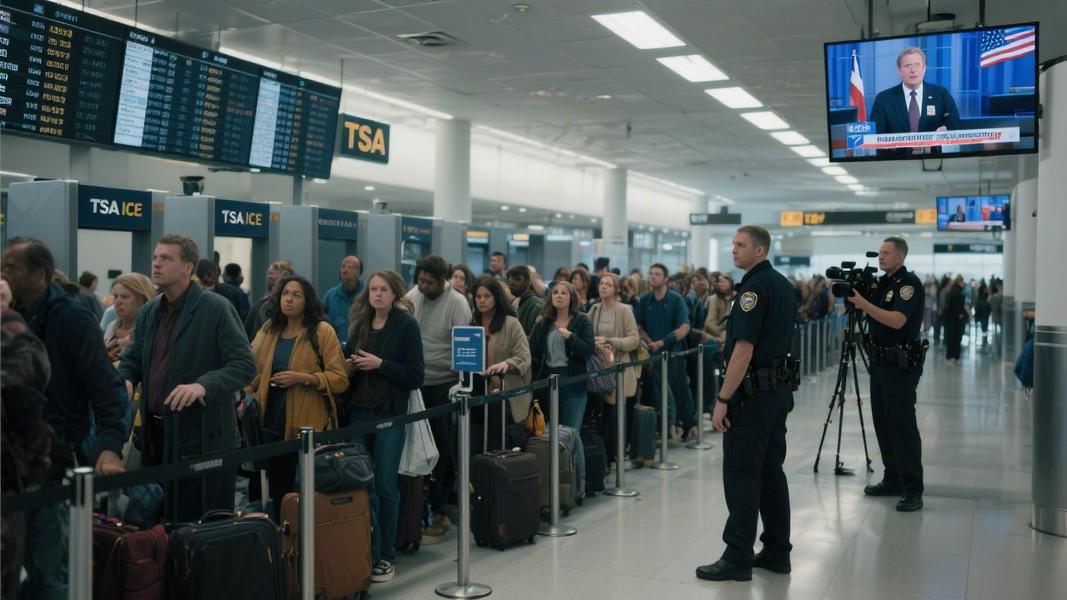
The partial government shutdown has hit America’s airports hard — and now the political blame game is flying just as fast as the departures board.
With 400 TSA employees having quit nationwide since last month over missed paychecks, the Trump administration has turned to an unconventional fix: deploying Immigration and Customs Enforcement officers to bolster security at airports hit hardest by staffing shortages. But not every airport is getting the help — and the reasons why are exposing just how messy this standoff has become.
Dallas Airports Left Out — For Now
Dallas Love Field and DFW International Airport won’t be receiving ICE officers, at least not yet. The reason, according to officials, is relatively straightforward: their security lines are shorter than those at airports like Houston’s Bush Intercontinental, Hobby, and Atlanta’s Hartsfield-Jackson, which are bearing the brunt of the staffing crunch. In other words, Dallas’s comparative efficiency is, paradoxically, keeping federal reinforcements away.
Still, that doesn’t mean things are smooth on the ground. Johnny Jones, President of the American Federation of Government Employees Local 1040, has noted that TSA officers in Dallas remain committed to their work — but the stress of going without pay is real, and it’s taking a toll that no amount of dedication can fully absorb.
Trump’s ICE Idea
The president isn’t being shy about where the deployment idea came from. “ICE was my idea,” Trump told reporters on the tarmac before boarding Air Force One from West Palm Beach on Monday morning, according to Fox News. He also weighed in on optics, reportedly expressing a preference that agents not wear masks while assisting at airports — a detail that says something about how image-conscious this rollout has been from the start.
A DHS statement framed the deployment in sharper political terms, saying: “While the Democrats continue to put the safety, dependability, and ease of our air travel at risk, President Trump is taking action to deploy hundreds of ICE officers, who are currently funded by Congress, to airports being adversely impacted. This will help bolster TSA efforts to keep our skies safe and minimize air travel disruptions.” Trump has also conditioned his approval of DHS funding on passage of the SAVE America Act, tying the shutdown’s resolution to a broader legislative demand, as CBS News Texas reported.
Two Sides, Two Very Different Takes
The partisan divide on all of this couldn’t be sharper. U.S. Representative Julie Johnson didn’t mince words in her criticism. “It just shows us the Republicans are out of control,” she said. “What they need to do is fund TSA and get our trained TSA agents back on the job. I signed a discharge petition to fund TSA. Democrats in the Senate have offered five different amendments trying to get TSA funded. Republicans have refused to do this.”
But it’s not that simple — at least not if you ask U.S. Representative Beth Van Duyne. She praised the administration’s improvisation while simultaneously acknowledging the absurdity of the situation. “I think what you’re seeing is an administration who’s thinking outside the box and figuring out how can we make the suffering from the American people and from the TSA agents as small as possible,” she said. “But I also hate the fact that they’re having to get out of the field and doing the job that they were hired to do, and having to go into airports because we don’t have funding, which is ridiculous.”
That’s a rare admission — a Republican lawmaker calling the whole arrangement ridiculous even while defending it. Make of that what you will.
Eyes on Sea-Tac, Too
It’s not just Texas watching this unfold. Seattle-Tacoma International Airport issued a statement saying it’s keeping close tabs on potential ICE activity within its terminals. “We are aware of the latest news reports regarding potential federal immigration activity at airports,” the airport said. “We are communicating with federal partners and monitoring the situation. For now, we expect operations at SEA to continue as normal.” TSA wait times there are currently under 10 minutes, according to KOMO — a small mercy in an otherwise turbulent situation.
A Shutdown With No Clear Exit
How bad could it get? Four hundred TSA officers walking off the job in a single month is not a small number. These are trained screeners — people who know the protocols, the equipment, the specific rhythms of their airports. Replacing that institutional knowledge with ICE officers reassigned from the field is a stopgap, not a solution, and even supporters of the move seem to acknowledge as much.
Meanwhile, both parties are pointing fingers across the aisle, TSA workers are quietly weighing whether they can afford to keep showing up, and travelers are left hoping their airport happens to have short lines. The shutdown, it turns out, doesn’t just affect government workers — it affects everyone who’s got a flight to catch.
And right now, nobody in Washington seems to be in much of a hurry to land this plane.
